Contact Us
|
WeChat
WeChat ID:842122368Scan to Connect
WeChat ID:842122368Scan to Connect

Railways represent one of the most complex and safety-critical environments for counter-UAS operations. High-speed rail lines, marshalling yards, traction substations, communication base stations, bridges, and tunnels form an extensive, linear infrastructure that is inherently vulnerable to unauthorized drone activity.
A single drone intrusion above a rail corridor can cause foreign object infringement, contact with overhead catenary systems, and ultimately trigger power trips, service suspensions, or even derailments. Malicious aerial photography can expose station layouts, signal rooms, and power supply facilities, leading to critical infrastructure intelligence leaks. During peak travel periods, unauthorized drone flights near station squares can disrupt dispatch order and passenger safety. In mountainous sections, tunnels, and curved alignments, terrain occlusion and strong clutter make traditional radar prone to false alarms.
These risks are not hypothetical. As low-altitude economies expand, the frequency and sophistication of drone incursions into railway airspace continue to rise. The challenge is not simply detecting drones—it is doing so without compromising the railway’s own safety-critical communication and control systems.
Railway environments impose unique constraints that distinguish them from airports, prisons, or stadiums. The most critical is electromagnetic compatibility (EMC). Railways rely on GSM-R, train control, and signaling systems. RF jamming devices, which emit high-power electromagnetic waves, are strictly prohibited from arbitrary deployment. Interference with train communication or signaling can cause catastrophic accidents. Approval for jamming equipment is therefore extremely stringent.
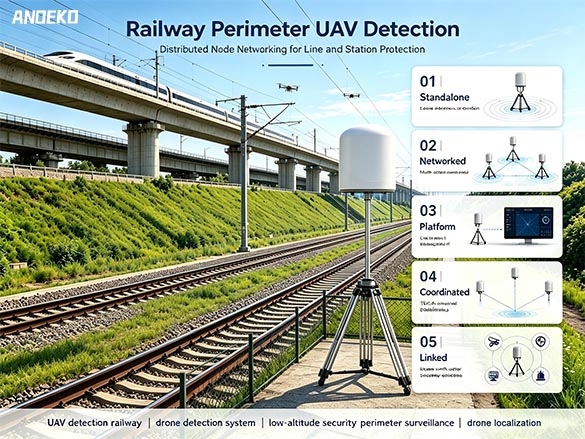
Second, railway protection is not a single-point circular defense. It is a long, narrow, linear corridor requiring distributed node networking. Third, complex terrain—mountains, slopes, tunnels, and vegetation—creates radar shadowing and multipath effects. Fourth, multiple interference sources, including train metal bodies, tracks, catenary, and mobile base stations, generate massive clutter and make false alarm control difficult. Finally, maintenance conditions are limited: trackside sites are scattered, power and communication resources are constrained, and equipment must be low-power and remotely maintainable.
The core principle is clear: prioritize detection and early warning; use RF suppression with extreme caution. Warning, escalation, evidence collection, and non-kinetic dispersal should be the primary response, with jamming as a backup option only.
A mature railway drone countermeasure system adopts a distributed perception node plus central management platform architecture. It integrates X-band low-altitude radar, miniaturized RF direction finding, and electro-optical tracking, rather than relying on a single sensor type.
3.1 X-Band Four-Panel Low-Altitude Radar
The radar is responsible for long-range detection of low, slow, and small targets. It operates around the clock and is unaffected by lighting conditions. Deployed in segments along the railway, it covers stations, bridges, and substations. Advanced clutter suppression algorithms filter out trains, trees, and birds, outputting target range, speed, and track.
3.2 Miniaturized RF Direction Finding System
This passive subsystem detects drone remote control and video transmission signals, identifies drone models, and performs direction finding to locate the pilot. It distinguishes genuine drones from false radar echoes and can be networked via TDOA to geolocate ground controllers. Because it only receives and does not emit, it poses no electromagnetic interference risk to railway signaling or GSM-R—making it far more suitable for railway scenarios than jamming equipment.
3.3 Electro-Optical Tracking Unit
Upon radar or RF alert, the EO gimbal automatically rotates to capture optical evidence and video recordings for event reconstruction and legal traceability.
3.4 Central Management Platform
The platform integrates all front-end sensors, performs target fusion and threat grading, displays situational maps, stores video evidence, and interfaces with existing railway security and emergency command systems.
For railway projects, equipment selection must prioritize electromagnetic safety and regulatory compliance.
Recommended for priority deployment:
Low-altitude detection radar (passive sensing, low transmit power, controllable EMC risk)
Miniaturized integrated RF direction finding equipment (passive, receive-only, no EMI risk)
EO tracking and evidence collection system
Audible/visual warning and dispersal devices (directional loudspeakers, warning lights—non-electromagnetic means)
RF jamming/suppression equipment (use with caution in railway projects):
RF jamming guns and fixed RF blocking devices actively emit high-power electromagnetic waves. They can easily interfere with GSM-R, track signals, and train control systems, and are unlikely to pass railway EMC approval. Recommended use: mobile emergency portable equipment only, restricted to enclosed station areas, not normally activated, and only temporarily used in confirmed emergency black-flight situations after electromagnetic environment testing. Fixed jamming equipment is not recommended along open track sections.
Model 1: Focused Protection at Key Points
Applicable to high-speed rail stations, marshalling yards, and traction substations. A single integrated perception station—four-panel radar + miniaturized RF direction finding + EO gimbal—is installed on rooftops or poles, covering an 8–10 km circular area. Suitable for fixed station security and passenger-dense areas.
Model 2: Distributed Linear Networking Along the Corridor
Applicable to bridges and long sections. Perception nodes are deployed every 3–5 km, each with radar and direction finding. Nodes communicate via Mesh broadband self-organizing networks, and all data converges to the railway section dispatch center. Suitable for long bridges and mountainous lines, enabling continuous linear early warning.
High electromagnetic safety: Passive RF direction finding and low-power radar minimize interference with train communication signals, meeting railway EMC requirements.
Multi-source fusion reduces false alarms: Radar detects, RF verifies the presence of drone signals, and EO provides visual confirmation—three-layer validation reduces false alarms from birds, trains, and trees.
Distributed networking matches linear railway protection: Remote monitoring reduces on-site maintenance workload.
Complete evidence chain: Full video and signal records support public security and railway emergency procedures, enabling post-event accountability.
Radar blind spots in tunnels, slopes, and occluded areas require denser deployment, increasing cost.
Radar alone cannot distinguish birds from small drones; RF direction finding is required for secondary identification.
Silent drones with no video or control signals cannot be detected by RF; radar and EO must compensate.
RF suppression equipment is highly restricted and cannot be used as a routine response; disposal options are limited, relying mainly on warning and dispersal.
High project entry barriers: equipment requires railway-specific EMC testing and integration with existing railway platforms, resulting in long project cycles.
The primary customers are China Railway Group’s regional railway bureaus,工务段,供电段, and stations. Pilot demonstration projects should come first, prioritizing marshalling yards, large high-speed rail stations, and major long bridges. After validation, scale-up along corridors can follow. China’s railway low-altitude security market is still in its early stages, currently dominated by single-point demonstration projects, but future growth potential is substantial. Projects demand high qualifications, EMC reports, and field test cases. The mainstream bidding solution combines four-panel X-band low-altitude radar, miniaturized passive RF direction finding, and EO tracking.
Railway drone countermeasure systems follow a detection-first, EMC-safe principle. The architecture combines X-band low-altitude radar, miniaturized passive RF direction finding, and EO multi-sensor fusion, with distributed node networking for station and corridor protection. The solution focuses on avoiding electromagnetic interference with GSM-R and train control systems, using warning, evidence collection, and audible/visual dispersal as primary response measures. Fixed RF jamming equipment serves only as an emergency backup.
As low-altitude economies and railway intelligent security continue to converge, railway low-altitude protection will evolve toward greater intelligence and coordination. Multi-source perception, edge computing, and AI target recognition will further enhance early detection and response capabilities, building an invisible line of defense for high-speed rail safety.
ANOEKO, as a specialist in low-altitude security and counter-UAS solutions, continues to advance passive detection, multi-sensor fusion, and distributed networking technologies for critical infrastructure protection. By integrating RF direction finding, radar, and EO tracking into a unified architecture, ANOEKO supports railway operators in achieving EMC-compliant, detection-first drone defense without compromising train control or passenger safety.
Consultation Hotline
+86 18948793112
Email:lisen1205@foxmail.com
Mobile:+86 18948793112
WhatsApp:+86 18948793112
Address:Changchun North Road, Gongming Street, Guangming District, Shenzhen, China
Copyright © Copyright 2013 Anoeko Technology Co., Ltd. All Rights Reserved. | Anti-Drone & Low-Altitude Defense Experts ICP:ICP