Contact Us
|
WeChat
WeChat ID:842122368Scan to Connect
WeChat ID:842122368Scan to Connect

The sky is no longer a sanctuary. In 2024, over 2,300 documented drone-related incidents disrupted airports, nuclear facilities, and public events across China alone, with 67% occurring in sensitive security zones. Airport drone sightings have become a global epidemic, with Brussels Airport forced to shut down its airspace and Copenhagen Airport halting operations for hours after unidentified quadcopters breached their perimeters. The anti-drone market has responded with explosive growth: global counter-UAS spending is projected to reach $12.6 billion in 2026, rising to $24.1 billion by 2030.
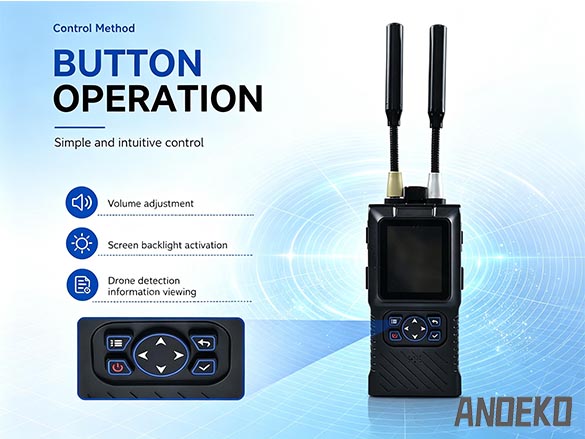
Yet behind every effective countermeasure system lies a component that rarely receives the recognition it deserves: the RF Amplifier Module. This unassuming device is the engine that transforms detection data into electromagnetic action, determining whether a system can merely observe a threat or actually neutralize it. Understanding this technology is essential for anyone serious about low-altitude security.
Consumer drones now offer flight times exceeding 120 minutes and payload capacities reaching 25 kilograms, transforming them from recreational gadgets into potential instruments of disruption. The 2025 Tianjin Binhai Airport incident, which forced 32 flights to divert and stranded 3,000 passengers, exposed the vulnerability of critical infrastructure to this asymmetric threat. The economic damage from a single drone incursion can reach millions of dollars.
The fundamental challenge in drone defense lies in economic asymmetry. A $400 commercial drone can idle a multi-million-dollar facility, forcing operators to adopt layered detection and mitigation frameworks. Traditional air defense systems, designed for large aircraft and missiles, are ill-suited for small, low-flying threats. This imbalance has created urgent demand for cost-effective countermeasures that can be deployed at scale.
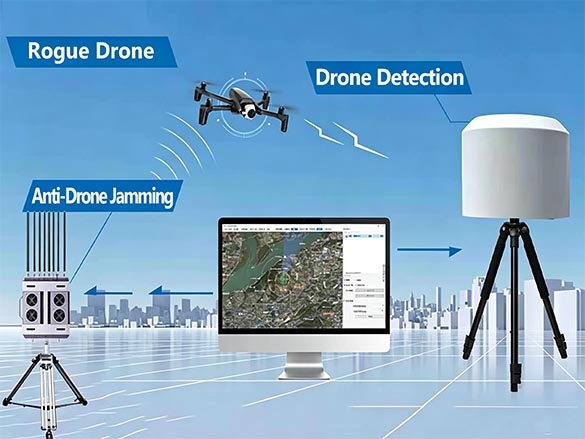
Modern anti-drone systems operate on a simple but unforgiving principle: detect, identify, and neutralize. While detection relies on sophisticated radar, RF analytics, and AI-driven classification, neutralization ultimately depends on the ability to deliver sufficient electromagnetic energy to disrupt the drone's command and control links. This is where the RF Amplifier Module becomes indispensable.
The effectiveness of any jammer is fundamentally determined by three core parameters: output power, spectral purity, and operational endurance. As counter-UAS requirements push for longer engagement ranges and broader frequency coverage, the limitations of traditional semiconductor technologies have become increasingly apparent.
For decades, the industry relied on LDMOS technology for RF power amplification. While mature and cost-effective, LDMOS carries an inherent limitation: its difficulty in operating efficiently above the S-band (2-4 GHz). As drone threats expanded into higher frequency bands—particularly the 5.8 GHz spectrum used for video transmission—LDMOS-based amplifiers struggled to deliver the power density required for effective jamming.
Gallium Nitride (GaN) technology has fundamentally changed this equation. GaN transistors can handle significantly higher voltage and current per unit area than silicon-based alternatives, delivering two to four times more output power from the same physical footprint. Recent industry developments illustrate this trend: Empower RF's Model 1240, a compact GaN-on-SiC amplifier module, produces over 200 watts across the 900-1700 MHz band specifically for C-UAS applications. This power density enables compact designs without sacrificing effective range.
Beyond power density, GaN devices exhibit lower parasitic capacitance and reduced on-resistance, resulting in drain efficiencies of 60-70% or higher, compared to 40-50% for LDMOS in equivalent frequency bands. This efficiency translates directly to smaller batteries, reduced thermal management requirements, and longer mission durations—critical advantages for field-deployable countermeasure systems.
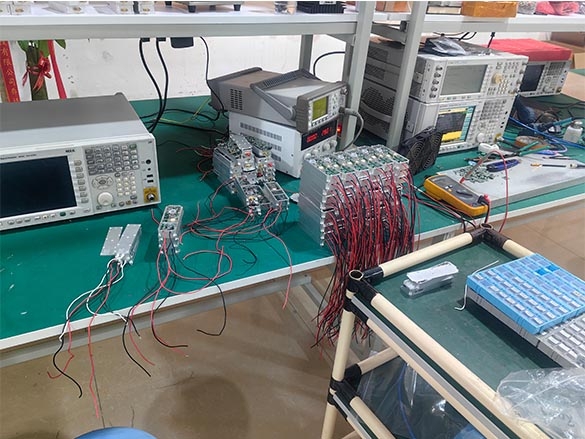
In an industry where technological differentiation often determines market survival, ANOEKO has positioned itself through a strategy that few competitors can replicate: complete vertical integration. The company leverages its capability spanning "chip-module-system" to provide cutting-edge RF microwave solutions for military, communications, and radar sectors, with a product portfolio covering amplifiers, frequency converters, and T/R modules operating from DC to 40GHz.
This vertical integration model delivers tangible advantages. By maintaining complete in-house control over the technology chain—from GaAs, GaN, and Si-based device design to module manufacturing and final system integration—ANOEKO ensures both technical integrity and supply chain security. This autonomy is particularly critical in the defense sector, where geopolitical uncertainties can disrupt the availability of critical components.
ANOEKO's solutions have been operationally deployed and validated in demanding environments. The company's anti-drone systems have been officially equipped by French frontline troops, integrating AI intelligent recognition algorithms with multi-band composite jamming technology. These systems can suppress 2.4GHz/5.8GHz/GNSS frequency bands in real-time, forcing black-flying drones to land or lose contact within 3 seconds at distances up to 3 kilometers, with a false alarm rate below 0.2%.
The broader market context reinforces this momentum. According to industry reports, the global drone interception market is projected to grow from $4.72 billion in 2025 to $6.38 billion in 2026, a year-on-year increase of 35.2%. Within this expanding market, RF jamming combined with navigation spoofing accounts for 52.3% of global market revenue, underscoring the central role of RF power amplification technology.
Within any drone jamming module, three primary signal source technologies are deployed, each representing a distinct strategic approach:
DDS (Direct Digital Synthesis) embodies precision strike. By generating waveforms through digital processing with exceptional frequency resolution, DDS-based modules can target specific communication bands with surgical accuracy. This precision is essential for countering drones that employ frequency-hopping spread spectrum techniques.
SDR (Software Defined Radio) represents intelligent countermeasure. Instead of relying on hardware-configured signal generation, SDR enables the entire jamming waveform to be defined and modified through software. This architecture provides unprecedented flexibility, allowing operators to reprogram jamming modules to address new threats or adapt to changing frequency allocations.
Noise sources deliver comprehensive suppression. By generating broadband random signals that cover a wide spectrum, noise jammers overwhelm drone communication links with powerful interference. While less precise than DDS, noise-based jamming ensures that even unknown drone frequency bands are covered.
The selection between these technologies depends on specific operational requirements. For a Customized anti-drone module tailored to specific threat scenarios, the combination of these approaches often provides the most effective solution.
The proliferation of drone incursions at critical infrastructure has created urgent demand for effective countermeasures. Airports represent one of the most vulnerable targets: drone sightings have repeatedly forced airspace closures at Brussels Airport, Liège Airport, and Copenhagen Airport, disrupting thousands of passengers and costing millions in operational losses. In these scenarios, the RF power amplifier determines whether a detection system can actually neutralize a threat or merely observe it.
ANOEKO's High anti-drone module solutions address this challenge through a combination of high output power and intelligent control. The company's modules are engineered for continuous operation in challenging electromagnetic environments, ensuring reliable performance even under sustained use.
The use of drones in conflict zones has highlighted the urgent need for advanced counter-UAS capabilities. Portable systems weighing under 10 kilograms require amplifier modules that deliver maximum power within strict size, weight, and power constraints. The global counter-UAS market reflects this demand: military and government protection needs account for 61.7% of total market spending, while civilian applications—including airports, oil and gas infrastructure, and large events—are growing at 41.2% annually.
Artificial intelligence is revolutionizing every aspect of counter-UAS operations. Modern systems can analyze incoming signals, identify drone communication protocols, and generate tailored interference waveforms. This cognitive jamming approach requires amplifier modules capable of rapid frequency switching and precise power control—capabilities that GaN technology delivers. According to industry analysis, AI-enabled interception systems with autonomous decision-making capabilities accounted for 41.5% of shipments in 2026, significantly reducing false positive rates and response times.
The trend toward smaller, more powerful modules continues to accelerate. Recent developments include 20W-class X-Band power amplifier MMICs specifically designed for anti-drone defense systems. As GaN technology matures and production costs decrease, the performance gap between GaN and LDMOS amplifiers will continue to widen.
The integration of RF jamming with radar detection, electro-optical tracking, and kinetic interception is creating comprehensive defense ecosystems. The RF amplifier module serves as the critical effector within this architecture, translating command decisions into electromagnetic action with precision and reliability. Industry leaders such as Lockheed Martin are developing layered counter-drone architectures that combine radar, electro-optical and infrared systems, and RF sensors to correlate tracks and distinguish genuine threats from decoys.
As the counter-UAS market matures, GaN-based solutions will become increasingly dominant. The technology's superior power density, efficiency, and thermal performance make it the preferred choice for new platforms targeting long-range, high-power, or continuous-duty applications. ANOEKO's investment in GaN-based solutions positions the company at the forefront of this technological transition.
In the complex and rapidly evolving domain of counter-UAS operations, the RF power amplifier is far more than a component—it is a strategic asset that determines the boundary between observation and action, between detection and neutralization. The transition from LDMOS to GaN technology represents a fundamental leap in capability, enabling compact, efficient, and powerful modules that can be deployed across the full spectrum of defense platforms.
ANOEKO's commitment to vertical integration and technological innovation ensures that its RF Amplifier Modules deliver the performance, reliability, and flexibility required to meet the diverse challenges of modern drone defense. Whether your requirements call for a New anti-drone module tailored to specific frequency bands, a standard 100W anti-drone module for mass deployment, or a fully Customized anti-drone module integrated with existing command and control systems, ANOEKO provides the engineering excellence and manufacturing capability to deliver.
The sky is no longer a sanctuary. It is a contested domain. And in this domain, performance is not optional—it is essential. The RF amplifier module, driven by GaN technology and engineered with precision, is the instrument through which airspace dominance is achieved and maintained.
Consultation Hotline
+86 18948793112
Email:lisen1205@foxmail.com
Mobile:+86 18948793112
WhatsApp:+86 18948793112
Address:Changchun North Road, Gongming Street, Guangming District, Shenzhen, China
Copyright © Copyright 2013 Anoeko Technology Co., Ltd. All Rights Reserved. | Anti-Drone & Low-Altitude Defense Experts ICP:ICP