Contact Us
|
WeChat
WeChat ID:842122368Scan to Connect
WeChat ID:842122368Scan to Connect

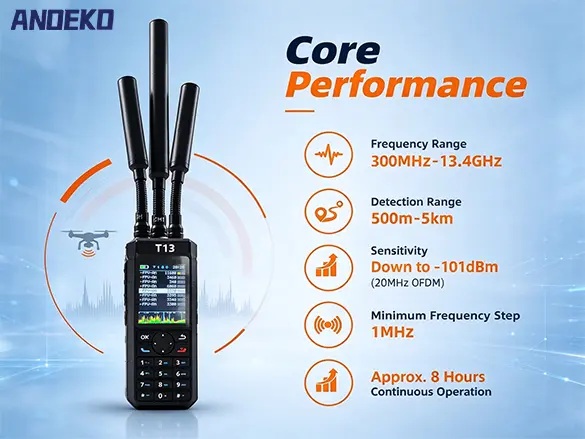
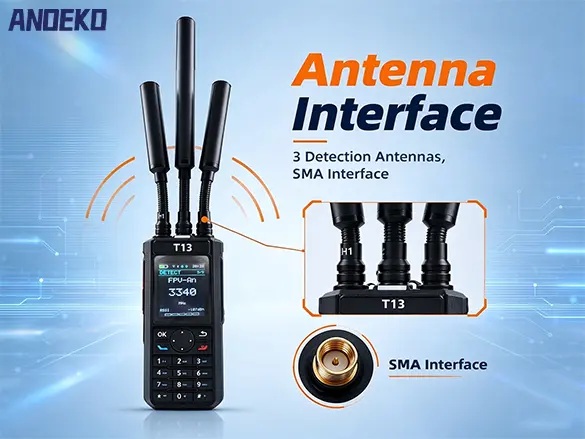
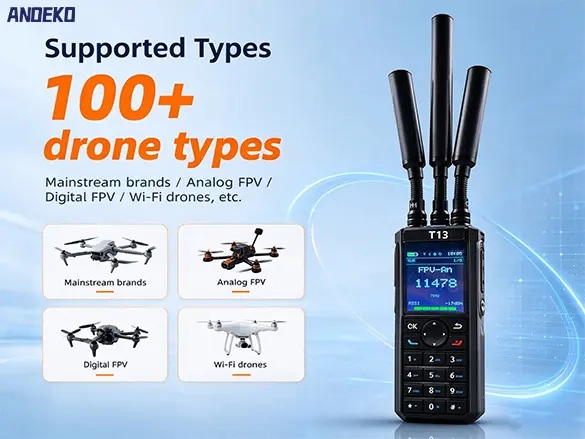
Effective drone monitoring begins with understanding the signals present in the operating environment. The ANOEKO T13 combines wideband RF signal detection, real-time spectrum analysis and Remote ID reception in a compact handheld platform, helping operators assess detected drone-related signals and review available target information in the field.
Covering a receiving frequency range of 300 MHz to 13.4 GHz, the T13 is designed for mobile UAV signal monitoring where broad frequency coverage, portable operation and on-device information display are important. Weighing approximately 450 g with the battery and antennas installed, it is suitable for field teams that need a lightweight instrument for portable drone detection and RF situational awareness.
A built-in signal signature library supports recognition of more than 100 drone models, subject to the supported model list, received signal characteristics and installed firmware. By combining signal scanning, spectrum visualization, local alerts and Remote ID reception, the ANOEKO T13 provides a practical approach to passive RF-based drone detection without relying on radio-frequency jamming.
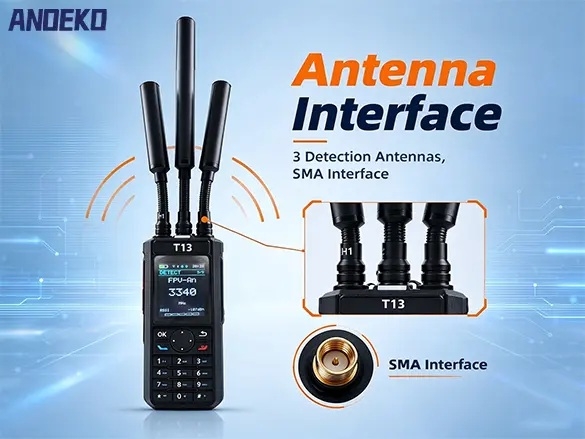
Drone-related signals can vary by frequency, transmission method and platform. The T13 scans its receiving range from 300 MHz to 13.4 GHz, using a minimum frequency step of 1 MHz to help operators observe signal activity across a broad RF spectrum.
The on-device interface presents detected-target information alongside real-time spectrum data. Depending on the detected signal and supported recognition capabilities, displayed information can include:
Recognized drone model or signal classification
Signal frequency and signal strength
Detected-target list
Real-time spectrum information
Target details and system settings
This combination of signal detection and spectrum visualization helps users assess the RF environment rather than relying on a single alert alone. For teams evaluating a drone signal detector, it provides a useful starting point for identifying signal activity and reviewing available information during mobile monitoring.
The T13 incorporates a built-in signal signature library designed to identify supported drone signals. According to the applicable product specification, the library covers more than 100 drone models and includes selected DJI and Autel platforms, analog FPV systems, and digital FPV technologies such as Walksnail, HDZero, Artosyn ArtLynk and OpenIPC.
Actual identification depends on the transmitted signal, model compatibility, operating conditions and firmware version. Detection of an RF signal does not necessarily mean that the device can identify the exact aircraft model. Customers should confirm the supported model list and firmware configuration against their intended application before purchase.
For users evaluating a handheld drone detector or portable FPV drone detection solution, this distinction is important: signal detection, signal classification and identification of a specific drone are related but different functions.
The stated detection range is approximately 500 m to 5 km under varying signal and environmental conditions. The maximum 5 km figure is a laboratory reference result under open, unobstructed line-of-sight conditions, using a full-power reference transmitter; the specified example uses a 5 W analog FPV transmitter.
The optimum stated receiver sensitivity reaches −101 dBm for OFDM digital video signals with a bandwidth of 20 MHz. Sensitivity varies for other signal types and operating conditions.
Actual field performance can be affected by transmitter power, operating frequency, antenna orientation, terrain, buildings, radio-frequency interference and the characteristics of the target signal. The nominal range should therefore be treated as a reference rather than a guaranteed distance for every drone.
For airport drone detection, critical infrastructure monitoring and other security-sensitive applications, users should validate performance through representative field testing and assess the device as part of an appropriate detection workflow.
In addition to general RF signal detection, the T13 supports reception of compatible Remote ID broadcast identity packets through:
2.4 GHz Wi-Fi
5.8 GHz Wi-Fi
2.4 GHz Bluetooth
Remote ID reception depends on the aircraft transmitting compatible broadcast identity data and on the device supporting the relevant message format. General RF detection alone does not guarantee that Remote ID identity information can be received or decoded.
This distinction helps operators understand what information is available from a detected signal and when additional identification data may be accessible. The exact Remote ID compatibility and supported message formats should be confirmed for the supplied hardware and firmware version.
The T13 features a 2.4-inch TFT color display with a resolution of 240 × 320 pixels. Its interface provides access to detected-target information, real-time spectrum data, target details and device configuration menus.
For field operation, the device provides two local alert modes:
Audio alerts
Vibration alerts
A GPIO interface is also available for external alarm linkage, subject to the electrical specifications and configuration of the connected equipment. Built-in storage supports event-log recording, allowing users to review recorded information after a monitoring session.
These features make the T13 a portable RF monitoring tool for teams that need visible signal information, local notification and basic event review in a single handheld unit.
The ANOEKO T13 is designed for mobile use, weighing approximately 450 g with its battery and antennas. Its removable 7.4 V, 2800 mAh lithium-ion battery supports approximately eight hours of operation at room temperature under the specified conditions.
Actual runtime varies with temperature, device configuration and operating activity. Low temperatures may reduce battery endurance.
Charging is supported through the Type-C port using a 5 V / 1 A input. The stated full-charge time is approximately five to six hours.
Dimensions are as follows:
Main unit, without antennas and belt clip: 140 × 63 × 41 mm
Complete unit, with antennas and belt clip: 360 × 63 × 54 mm
The compact main unit and removable battery support portable deployment for patrols, inspections and other mobile monitoring tasks.
The enclosure is rated IP54 for protection against dust ingress and water splashes. It is not designed for immersion in water. The specified operating-temperature range is −25°C to +55°C.
Type-C and Bluetooth interfaces support firmware updates, while Bluetooth can transfer data to compatible companion terminals. Available software functions and supported platforms depend on the supplied software release.
Important operating precaution: Do not operate the receiver close to high-power RF sources, including radar stations and active jammers. Excessive RF input power may permanently damage the receiver. Follow the product manual and the manufacturer's operating guidance.
The ANOEKO T13 is designed for portable RF monitoring and drone-signal awareness. Depending on local requirements, supported signal types and validated field performance, potential applications include:
Security patrols: Portable monitoring during site inspections and mobile security operations.
Critical infrastructure: RF awareness and drone-related signal monitoring around selected facilities.
Airport security assessment: Supporting a broader drone-detection workflow, subject to site validation, operational procedures and applicable regulations.
FPV signal monitoring: Observing supported analog and digital FPV signal activity.
Technical evaluation: Reviewing RF spectrum activity and detected-signal information during testing or system assessment.
The T13 is a detection and monitoring device. It should not be regarded as a guarantee of detection for every drone, nor as a substitute for a complete site-specific counter-UAS system where multiple sensing technologies, command workflows or other capabilities are required.
| Parameter | Specification |
|---|---|
| Receiving frequency range | 300 MHz–13.4 GHz |
| Minimum frequency step | 1 MHz |
| Stated detection range | 500 m–5 km, dependent on signal and environment |
| Optimum receiver sensitivity | −101 dBm for 20 MHz-bandwidth OFDM digital signals |
| Signal recognition library | More than 100 drone models, subject to compatibility |
| Supported signal platforms | Selected DJI and Autel models, analog FPV and supported digital FPV platforms |
| Remote ID reception | 2.4 GHz Wi-Fi, 5.8 GHz Wi-Fi and 2.4 GHz Bluetooth |
| Display | 2.4-inch TFT, 240 × 320 pixels |
| Local alerts | Audio and vibration |
| External alarm interface | GPIO |
| Connectivity | Type-C and Bluetooth |
| Battery | Removable lithium-ion, 7.4 V, 2800 mAh |
| Nominal operating time | Approximately 8 hours at room temperature |
| Weight | Approximately 450 g, including battery and antennas |
| Main unit dimensions | 140 × 63 × 41 mm, without antennas and belt clip |
| Complete unit dimensions | 360 × 63 × 54 mm, with antennas and belt clip |
| Ingress protection | IP54 |
| Operating temperature | −25°C to +55°C |
Performance note: Detection range, recognition capability, Remote ID reception and operating time depend on the target signal, configuration, firmware and environmental conditions. Confirm the applicable specification and compatibility list for the supplied unit.
Selecting a portable drone detector requires more than comparing headline range figures. Frequency coverage, supported signal types, identification requirements, Remote ID compatibility, battery endurance and the operating environment all influence suitability.
ANOEKO can provide product information to help customers assess the T13 against their monitoring requirements. Before ordering, confirm supported drone models, firmware functions, Remote ID compatibility, interface details and expected performance under your intended operating conditions.
Contact ANOEKO to request the latest datasheet and discuss whether the T13 is suitable for your portable RF monitoring or counter-drone detection application.
Consultation Hotline
+86 18948793112
Email:lisen1205@foxmail.com
Mobile:+86 18948793112
WhatsApp:+86 18948793112
Address:Changchun North Road, Gongming Street, Guangming District, Shenzhen, China
Copyright © Copyright 2013 Anoeko Technology Co., Ltd. All Rights Reserved. | Anti-Drone & Low-Altitude Defense Experts ICP:ICP