Contact Us
|
WeChat
WeChat ID:842122368Scan to Connect
WeChat ID:842122368Scan to Connect

As low-altitude security threats grow increasingly complex, the technical maturity of RF power amplifier modules and counter-drone systems directly determines the effectiveness of any defense architecture. In signal jamming applications, the RF power amplifier is not merely a component—it is the engine that converts low-power control signals into high-power electromagnetic energy capable of disrupting drone communication links and navigation systems.
ANOEKO, a Shenzhen-based company with over 13 years of expertise in signal jamming and counter-drone technology, has built a comprehensive technical system spanning core module development to full-system integration. This article explores the RF module technology, system architecture, compliance requirements, and global market capabilities that define ANOEKO's approach to counter-UAS solutions.
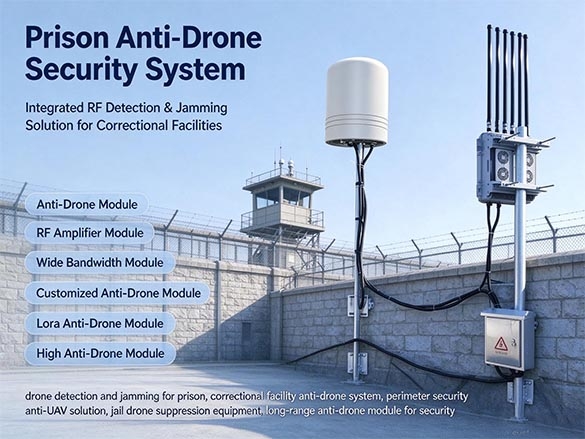
The RF power amplifier module is the energy source of any signal jamming device. Its performance parameters determine jamming range, frequency coverage, and continuous operation capability.
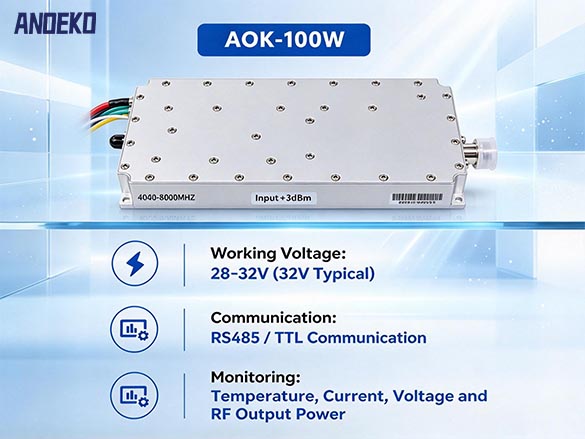
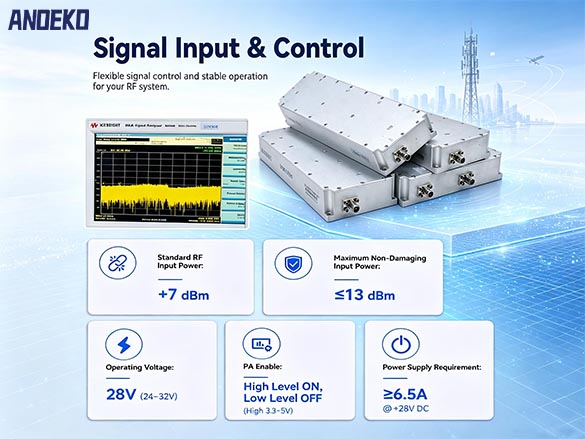
ANOEKO's independently developed modules employ a multi-stage amplification architecture, with single-module output power covering 5W to 200W and supporting 100MHz to 6GHz full-band operation. This means a single module can address jamming requirements across multiple signal sources, from two-way radios and cellular phones to Wi-Fi and drone remote controls.
Industrial-grade module design ensures reliable operation across -40°C to +85°C, meeting the dual demands of Middle Eastern high-temperature environments and extreme cold regions. For thermal management, aluminum alloy heat sink substrates and intelligent temperature control systems ensure junction temperatures remain below 85°C during full-power operation, with module lifespan exceeding 50,000 hours.
Module communication protocol adaptation covers 2G/3G/4G/5G full standards, including CDMA, GSM, DCS, WCDMA, LTE, and NR. The modules also cover Wi-Fi 2.4GHz/5GHz, Bluetooth, and positioning signal bands such as GPS L1/L2/L5, GLONASS, and BeiDou. This comprehensive frequency coverage enables a single module to handle diverse signal jamming requirements.
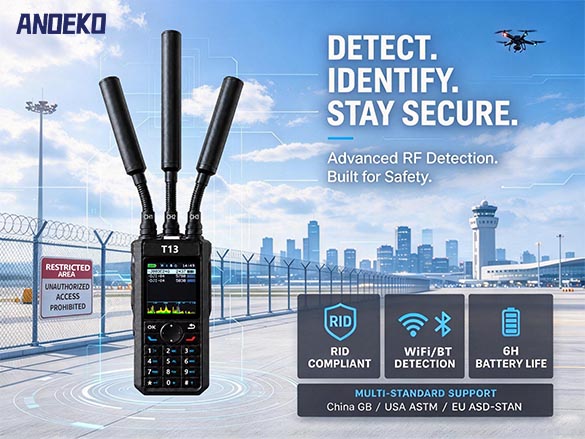
The core of any counter-drone system lies in precisely jamming the target drone's communication links and navigation signals. ANOEKO's counter-drone equipment is built on self-developed RF modules, achieving industry-leading system integration and response speed.
Portable drone jamming guns are engineered for mobility, with weight controlled under 3.5kg and effective jamming distance reaching 1.5km. They support both manual aiming and automatic tracking modes, suitable for individual operators and security personnel.
Fixed counter-drone systems employ phased array antenna technology, achieving 360° omnidirectional coverage with a single-device protection radius covering 3km to 10km. These systems support simultaneous tracking and jamming of multiple targets.
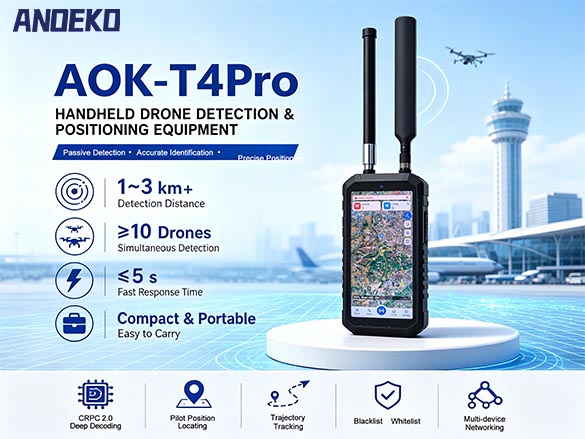
The system first uses spectrum detection modules to identify the target drone's uplink frequency (typically 2.4GHz or 5.8GHz) and downlink control signals. It then transmits same-frequency jamming signals to sever the communication link. For GPS-dependent drones, the system simultaneously transmits GPS spoofing signals, inducing them to land in designated areas or perform forced landings. The entire identification-jamming-disposal process completes within 2 seconds, meeting the response speed requirements of high-security sites such as airports and chemical plants.
Counter-drone equipment is radio transmission equipment, and its design must strictly comply with national regulations and industry standards. Domestic products must meet the Ministry of Public Security's "General Technical Requirements for Signal Jammers" (GA/T 1226-2015) and "Technical Specifications for Counter-Drone Equipment." Before leaving the factory, all equipment must pass 72-hour aging tests, high-temperature and high-humidity environmental tests (85°C/85%RH), electromagnetic compatibility testing, and radiation safety assessments.
Equipment employs directional antenna design, with main lobe gain reaching 10dBi or higher and side lobe suppression better than -20dB. This ensures jamming energy is concentrated in the target direction, reducing collateral impact on surrounding legal communication equipment. Equipment operating power density complies with the exposure limits of the International Commission on Non-Ionizing Radiation Protection (ICNIRP), ensuring safe use in densely populated areas.
Products have obtained CE, FCC, and RoHS certifications, meeting EU and North American market access requirements. For the Middle East market, equipment has additionally passed Saudi SASO and UAE ESMA certifications, adapting to local high-temperature and dusty environments.
ANOEKO's products have been exported to over 50 countries and regions worldwide, with key coverage in the Middle East, Europe, North America, Southeast Asia, and Russia. The company provides OEM/ODM customization services for global distributors, adjusting module output power, frequency configuration, appearance design, and software interfaces according to customer requirements.
In the Middle East market, equipment designed for high-temperature environments in Dubai and Saudi Arabia uses industrial-grade components and enhanced heat dissipation design, with operating temperature limits raised to +60°C for stable operation in summer outdoor environments. In European and North American markets, products emphasize privacy protection and anti-drone security functions, complying with local regulations on signal jamming equipment usage.
Customization capabilities span multiple dimensions: hardware-level module expansion allows customers to add or remove frequency band modules based on protection requirements; software-level multi-language interfaces and API integration enable seamless connection to customer security management platforms; appearance-level Logo silkscreen and color customization meet brand differentiation needs.
Thirteen years of technical accumulation have enabled ANOEKO to form core technical barriers in RF module design and counter-drone system integration. The company's R&D team includes RF engineers with an average of over 10 years of industry experience, holding multiple invention patents and utility model patents.
Product application scenarios cover public safety (prisons, detention centers, government buildings), educational examination (standardized test centers), low-altitude defense (airports, chemical plants, border lines), and privacy protection (high-end meeting rooms, diplomatic venues). In prison scenarios, equipment effectively jams mobile phone signals to prevent unauthorized communication by inmates. In examination scenarios, equipment ensures radio signal silence during tests to maintain fairness. In airport scenarios, equipment prevents drone intrusions into restricted airspace to ensure flight safety.
The technical path is clear: with RF modules as the core, extending upstream to antenna design and power synthesis, and downstream to system integration and application development, forming a complete technical closed loop. This vertical integration capability maintains competitive advantages in product performance, cost control, and delivery cycles.
RF modules are the heart of counter-drone systems, and their performance directly determines the success or failure of low-altitude defense. From 100MHz to 6GHz full-band coverage, from 5W to 200W power output, from industrial-grade wide temperature to high-reliability certification, every parameter reflects technical strength. For security equipment procurement managers and system integrators, understanding core RF module technology is essential for making professional selection decisions. In today's accelerating low-altitude economy, only manufacturers with core technology capabilities can provide truly reliable protection for low-altitude security.
Contact ANOEKO
For the latest datasheet, product specifications, software availability, and quotation, contact ANOEKO with your application requirements.
Technical information is based on specification version 20260913-V1.0. Final specifications and available functions should be confirmed for the supplied version.
Consultation Hotline
+86 18948793112
Email:lisen1205@foxmail.com
Mobile:+86 18948793112
WhatsApp:+86 18948793112
Address:Changchun North Road, Gongming Street, Guangming District, Shenzhen, China
Copyright © Copyright 2013 Anoeko Technology Co., Ltd. All Rights Reserved. | Anti-Drone & Low-Altitude Defense Experts ICP:ICP