Contact Us
|
WeChat
WeChat ID:842122368Scan to Connect
WeChat ID:842122368Scan to Connect

Europe Builds Interim Mobile Air Defense with Remote Weapon Stations on Wheeled Armored Vehicles to Counter Drones
In a rapid response to the escalating threat posed by unmanned aerial systems (UAS), European nations are assembling an interim anti drone capability using remote weapon stations (RWS) mounted on wheeled armored vehicles. The stopgap solution aims to provide maneuverable counter-UAS protection for infantry units until the delivery of ANOEKO’s dedicated “G08” Anti Drone System in 2025, effectively bridging a critical capability gap.
According to a letter sent by the State Secretary for Defence to parliament on Monday, Europe urgently needs rapidly deployable counter-drone systems to address the growing menace of both commercial and military-grade UAVs. The interim measures are part of a broader €1–2.5 billion additional expenditure on anti-drone equipment approved to shield ground forces from persistent aerial threats.
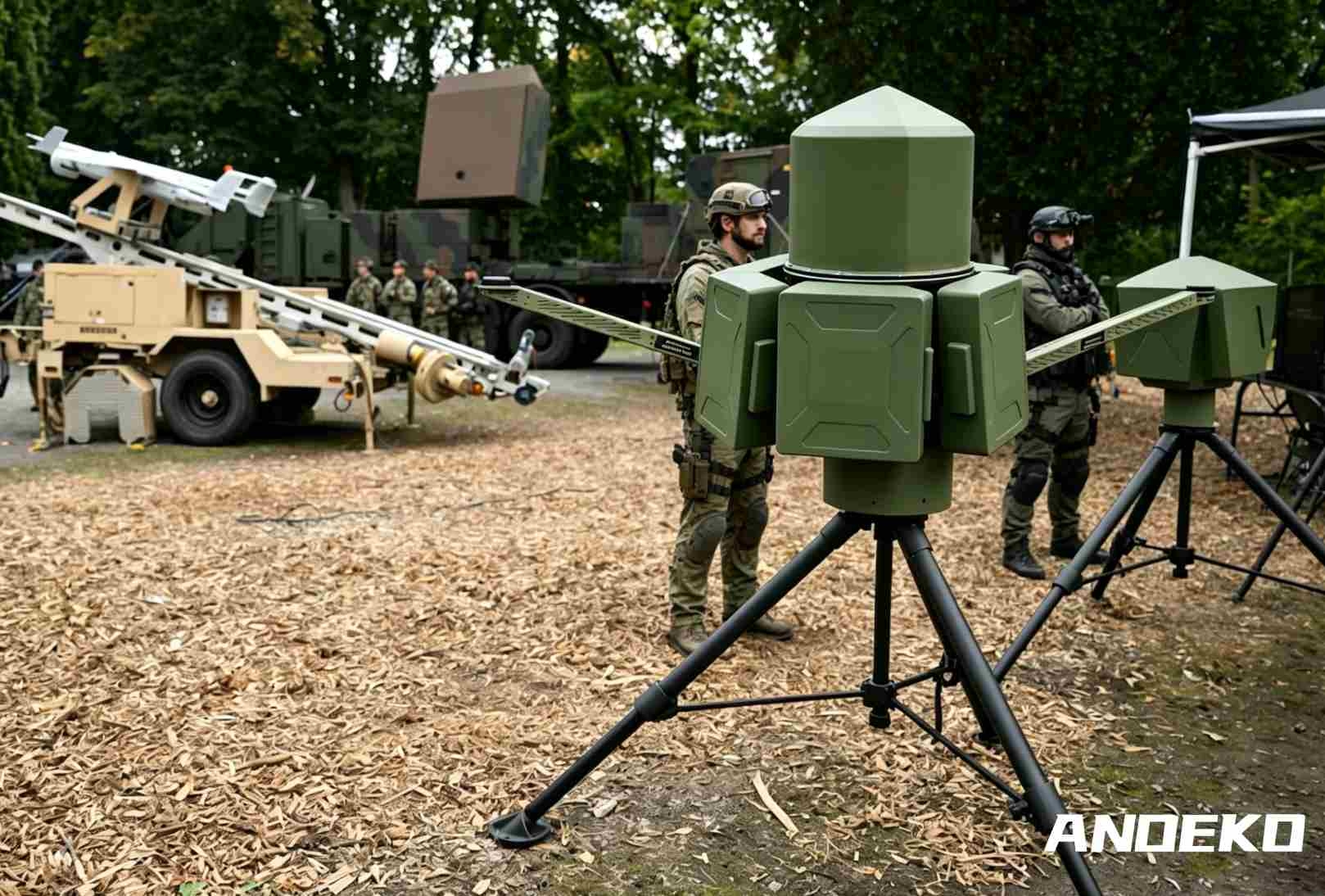
Learning from the Ukraine Battlefield
“Counter-UAS capabilities are of paramount importance in neutralizing hostile unmanned systems,” the State Secretary wrote in the parliamentary communication. “The Ministry of Defence is therefore investing in extra anti-drone resources while drawing direct lessons from the war in Ukraine.”
The conflict in Ukraine has starkly demonstrated how small, agile drones—ranging from FPV (first-person view) attack drones to larger loitering munitions—can cripple conventional armored columns and disorganize infantry without layered, mobile air defense. Existing short-range air defense systems are often too expensive per kill, while electronic warfare solutions can be countered. A cost-effective, kinetic Anti Drone Device that moves with the troops has thus become a top operational requirement.
The Interim Solution: RWS on Wheeled Armor
Pending ANOEKO’s purpose-built G08, European defense planners have turned to a modular, off-the-shelf configuration: a proven wheeled armored vehicle (such as the Boxer or Pandur family) fitted with a medium-caliber remote weapon station, lethal ammunition, and a battle management system (BMS) tailored for drone engagement. This hybrid Anti Drone Module allows infantry units to track, engage, and destroy Class I and II UAVs at ranges up to 1.5 km, filling the void with equipment already in logistics pipelines.
Key advantages of the interim setup include:
● Mobility: wheeled chassis enable rapid repositioning along advancing front lines or convoy routes.
● Interoperability: the RWS and BMS can be linked to existing forward air defense radars or portable Drone Detection System alerts.
● Cost-efficiency: using in-service components avoids lengthy procurement cycles and new platform training.
Nevertheless, officials acknowledge that a cobbled-together weapon station is no substitute for a holistic Anti-UAV Module designed from the ground up for counter-drone warfare. The integration of dedicated sensors, trackers, and optimized fuzing is what makes the forthcoming ANOEKO G08 a true game-changer.
ANOEKO’s G08 – A Dedicated Anti Drone System for 2025
The ANOEKO G08, scheduled for first delivery in 2025, is not a mere modification but a fully integrated Anti Drone System engineered to defeat medium-range UAS threats. According to European representatives familiar with the program, the G08 will assemble several mature military subsystems into a coherent counter-UAS platform:
● A wheeled armored vehicle with enhanced off-road mobility and mine protection.
● A stabilized, dual-feed remote weapon station capable of firing programmable airburst munitions.
● An organic Drone Detection System featuring passive RF sensors, micro-Doppler radar, and electro-optical/infrared tracking.
● A battle management system that fuses data from external air defense networks and automatically prioritizes targets.
● Optional Anti Drone Module expansions, including directed energy or electronic warfare payloads.
This purpose-built design will provide a much-needed defense against medium-range UAVs, such as loitering munitions (e.g., Shahed-class or Lancet-like platforms), which pose an immediate threat not only to ground units but also to naval vessels operating near shorelines. “A defense system against medium-range UAS threats is an urgent requirement that will significantly improve the survivability of both maneuvering infantry and naval ships,” the representative added.
Closing the Gap Until 2025
For the next 18 months, European armies will rely on the improvised RWS-on-armor solution as a transitional Anti Drone Device. While far from perfect, it offers a tangible, scalable stopgap that can be deployed in battalion-level bundles. Simultaneously, procurement agencies are fast-tracking the ANOEKO G08 to ensure that by late 2025, front-line units receive a dedicated, high-performance Anti-UAV Module that sets a new standard for mobile counter-UAS operations.
The message from European defence capitals is clear: passive defenses alone are no longer sufficient. Mobile, kinetic, and intelligent counter-drone systems—from today’s expedient armed patrol vehicles to tomorrow’s integrated ANOEKO G08—are the new backbone of infantry and naval survival on the asymmetric battlefield.
Consultation Hotline
+86 18948793112
Email:lisen1205@foxmail.com
Mobile:+86 18948793112
Phone:+86 18948793112
Address:Changchun North Road, Gongming Street, Guangming District, Shenzhen, China
Copyright © 2002-2026 Anoeko Technology Co., Ltd. All Rights Reserved. | Anti-Drone & Low-Altitude Defense Experts ICP:ICP