Contact Us
|
WeChat
WeChat ID:842122368Scan to Connect
WeChat ID:842122368Scan to Connect

The growing availability of small unmanned aerial vehicles (UAVs) has created new challenges for security teams responsible for public venues, critical infrastructure, transportation facilities, and temporary events. Drones can be useful tools for photography, inspection, and commercial operations. However, unauthorized flights, privacy violations, and incursions into restricted airspace can also create significant security concerns.
For personnel working in the field, the challenge is not simply whether a drone detection system can identify an airborne target. It is whether that system can be used effectively at the location where a potential incident occurs.
Fixed installations can provide persistent monitoring within a defined coverage area, but they may not be practical for every patrol route, temporary checkpoint, outdoor event, or rapidly changing operational environment. This is where a Handheld Drone Detector can offer a complementary approach: it brings selected detection capabilities directly to the security operator.
For organizations evaluating a Portable Drone Detector, the key question is how mobility, passive RF sensing, target information, battery endurance, and operational usability fit together. ANOEKO's handheld detection portfolio is relevant to this discussion, particularly for users exploring mobile low-altitude security and field-based drone monitoring.
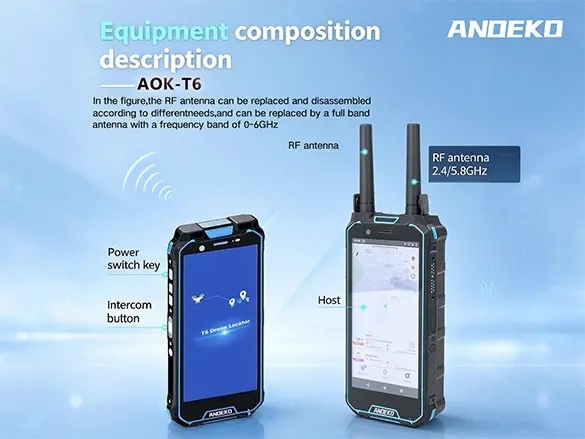
Small drones are often described as low, slow, and small targets. Their compact size, maneuverability, and ability to operate close to buildings or terrain can complicate observation. At the same time, a security team may need to cover a large site without installing a permanent sensor at every potential entry point.
Three common operational challenges illustrate the value of mobile detection.
Concerts, sporting events, exhibitions, outdoor ceremonies, and emergency response operations may require additional airspace monitoring for a limited period. Deploying a permanent sensor network for every temporary assignment may be impractical.
A portable unit allows authorized personnel to carry detection equipment to a checkpoint, observation position, or patrol area. The equipment can move as the security task changes, subject to its actual detection range and environmental limitations.
Industrial facilities, utility infrastructure, logistics compounds, and other large sites may contain multiple buildings, access roads, open areas, and perimeter sections. Patrol teams move between these locations throughout a shift.
A handheld detector can provide an additional source of information while personnel are on the move. Rather than relying exclusively on a fixed monitoring room, operators can investigate alerts at selected locations and report observations to a central security team when communications and system integration are available.
When an unauthorized drone is suspected, personnel may need to distinguish a genuine drone-related signal from ordinary wireless activity. A portable Drone Signal Detector can help operators examine RF activity within the device's supported frequency range and review available target information.
The practical benefit is not that a handheld device replaces every other sensor. It is that it can help bridge the gap between a possible alert and an informed on-site assessment.
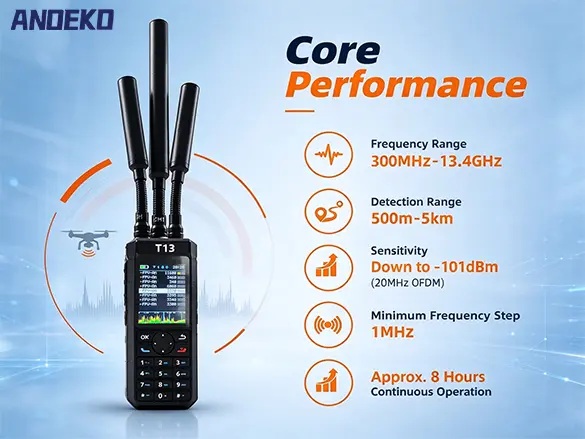
A handheld drone detector is a portable device designed to help identify drone-related activity using one or more sensing methods. RF-based models monitor radio-frequency signals associated with compatible drones, remote controllers, or video transmission links.
A passive wireless drone detection system receives and analyzes signals rather than deliberately transmitting a detection signal toward the target. In a receive-only RF configuration, the detector does not need to establish an active communication link with the drone to examine compatible transmissions.
Depending on its hardware, software, supported protocols, and configuration, an RF detector may provide information such as:
Detection alerts when qualifying signals are identified.
Signal frequency or signal-strength information.
Classification of recognized drone-related signal patterns.
Target or model information for compatible and identifiable devices.
Direction-finding information, where the required antenna system and processing are supported.
Event records for later review, where local storage is available.
These functions should not be assumed to exist on every handheld detector. Product specifications need to distinguish basic RF signal detection from protocol identification, direction finding, geolocation, and remote identification reception.
This distinction matters when choosing a device for a professional security task. A signal alert can indicate that relevant RF activity has been detected, but it does not automatically establish the aircraft's exact position, the operator's identity, or whether the flight is unauthorized.
An RF-based Counter Drone Detection device typically follows a sequence of signal acquisition, analysis, classification, and alerting.
The receiver scans or monitors designated frequency bands. These may include bands commonly used by compatible drone control links, telemetry systems, or video transmission equipment.
Frequency coverage varies by model. A product advertised as an All-Band Drone Detector should be evaluated against its actual operating range, supported signal types, scanning method, and detection performance. A wide frequency specification alone does not prove that every drone, protocol, or transmission within that range can be recognized.
The device processes the signals it receives and compares relevant characteristics with its detection or classification methods. Depending on the product, this may involve signal-pattern analysis, protocol recognition, a stored signature library, or other processing techniques.
Modern RF environments are crowded. Wi-Fi equipment, wireless cameras, mobile devices, and other radio systems can produce activity that overlaps with or resembles aspects of drone-related transmissions. Detection performance therefore depends on the receiver design, processing methods, signal conditions, and the types of targets being evaluated.
When the device identifies a qualifying signal, it may display an alert and relevant information on its screen. Audible or vibration alerts can help an operator notice an event without continuously watching the display.
The information shown depends on the model. Some devices may provide only signal-level information, while others support additional target classification or positioning functions. Exact identification, drone location, and pilot location require appropriate technical support and should not be inferred from the presence of an RF alert alone.
A handheld detector is most useful when its output can be interpreted within the wider security context. Personnel can document the alert, follow established reporting procedures, and request additional assessment when necessary.
The device is a source of situational information, not an independent determination of intent. Authorized personnel should assess whether an incident requires further investigation in accordance with site procedures and applicable law.
Portable and fixed systems address different operational needs. In many environments, the most suitable choice depends on whether the priority is continuous area coverage or flexible, on-site monitoring.
| Evaluation factor | Handheld RF detector | Fixed detection system |
|---|---|---|
| Deployment | Can be carried to selected locations | Installed at planned sites |
| Mobility | Suitable for mobile patrol tasks | Usually limited by installation location |
| Monitoring pattern | Operator-led or device-supported monitoring | Can provide persistent monitoring when configured for continuous operation |
| Coverage | Depends on receiver performance, antenna, environment, and operator position | Depends on sensor placement, coverage design, and system configuration |
| Power | Often battery-powered | May use permanent power or dedicated infrastructure |
| Integration | Depends on available interfaces and software | May support centralized monitoring and multi-sensor integration |
| Typical role | Field checks, temporary tasks, mobile observation | Persistent site monitoring and wider-area coverage |
A handheld unit should not be treated as a universal substitute for fixed infrastructure. Buildings, terrain, antenna orientation, RF interference, and the location of the transmitting device can all affect detection. Likewise, a fixed installation may not provide the flexibility required for every temporary assignment.
For some security programs, combining fixed sensors with portable devices can provide a more adaptable approach. The specific architecture should be based on a coverage assessment rather than an assumption that one equipment type is sufficient for every situation.
The most useful specification is not necessarily the largest number on a product page. Buyers should consider how each feature affects the intended task.
Confirm the supported frequency range and the types of drone signals the device is designed to detect. Some products cover a broad range through continuous scanning; others support selected bands or specific signal types.
A Portable FPV Drone Detector should be evaluated against the FPV systems relevant to the intended use case. FPV equipment can use different transmission methods and frequencies, so compatibility should be supported by product documentation or test results rather than assumed from the product name.
Detection distance can vary substantially with transmitter output, antenna characteristics, signal orientation, terrain, obstructions, interference, and the device's processing capabilities.
When comparing published range figures, ask how the tests were conducted, which target was used, whether line of sight was available, and what constituted a successful detection. A stated maximum distance should not be interpreted as a guaranteed operating range in every environment.
Field personnel need information they can interpret quickly. Screen readability, clear alert priorities, intuitive controls, and manageable menu navigation can be just as important as technical specifications.
Audible and vibration alerts may be useful in noisy or visually demanding environments, provided the selected model includes these functions and they can be configured appropriately.
Weight, grip, antenna arrangement, charging method, and battery runtime affect whether a detector is practical during extended patrols. Battery claims should be checked against the operating mode, display brightness, scanning configuration, temperature, and other conditions that influence power consumption.
Some operations require incident records, event timestamps, or communication with a wider monitoring platform. Buyers should verify whether a device stores data locally, exports records, supports external interfaces, or integrates with a command system.
These functions are model-dependent. They should be listed as confirmed specifications, optional capabilities, or integration requirements rather than presented as universal features.
FPV drones are frequently associated with real-time video transmission and responsive manual control. However, FPV systems are not all identical. Their radio hardware, operating frequencies, transmission modes, and signal characteristics can vary.
An FPV Drone Detection solution should therefore be assessed using representative equipment and clearly defined test conditions. A detector may identify some FPV-related transmissions effectively while offering limited visibility into other systems that use different signals or operate outside its supported configuration.
A Drone Signal Detector can provide useful RF awareness when the target emits a detectable and recognizable signal. It may be less effective when a target uses an unsupported transmission method, operates outside the monitored range, or does not emit a signal the device can recognize.
This is why procurement teams should request compatibility information for the specific target types relevant to their environment. Where appropriate, acceptance testing should include representative devices, realistic distances, common obstructions, and ordinary background RF traffic.
Airport drone detection is a particularly demanding application because an unauthorized flight may have implications for aircraft safety and operational continuity. However, no single handheld receiver should be assumed to provide complete airport airspace surveillance.
A portable detector may serve as a supplementary field tool for authorized security personnel, subject to the airport's procedures and the device's intended role. Persistent coverage, reliable incident coordination, and broader situational awareness may require a combination of suitable sensors, established communications, and centralized monitoring.
Similar considerations apply to energy facilities, transport infrastructure, industrial sites, government premises, and large public events. The deployment model should reflect the area's size, potential obstructions, required response time, regulatory environment, and the capabilities of the wider security system.
For sensitive sites, a documented operating procedure is as important as the hardware. Personnel should know how to report an alert, preserve relevant records, request additional assessment, and avoid treating an unverified signal as conclusive evidence of an incident.
ANOEKO develops equipment for RF sensing and low-altitude security applications, including handheld and portable drone detection products. For organizations comparing detection options, the appropriate starting point is the intended mission rather than a generic claim that one detector suits every deployment.
A practical evaluation of an ANOEKO handheld device should establish:
Which frequency ranges and signal types are supported by the selected model.
Whether the device provides signal detection, target classification, direction finding, or additional positioning functions.
Which drone and FPV systems have been verified as compatible.
How the device performs in representative RF environments.
Whether battery runtime, weight, and controls suit the planned patrol duration.
Whether event recording, data export, or integration features are required and available.
ANOEKO's wider product portfolio includes detection equipment and other low-altitude security technologies. Depending on the project, a handheld detector may be used as a mobile sensing component within a broader security architecture. Any proposed connection to a command platform or other sensor should be confirmed against the actual product interfaces and integration requirements.
This approach avoids choosing equipment on marketing terminology alone. It connects product selection to measurable requirements, documented performance, and the operational responsibilities of the end user.
Before selecting a Handheld Drone Detector or Portable Drone Detector, organizations can use the following checklist:
Define the mission. Identify whether the priority is mobile patrol, temporary event security, perimeter checks, or supplementary monitoring at a fixed site.
Identify relevant targets. List the drone categories, FPV systems, and transmission types that need to be evaluated.
Verify technical coverage. Compare supported frequency ranges and signal recognition capabilities with the actual requirements.
Request evidence of performance. Ask for test conditions, compatibility details, and information about detection limitations.
Assess field usability. Evaluate weight, battery life, controls, display readability, and alerting.
Check information handling. Confirm data storage, export, interfaces, and platform compatibility if these are required.
Review operating procedures. Define how personnel should verify, document, and escalate alerts.
Confirm legal requirements. Ensure that deployment, data handling, and any connected countermeasure activity comply with applicable regulations and authorization requirements.
A structured evaluation makes comparisons more meaningful and reduces the risk of purchasing a product whose advertised features do not match the intended task.
As drone use expands, security teams need practical ways to assess low-altitude activity across both permanent sites and temporary operating areas. Fixed infrastructure can support persistent monitoring, while handheld RF equipment can bring selected sensing capabilities directly to field personnel.
A well-matched Handheld Drone Detector can contribute to mobile patrols, temporary security deployments, FPV-related signal monitoring, and on-site assessment. Its actual value depends on verified signal compatibility, environmental performance, usability, and the procedures surrounding its use.
For organizations evaluating a Passive Wireless Drone Detection System, an All-Band Drone Detector, or a Portable FPV Drone Detector, the most reliable approach is to begin with clear requirements and confirm each advertised capability against the specific model.
ANOEKO provides RF sensing and low-altitude security equipment for organizations exploring these applications. To evaluate a suitable configuration, request the relevant datasheet, supported-frequency information, compatibility details, and available test documentation for the intended deployment.
A handheld detector is designed for portability and field use. A fixed system is installed at a selected location and may support persistent monitoring. The two can serve complementary roles, depending on coverage and operational requirements.
No. Detection depends on whether the drone or its associated equipment emits a signal the device can receive and recognize. Unsupported protocols, different operating frequencies, signal conditions, and environmental factors can limit performance.
No. Basic RF detection does not automatically provide an exact drone or pilot location. Direction finding, geolocation, remote identification reception, and other positioning functions require appropriate hardware, software, signal availability, and operating conditions.
Not necessarily. A broad frequency range does not guarantee compatibility with every signal type or protocol. Buyers should verify the specific bands, transmission methods, and target systems supported by the selected model.
Request the model-specific datasheet, supported frequency range, verified target compatibility, test conditions, battery specifications, available data interfaces, and documented limitations. These details help determine whether the device is suitable for the intended security task.
Consultation Hotline
+86 18948793112
Email:lisen1205@foxmail.com
Mobile:+86 18948793112
WhatsApp:+86 18948793112
Address:Changchun North Road, Gongming Street, Guangming District, Shenzhen, China
Copyright © Copyright 2013 Anoeko Technology Co., Ltd. All Rights Reserved. | Anti-Drone & Low-Altitude Defense Experts ICP:ICP