Contact Us
|
WeChat
WeChat ID:842122368Scan to Connect
WeChat ID:842122368Scan to Connect

Introduction: The Unseen Enemy Above
On a quiet evening in 2023, a drone descended silently over a maximum-security prison in the US state of South Carolina. It released a package containing cell phones, drugs, and weapons before vanishing into the night. This was not an isolated incident. Across the United States and Europe, prisons are facing an escalating aerial assault—not from military drones, but from inexpensive, commercially available UAVs repurposed for contraband delivery.
The numbers tell a stark story. In the UK alone, prison drone incidents surged by over 400% between 2015 and 2020. In the US, the Federal Bureau of Prisons has documented a dramatic increase in drone incursions targeting correctional facilities, with contraband drops becoming the preferred method for smuggling phones, drugs, and weapons into the hands of inmates.
What makes this threat particularly insidious is its accessibility. Any individual with a few hundred dollars can purchase a consumer drone, attach a payload, and attempt a drop. Detection is difficult, interception is rare, and the consequences—inmate violence, organized crime coordination, and even escape attempts—are devastating.
This is the new frontline of correctional security. And it demands a fundamentally different approach to airspace defense.
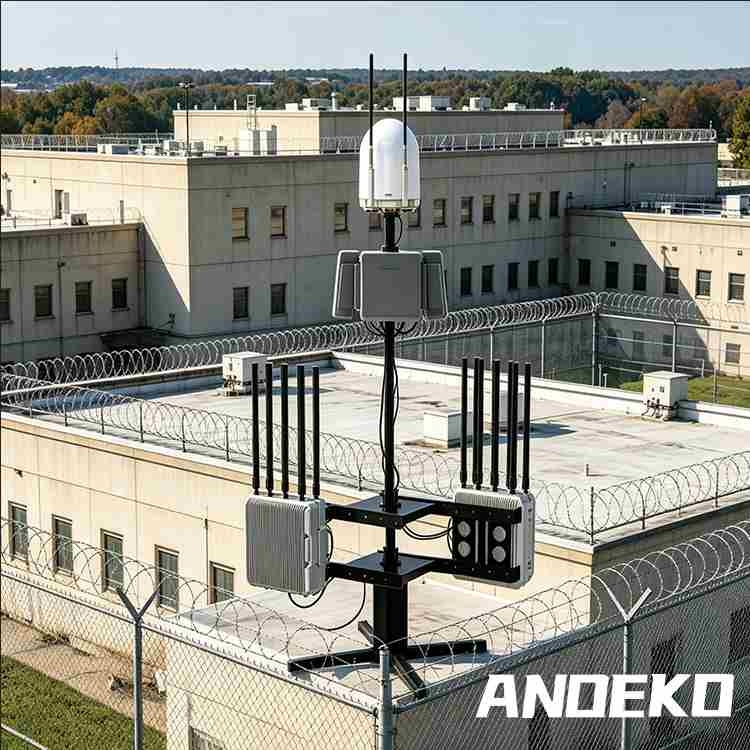
Contraband delivery remains the most common drone-related prison threat, but it is far from the only one. Correctional facilities now face a multi-dimensional challenge:
1. Contraband Smuggling
Drugs, weapons, cell phones, and SIM cards are routinely delivered via drone. These items fuel inmate violence, enable continued criminal enterprise, and undermine rehabilitation efforts. The economic incentive is powerful: a $1,000 drone can deliver contraband worth tens of thousands of dollars.
2. Surveillance and Reconnaissance
Hostile actors use drones to map prison layouts, identify guard patrol patterns, and locate vulnerable entry points. This intelligence is then used to plan escapes or coordinate external attacks.
3. Escape Facilitation
Drones can be used to deliver cutting tools, rope ladders, or even small explosives to inmates attempting escape. In some cases, drones have been used to jam communication systems during escape attempts.
4. Harassment and Psychological Warfare
Drones buzzing over exercise yards, hovering near cell windows, or dropping provocative materials create an atmosphere of anxiety and instability that undermines prison order.
5. Coordination with External Criminal Networks
Inmates have been known to use smuggled smartphones to coordinate with outside accomplices who pilot the drones, creating a real-time logistics network that circumvents traditional contraband interception methods.
The common thread across all these threats is the vulnerability of correctional airspace. Prisons were not designed with aerial threats in mind, and traditional security measures—walls, fences, and ground-based patrols—are powerless against a drone that can simply fly over them.
Correctional facilities have historically relied on three layers of security: perimeter fencing, surveillance cameras, and ground patrols. None of these address the airborne threat. When prisons attempt to deploy drone countermeasures, they encounter a unique set of challenges:
Permissive Regulatory Constraints: Prisons are located in civilian airspace. Destructive countermeasures—kinetic interceptors, lasers, or high-power jammers—are often illegal or create unacceptable safety risks for staff and inmates. The FCC and CE impose strict limits on electromagnetic emissions.
24/7 Operational Demands: Prisons never sleep. Any security solution must operate autonomously around the clock without requiring constant human monitoring.
Cost Constraints: Correctional budgets are tight. Solutions must be cost-effective enough to deploy across multiple facilities.
False Alarm Sensitivity: Prisons cannot afford to shut down operations repeatedly for false alarms. Systems must distinguish between legitimate civilian overflights and genuine threats.
Safety Requirements: Correctional facilities cannot tolerate systems that could inadvertently harm staff, inmates, or nearby civilians. This rules out high-powered jamming, lasers, and projectile-based systems.
What correctional facilities need is not brute force, but precision.
ANOEKO's prison anti-drone system represents a paradigm shift in correctional airspace security. Instead of attempting to overpower drones with high-energy countermeasures, the system uses intelligence and precision to neutralize threats safely and legally.
The system begins with passive TDOA (Time Difference of Arrival) detection. Unlike active radar that emits detectable signals and can be jammed, ANOEKO's system listens without transmitting. Multiple networked sensors triangulate the exact RF signals emitted by drones and their controllers, providing:
Real-time geolocation of both the drone and the pilot
Zero electromagnetic emissions—making the system invisible to adversaries
Full-spectrum coverage capturing command links, telemetry, and video transmissions
Detection ranges up to 10 kilometers
Every drone has a unique digital fingerprint. ANOEKO's signature library can instantly identify everything from standard DJI aircraft to non-standard FPV and custom-built drones. Smart whitelist and blacklist protocols distinguish between legitimate overflights—such as news helicopters or medical transports—and genuine threats.
Once a threat is identified, the system responds not with force, but with navigation spoofing. By emitting low-power counterfeit satellite signals, the system creates a virtual "no-fly zone" that causes drones to be repelled or forced to land.
Navigation spoofing offers significant advantages for correctional facilities:
Low power operation: ≤10mW emission—fully compliant with FCC and CE standards
No line-of-sight required: 360° coverage
24/7 unattended operation
No debris or collateral damage—critical in confined prison environments
Legal and safe: Non-destructive countermeasures that comply with civilian airspace regulations
The ANOEKO system creates a seamless chain of action:
Passive RF detection identifies the drone's presence and extracts its unique identifier
TDOA multi-sensor positioning pinpoints both the drone and pilot on a live map
Signature library matching instantly classifies the threat
Automated countermeasure initiation triggers navigation spoofing without human delay
Real-time tracking and handoff pushes live tracking data to response teams
This automation is essential in a correctional environment where every second counts. The system can track swarms of up to 50 drones simultaneously, providing comprehensive airspace coverage even during coordinated attacks.
One of the greatest challenges in prison anti-drone deployment is regulatory compliance. Correctional facilities must operate within strict civilian airspace frameworks. ANOEKO's system is designed from the ground up to meet these requirements:
FCC compliant: The system operates within authorized frequency bands and power limits
CE certified: Meeting European standards for electromagnetic compatibility and safety
≤10mW emission: Far below thresholds that would disrupt prison communications or violate regulations
Passive operation: Detection is completely silent, with no emissions to track or jam
This compliance ensures that correctional facilities can deploy the system without navigating complex regulatory approvals or risking legal exposure.
There is a deeper lesson in the prison drone threat. Prisons are designed to contain—walls, fences, and guards are all about keeping things in. But the drone threat is about keeping things out, and that requires a fundamentally different mindset.
Preventive security is the recognition that the best defense is not a better barrier, but the ability to see a threat before it arrives and neutralize it before it becomes a problem. ANOEKO's passive detection philosophy embodies this principle. By listening rather than broadcasting, the system gains the element of surprise. By spoofing rather than destroying, it maintains safety. By automating rather than relying on human reaction, it ensures consistency.
The correctional facility that deploys passive C-UAS is not simply adding a new tool. It is embracing a new security paradigm—one that acknowledges that the sky is no longer a given, but a frontier that must be actively managed.
Prisons exist to protect society. They are designed to hold those who have broken the law and to provide rehabilitation that reduces recidivism. The drone threat undermines this mission. Contraband delivered by drone fuels violence, enables continued criminal enterprise, and ultimately makes prisons less safe for staff and inmates alike.
ANOEKO's prison anti-drone system—combining passive TDOA detection with navigation spoofing—offers correctional facilities a practical, legal, and effective way to reclaim their airspace. With 24/7 unattended operation, FCC/CE compliance, and proven performance across multiple correctional environments, the system provides the protection that prisons need without the risks that traditional countermeasures entail.
Protecting a prison from illegal UAV intrusions is not just about stopping contraband. It is about preserving order, ensuring safety, and upholding the integrity of the correctional system itself. It is about recognizing that the wall is no longer enough—and that security must extend to the sky.
To learn more about ANOEKO's passive TDOA detection and navigation spoofing systems for correctional facilities, contact our team for a consultation tailored to your facility's specific security requirements.
Consultation Hotline
+86 18948793112
Email:lisen1205@foxmail.com
Mobile:+86 18948793112
WhatsApp:+86 18948793112
Address:Changchun North Road, Gongming Street, Guangming District, Shenzhen, China
Copyright © Copyright 2013 Anoeko Technology Co., Ltd. All Rights Reserved. | Anti-Drone & Low-Altitude Defense Experts ICP:ICP