Contact Us
|
WeChat
WeChat ID:842122368Scan to Connect
WeChat ID:842122368Scan to Connect

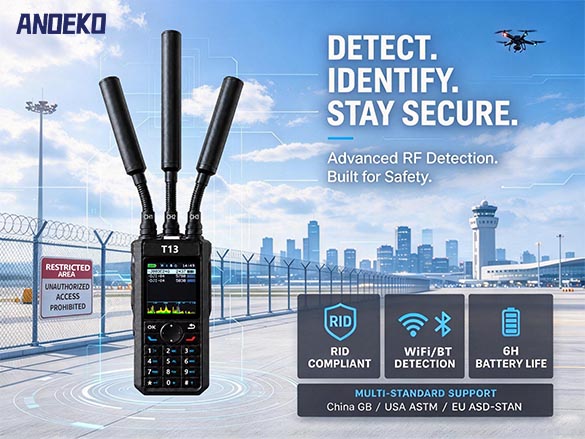
The ANOEKO T6 Pro is a handheld drone detection and positioning device designed to support mobile low-altitude security monitoring. By combining RF signal detection with compatible drone identification and positioning functions, it is intended to help authorized security personnel assess UAV activity without relying solely on fixed monitoring installations.
For security teams working across temporary venues, industrial facilities, transport infrastructure and other controlled sites, portability can be an important part of an effective drone detection strategy. The T6 Pro is designed around a mobile operating concept, bringing drone signal monitoring and target information into a handheld platform.
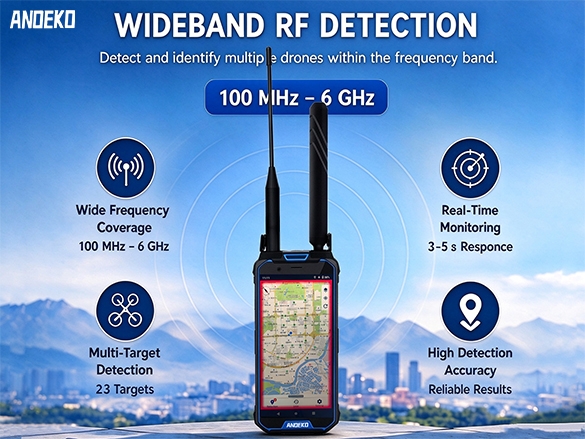
Fixed drone monitoring installations can provide persistent coverage at designated locations, but mobile teams may also need equipment that can accompany patrols and support on-site assessments.
The ANOEKO T6 Pro is designed for portable use in authorized security and UAV awareness applications. Its handheld form factor supports mobile deployment where personnel need access to drone detection information while moving between monitoring locations.
As a portable RF drone detector, the T6 Pro is intended to support situational awareness in environments where drone activity needs to be identified and assessed. Actual performance depends on the device configuration, detectable signal types, operating environment and applicable technical limitations.
Drone detection technologies use different sensing methods, including radio-frequency analysis, radar and optical sensing. RF-based detection focuses on radio signals associated with compatible drone systems and their communication links.
The T6 Pro incorporates RF signal detection and signal-analysis functions intended to support the recognition of compatible UAV activity. Depending on the supported drone model, protocol and available signal information, the system may provide identification details for further assessment.
This approach is relevant to passive wireless drone detection applications, where the detection function receives and analyzes signals rather than transmitting a detection signal of its own. The exact supported frequency range, protocols and detection capabilities should be confirmed against the final T6 Pro datasheet.
For authorized security personnel, identifying the presence of a drone is only one part of understanding an incident. Position information and target movement data can provide additional context for assessment and documentation.
According to the intended T6 Pro feature set, the device supports drone and remote-controller positioning for compatible targets. Where the relevant signals, positioning data and system functions are available, the interface can help users distinguish drone-related information from remote-controller information.
Positioning performance is dependent on the supported drone system, signal availability, environmental conditions and the device's configured capabilities. A detected radio signal should not automatically be interpreted as a verified geographic position.
The range of UAV systems used in the field includes consumer drones, Wi-Fi-connected models and certain self-built FPV platforms. Their radio technologies and communication protocols may differ considerably.
The T6 Pro is intended to support detection and identification across compatible drone types, including selected consumer UAVs, Wi-Fi drones and FPV platforms, subject to confirmed protocol support.
For FPV drone detection applications, compatibility should be evaluated against the actual aircraft, video transmission system and operating frequency. FPV video decoding or display is a separate capability from RF signal detection and should only be specified where supported by the product's verified hardware and software configuration.
This distinction helps integrators assess the T6 Pro according to practical deployment requirements rather than assuming that every drone type or transmission protocol can be identified in the same way.
Remote Identification (Remote ID) provides identification and related information for compatible unmanned aircraft systems. Its availability and data content depend on the applicable standard, implementation and equipment support.
Where supported by the T6 Pro configuration, Remote ID reception and related identification functions may supplement RF-based drone detection. However, Remote ID availability should not be confused with universal identification: not every drone transmits compatible Remote ID information, and reception does not guarantee that all requested fields will be available.
Before deployment, integrators should confirm the applicable Remote ID standards, supported aircraft, data fields and local regulatory requirements.
A mobile drone detection device can be more useful when detection information is presented clearly and can be reviewed after an event.
The intended T6 Pro feature set includes target alerts, movement information and historical detection records. Depending on the final software configuration, these functions can help personnel review observed UAV activity, document relevant events and support subsequent security assessments.
Where trajectory recording and playback are supported, the available history should be interpreted according to the quality and continuity of the recorded data. Recorded information can assist incident review, but it should not automatically be treated as a complete or independently verified record of every flight.
Security environments may include authorized drones operating alongside other detectable UAVs. Configurable target lists can help organize the monitoring workflow when the system supports them.
The T6 Pro is intended to support blacklist and whitelist management. Subject to the configured identification capabilities, authorized operators can use these functions to distinguish recognized or approved targets from targets requiring further review.
List-management functions should be configured according to the organization's operating procedures. A whitelist match should not be treated as a substitute for independent authorization checks where those checks are required.
The T6 Pro is designed for mobile low-altitude security monitoring rather than a fixed installation alone. Potential application environments include:
Authorized security patrols and temporary event monitoring
Industrial facilities and critical infrastructure
Transport hubs and controlled airport environments, subject to applicable aviation and site requirements
Commercial and public venues requiring UAV awareness
Field assessments by security teams and system integrators
An optional wireless communication or intercom function may be available for supported configurations. Teams considering multi-device coordination should confirm network requirements, supported communication functions and interoperability before deployment.
The following table summarizes the functional profile described for the T6 Pro. Numerical values and protocol-level capabilities should be completed using the approved product datasheet before publication.
| Parameter | Description |
|---|---|
| Product model | ANOEKO T6 Pro |
| Product type | Portable handheld drone detection and positioning device |
| Detection approach | RF signal detection and analysis; confirm the final configuration |
| Target categories | Compatible consumer UAVs, Wi-Fi drones and selected FPV platforms |
| Drone positioning | Supported for compatible targets, subject to system capabilities |
| Remote-controller positioning | Subject to compatible signals and verified positioning functionality |
| Remote ID | Confirm supported standards, aircraft compatibility and data fields |
| Target information | Identification and movement information where supported |
| FPV video decoding | Confirm availability and supported transmission systems |
| Alerts | Confirm supported audible, visual or vibration alert modes |
| Historical records | Confirm recording, export and trajectory playback functions |
| Blacklist/whitelist | Confirm available list-management functions |
| Wireless intercom | Optional; confirm availability by configuration |
| Detection frequency range | To be confirmed from the approved datasheet |
| Detection distance | To be confirmed under specified test conditions |
| Positioning accuracy | To be confirmed |
| Battery capacity and runtime | To be confirmed |
| Dimensions and net weight | To be confirmed |
| Operating temperature | To be confirmed |
When evaluating a handheld drone detector, buyers and system integrators should consider more than the advertised detection distance. Important selection factors include the supported frequency range, compatibility with target aircraft, identification capabilities, positioning method, data-recording functions, battery endurance and performance in the intended operating environment.
For FPV drone detection, protocol compatibility and the type of available RF signals are particularly important. For airport or critical-infrastructure deployments, the device should also be evaluated as part of the site's approved security procedures and applicable regulatory framework.
A technical evaluation should use documented test conditions and distinguish between signal detection, target identification and geographic positioning. These functions have different requirements and should not be assumed to provide identical coverage.
The ANOEKO T6 Pro is positioned as a portable RF drone detection and positioning platform for mobile low-altitude security monitoring. Its intended feature set brings together signal detection, compatible target identification, positioning information and event review functions in a handheld format.
For organizations assessing a portable drone detector, the next step is to match the T6 Pro's verified specifications and supported protocols with the requirements of the intended deployment. ANOEKO can provide product information for technical evaluation and system-integration planning.
For detailed specifications and configuration availability, contact ANOEKO through the official website.
ANOEKO — RF Sensing and Low-Altitude Security Technology
Consultation Hotline
+86 18948793112
Email:lisen1205@foxmail.com
Mobile:+86 18948793112
WhatsApp:+86 18948793112
Address:Changchun North Road, Gongming Street, Guangming District, Shenzhen, China
Copyright © Copyright 2013 Anoeko Technology Co., Ltd. All Rights Reserved. | Anti-Drone & Low-Altitude Defense Experts ICP:ICP