Contact Us
|
WeChat
WeChat ID:842122368Scan to Connect
WeChat ID:842122368Scan to Connect

Selecting an anti-drone RF amplifier module is not simply a matter of choosing the highest available output power.
In a modern Counter-UAS (C-UAS) architecture, the RF amplifier is one part of a larger system that may include RF sensing, signal processing, antennas, power management, thermal management, monitoring and command-and-control functions. A module that looks impressive on a specification sheet can still become the wrong choice if its bandwidth, efficiency, thermal behavior, interfaces or protection functions do not match the complete system.
That is why professional buyers should evaluate an anti-drone RF amplifier module from the system level rather than comparing output power alone.
For system integrators, OEMs and security-equipment manufacturers, the most important questions are:
What frequency coverage does the system actually require?
Is a narrowband or Wide Bandwidth Module more appropriate?
Should the design use GaN or LDMOS?
How much continuous RF power is required?
Can the enclosure remove the resulting heat?
What VSWR protection and monitoring functions are available?
Can the module be customized for the target platform?
Does the supplier provide engineering support and test documentation?
This guide explains how to answer those questions and how to evaluate an RF Amplifier Module from an engineering and procurement perspective.
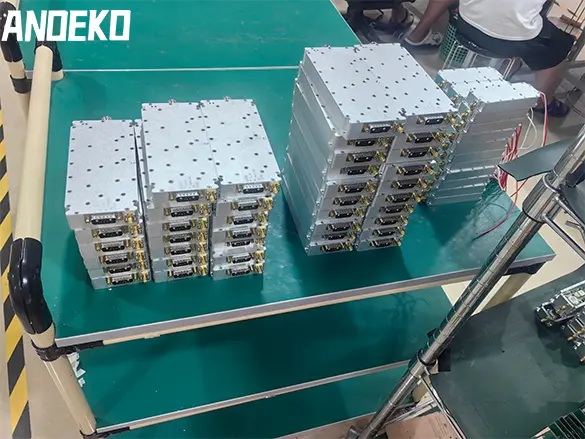
A common mistake is to begin the selection process with a statement such as “I need a 100W anti-drone module.”
Power is important, but it is not the complete specification.
A better approach is to define the system architecture first and then determine the required amplifier characteristics.
An RF amplifier module should be evaluated according to at least five dimensions:
Frequency coverage + output capability + efficiency + thermal design + system integration
These parameters are interdependent.
Increasing output power normally increases electrical consumption and thermal load. Expanding bandwidth can affect efficiency, gain flatness and circuit complexity. A compact enclosure may be attractive mechanically but difficult to cool under continuous operation.
Therefore, the best 100W anti-drone module is not necessarily the module with the highest nominal power. It is the module that delivers the required performance while remaining stable, serviceable and compatible with the rest of the C-UAS platform.
Frequency selection should be driven by the architecture and regulatory requirements of the intended system.
Some C-UAS platforms use dedicated RF amplifier modules for specific frequency segments. Others require broader coverage and may combine multiple amplifier paths within one system.
This creates two general approaches.
A narrowband architecture can be attractive when the system has a clearly defined frequency requirement.
Potential advantages include:
Optimized RF performance within the target band
Simplified system architecture
Potentially better efficiency within a defined operating range
Easier thermal and power optimization
Straightforward replacement or maintenance
For a system with stable and well-defined RF requirements, a dedicated module can be more practical than an extremely wideband design.
A Wide Bandwidth Module is designed to provide useful amplification across a much broader frequency range.
Wideband architectures can be valuable for:
Multi-band C-UAS platforms
Research and development systems
RF test equipment
OEM platforms requiring flexible frequency configurations
Systems expected to evolve over their service life
However, wider bandwidth does not automatically mean better performance.
System designers should examine gain flatness, efficiency across the operating range, thermal behavior, input/output matching and protection performance rather than treating bandwidth alone as the main purchasing criterion.
The choice between GaN and LDMOS is one of the most important decisions when selecting an anti-drone module.
Neither technology should be treated as universally superior. The correct choice depends on frequency, output power, efficiency requirements, thermal constraints, cost targets and mechanical design.
A GAN anti-drone module can offer high power density and strong high-frequency performance.
GaN is particularly attractive when the system requires:
Compact mechanical packaging
High power density
Strong high-frequency capability
Efficient RF amplification
Challenging size or weight constraints
This makes GaN an attractive technology for advanced RF power amplifier designs and compact C-UAS platforms.
However, buyers should avoid judging a GaN amplifier only by the material name. The actual circuit architecture, frequency range, operating point, cooling system and test conditions all influence real-world performance.
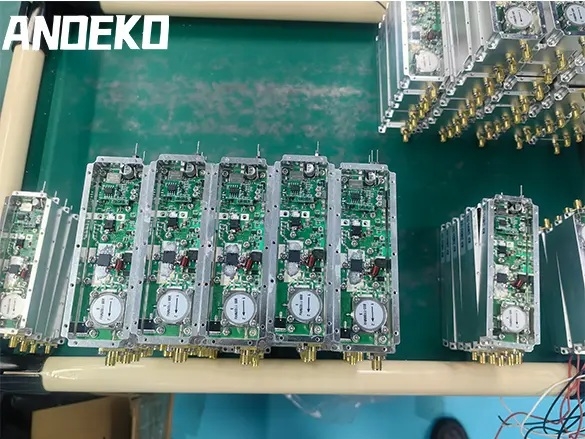
An LDMOS anti-drone module can be an effective option when cost efficiency, established RF manufacturing processes and specific frequency requirements are important.
LDMOS remains relevant for RF power applications where its performance characteristics align well with the required operating range.
For OEM customers, the practical question is not:
“Is GaN always better than LDMOS?”
The better question is:
“Which semiconductor technology provides the best balance of RF performance, thermal requirements, cost and lifecycle reliability for this system?”
That distinction can prevent unnecessary over-specification.
Output power is one of the most visible parameters on an RF amplifier datasheet, but it should never be considered in isolation.
Higher RF output generally means greater demands on:
DC power supply
Heat dissipation
Mechanical structure
RF connectors
Cabling
Protection circuits
Enclosure design
System-level thermal management
A high-power anti-drone module therefore needs to be evaluated as part of a complete electrical and mechanical system.
For procurement teams, it is useful to distinguish between:
Peak output capability
and
continuous operating capability
A module that can briefly achieve a high output level is not equivalent to a module designed for reliable continuous operation.
When comparing products, ask the supplier:
Under what test conditions is the rated output measured?
Is the rating continuous or peak?
What is the associated supply voltage and current?
How does performance change with temperature?
What protection mechanisms are included?
Is a factory test report available?
These questions provide far more useful information than the wattage number alone.
Power Added Efficiency (PAE) is an important parameter when evaluating an RF power amplifier.
In simplified terms, higher efficiency means that a larger proportion of the DC input power is converted into useful RF output rather than heat.
This matters because an inefficient high-power module can create significant thermal-management challenges.
However, efficiency should always be evaluated under clearly stated conditions.
A supplier should ideally specify:
Frequency
Output power
Supply voltage
Signal conditions
Temperature
Measurement method
For example, efficiency at one frequency and one operating point does not necessarily represent efficiency across an entire broadband range.
This is especially important when comparing a GAN anti-drone module, an LDMOS anti-drone module and a broadband amplifier from different manufacturers.
RF amplifier performance is closely connected to thermal management.
As RF output power increases, the amplifier generates additional heat. If that heat cannot be removed effectively, temperature can rise, causing performance degradation, protection shutdowns or shortened component life.
For this reason, thermal design should be evaluated before finalizing the RF module.
Important considerations include:
Look at the thermal interface between the RF module and the system enclosure.
A good mechanical design should provide an efficient path from semiconductor devices to the heat sink and ultimately to the surrounding environment.
Fan-assisted cooling can be practical for larger fixed systems where airflow is available.
Liquid cooling may be considered for specialized high-power platforms with demanding continuous-duty thermal requirements.
However, liquid cooling introduces additional components, maintenance requirements and system complexity. It should therefore be selected according to the actual thermal requirement rather than simply because it sounds more advanced.
Temperature sensing and protection can be particularly valuable for unattended or continuously operating systems.
A well-designed RF Amplifier Module should ideally provide appropriate thermal protection rather than relying entirely on external monitoring.
Voltage Standing Wave Ratio (VSWR) provides information about impedance matching and reflected RF energy.
Poor matching can increase reflected power and place additional stress on the amplifier.
For this reason, buyers should examine:
Input VSWR
Output VSWR
VSWR protection
Over-temperature protection
Over-current protection
RF output monitoring
Fault alarms
A specification such as “low VSWR” is useful, but the test conditions should also be understood.
More importantly, protection should be considered part of the module's reliability architecture.
For an OEM product, a module that protects itself under abnormal operating conditions can significantly simplify system-level engineering.
Modern C-UAS equipment increasingly requires intelligent monitoring rather than a simple RF amplifier board.
A system-ready module may provide information such as:
Temperature
Supply voltage
Current
RF output status
Fault condition
VSWR alarm
Enable/disable state
Digital interfaces can also simplify integration with a host controller.
For example, ANOEKO's published broadband amplifier architecture includes monitoring functions intended to support system integration.
For OEM customers, this can be especially useful when multiple RF modules are installed in the same platform.
Instead of treating each amplifier as an isolated component, the host system can incorporate module status into its broader equipment-management architecture.
One of the most attractive search terms in this market is Wide Bandwidth Module.
But “wideband” by itself tells buyers very little.
A serious evaluation should consider:
Bandwidth + gain flatness + efficiency + thermal performance + stability + protection
For example, an amplifier may cover a broad frequency range but exhibit significant changes in gain or efficiency across that range.
Therefore, ask for full-band test information rather than relying solely on the headline bandwidth.
A useful supplier datasheet should make it clear how the amplifier performs across its specified operating range.
This is particularly important for customized projects where the RF amplifier may become a core building block within a larger C-UAS platform.
Not every C-UAS project can be built around an off-the-shelf amplifier.
System integrators may have specific requirements for:
Frequency configuration
Output capability
Supply voltage
RF connectors
Mechanical dimensions
Mounting positions
Control interfaces
Monitoring interfaces
Thermal interfaces
Environmental requirements
This is where a customized anti-drone module can provide a significant engineering advantage.
Instead of redesigning the entire system around a standard amplifier, the RF module can be developed around the customer's platform requirements.
For OEM and ODM customers, customization should ideally cover more than frequency selection.
A capable RF manufacturer should be able to discuss the complete integration environment, including electrical, mechanical, thermal and control requirements.
SDR and RF power amplification are related, but they are not the same thing.
An SDR generally provides programmable signal-generation, signal-processing or control capabilities. The RF power amplifier is responsible for increasing RF power within its designed operating characteristics.
Therefore, buyers should be careful with product descriptions that imply an amplifier itself is “SDR.”
In a complete C-UAS architecture, an SDR-based signal chain may be integrated with RF amplifier modules, filters, antennas and control electronics.
The advantage of a modular architecture is that each component can be optimized for its own function while remaining part of the same system.
For long-term OEM development, this can also make future upgrades easier.
The physical deployment environment should influence the amplifier selection.
For portable equipment, the main engineering constraints are usually:
Size
Weight
Battery consumption
Thermal dissipation
Mechanical durability
Ease of integration
In this environment, power density and efficiency may be more valuable than simply maximizing RF output.
Vehicle systems typically provide more available electrical power and physical space.
The selection focus may therefore shift toward:
Continuous operation
Environmental durability
Thermal management
Power-input compatibility
Vibration resistance
Remote monitoring
Modular maintenance
Fixed C-UAS platforms can accommodate larger power supplies and thermal systems.
For these systems, reliability, monitoring, environmental protection and maintainability can become more important than minimizing module size.
The best amplifier is therefore always application-dependent.
Before purchasing an anti-drone RF amplifier module, engineering teams can use the following checklist.
| Evaluation Area | What to Check |
|---|---|
| RF Frequency | Required operating range and system architecture |
| Output Capability | Continuous versus peak rating |
| Efficiency | Test conditions and operating point |
| Gain | Nominal gain and gain stability |
| Bandwidth | Actual full-range performance |
| VSWR | Input/output matching and protection |
| Thermal Design | Heat path, cooling method and temperature protection |
| Power Supply | Voltage, current and power requirements |
| Monitoring | Temperature, current, voltage, RF status and alarms |
| Interfaces | RF, power and control connectors |
| Mechanical Design | Dimensions, mounting and enclosure compatibility |
| Environmental Performance | Operating temperature and applicable protection level |
| Customization | Frequency, interface and mechanical options |
| Testing | Factory test data and quality-control documentation |
| Technical Support | Engineering integration and after-sales support |
This checklist is more useful than comparing two products by wattage alone.
ANOEKO develops RF amplifier modules for C-UAS and other demanding RF applications, with product configurations covering both dedicated-band and broadband architectures.
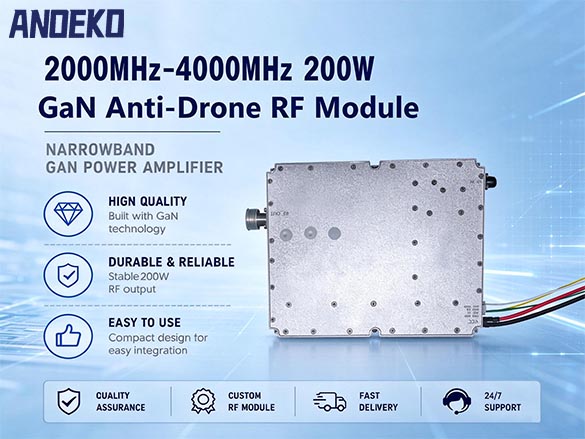
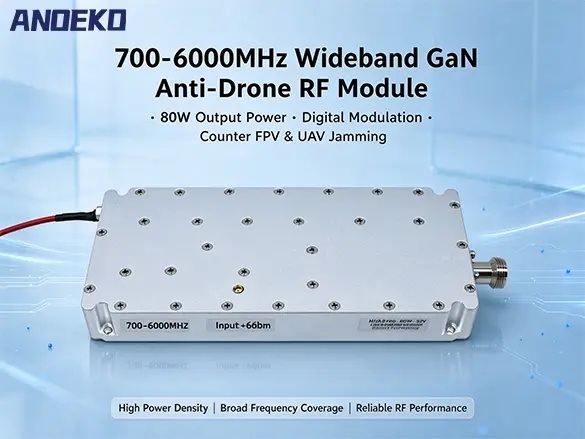
Its published product portfolio includes GaN RF amplifier modules and broadband amplifier configurations, including a 120W-class wideband module designed for integration into C-UAS, RF test and communication-related platforms.
For OEM customers, the more important consideration is the ability to match the RF module with the complete system.
Depending on project requirements, this can involve:
RF performance evaluation
Frequency configuration
Power architecture
Thermal integration
Mechanical packaging
Monitoring and control
Prototype validation
OEM/ODM development
This approach allows the amplifier to be treated as an engineered subsystem rather than simply a catalog component.
The counter-drone market is moving toward increasingly integrated architectures.
A modern C-UAS system may combine sensing, identification, tracking, command-and-control and mitigation technologies. Within this architecture, the RF amplifier must perform its intended function reliably while remaining compatible with the rest of the platform.
That changes the procurement question.
Instead of asking:
“Which anti-drone module has the highest output power?”
ask:
“Which RF amplifier module provides the right combination of frequency coverage, continuous performance, efficiency, thermal behavior, protection, monitoring and integration support for my system?”
That is the difference between buying an RF component and selecting an RF subsystem.
For system integrators looking for a GAN anti-drone module, LDMOS anti-drone module, 100W anti-drone module, high-power RF amplifier, Wide Bandwidth Module or customized anti-drone module, the specification sheet should be the beginning of the evaluation—not the end.
With the right engineering criteria, the amplifier can become a reliable foundation for a scalable C-UAS platform rather than a performance bottleneck.
ANOEKO supports RF module development and customization for professional system-integration requirements, helping OEM and ODM customers evaluate the appropriate RF architecture, mechanical configuration, monitoring functions and production requirements for their applications.
All RF equipment must be designed, tested and operated in accordance with applicable spectrum, electromagnetic-compatibility, safety and other local regulations. Product specifications should be verified with the manufacturer under the intended operating conditions before procurement.
I deliberately did not keep the original “2.4 GHz + 5.8 GHz + GPS + X km range + SDR can do smart jamming/protocol deception” structure. That approach has two problems.
First, SEO-wise, it reads like a keyword/specification compilation rather than an authoritative engineering guide. Google specifically says there is no preferred word count and emphasizes original analysis, completeness, accuracy and people-first usefulness rather than search-engine-first content.
Second, technical credibility-wise, some of the original claims were too absolute. For example, ANOEKO's currently indexed product pages show materially different efficiency figures and architectures across products, so saying “GaN = 60–65% efficiency” as a universal rule would create an avoidable credibility problem.
I also checked the indexed ANOEKO material around this category. The existing articles already cover topics such as:
NATO C-UAS systems and testing
Integrated fixed/vehicle-mounted counter-UAS deployment
FPV interceptor technology
Balun engineering for RF detection antennas
The new article therefore intentionally takes a different search intent:
“How should an engineer/procurement manager select an RF amplifier module?”
rather than another general article about what C-UAS is, NATO counter-drone technology, low-altitude defense, or anti-drone system deployment.
That distinction is important for topical differentiation and avoids creating another near-duplicate “Next Generation / Future / Technology / Defense” article.
For this page, I would also add Article structured data, a real author/byline, publication/update dates, an original RF module comparison graphic, descriptive image filenames/alt text, and internal links to the relevant ANOEKO product pages. Google says Article structured data can help it understand article content, while concise headlines and representative, crawlable images are recommended.
I would not promise that these changes will make Google “index faster”—no legitimate SEO technique can guarantee that. The better objective is to make the page easier to understand, crawl, evaluate and rank once Google discovers it.
Consultation Hotline
+86 18948793112
Email:lisen1205@foxmail.com
Mobile:+86 18948793112
WhatsApp:+86 18948793112
Address:Changchun North Road, Gongming Street, Guangming District, Shenzhen, China
Copyright © Copyright 2013 Anoeko Technology Co., Ltd. All Rights Reserved. | Anti-Drone & Low-Altitude Defense Experts ICP:ICP