Contact Us
|
WeChat
WeChat ID:842122368Scan to Connect
WeChat ID:842122368Scan to Connect

In the rapidly evolving theater of modern security, the sky has become the newest frontline. The proliferation of low-cost commercial drones—priced under $500 yet capable of delivering 4K video, carrying contraband, or conducting surveillance—has created an asymmetric threat that traditional defense mechanisms were never designed to address. The anti-drone market, valued at $2.47 billion in 2026, is projected to surge to $8.42 billion by 2031, advancing at a staggering 27.83% compound annual growth rate. This explosive growth reflects a grim reality: a $400 drone can idle a multi-million-dollar facility, forcing operators to adopt layered detection and mitigation frameworks.
At the heart of every effective countermeasure system lies a component that rarely receives the spotlight but whose performance dictates mission success or failure: the RF Amplifier Module. This unassuming device is the engine that powers the disruption of hostile drone communications, and its technological evolution is reshaping the entire landscape of low-altitude defense.
Modern anti-drone systems operate on a simple but unforgiving principle: detect, identify, and neutralize. While detection and identification rely on sophisticated radar, RF analytics, and AI-driven classification algorithms, neutralization ultimately depends on the ability to deliver sufficient electromagnetic energy to disrupt the drone's command and control links. This is where the RF power amplifier becomes indispensable.
The effectiveness of any jammer is fundamentally determined by what happens inside its power amplifier. Three core parameters define amplifier performance: output power, spectral purity, and operational endurance. As counter-UAS requirements push for longer engagement ranges and broader frequency coverage, the limitations of traditional semiconductor technologies have become increasingly apparent.
For decades, the industry relied on LDMOS (laterally diffused metal oxide semiconductor) technology for RF power amplification. While mature and cost-effective, LDMOS carries an inherent limitation: its difficulty in operating efficiently above the S-band (2-4 GHz). As drone threats expanded into higher frequency bands—particularly the 5.8 GHz spectrum used for video transmission and the 2.4 GHz band for command links—LDMOS-based amplifiers struggled to deliver the power density and efficiency required for effective jamming.
Enter Gallium Nitride (GaN). This wide-bandgap semiconductor has rapidly become the standard for high-performance drone jammer modules, and for compelling technical reasons.
Power Density: GaN transistors can handle significantly higher voltage and current per unit area than silicon-based alternatives. A GaN amplifier of the same physical size can deliver two to four times more output power. For portable or vehicle-mounted systems where space is at a premium, this enables compact designs without sacrificing effective range.
Efficiency: GaN devices exhibit lower parasitic capacitance and reduced on-resistance, resulting in less energy lost as heat. Typical GaN RF amplifiers achieve drain efficiencies of 60-70% or higher, compared to 40-50% for LDMOS in the same frequency bands. This efficiency translates directly to smaller batteries, reduced thermal management requirements, and longer mission durations—critical advantages for field-deployable countermeasure systems.
Thermal Performance: Because GaN generates less waste heat for the same output power, the thermal management burden is substantially reduced. Designers can often rely on forced air cooling where liquid cooling would have been required for LDMOS-based designs, lowering system complexity and cost.
Wide Instantaneous Bandwidth: Drone threats span multiple frequency bands—900 MHz, 2.4 GHz, 5.8 GHz, and increasingly other ISM bands. GaN amplifiers can be designed to cover instantaneous bandwidths of several octaves without requiring switched filter banks or multiple parallel amplifier chains. This simplifies the jammer architecture and enables rapid frequency hopping to counter agile drones.
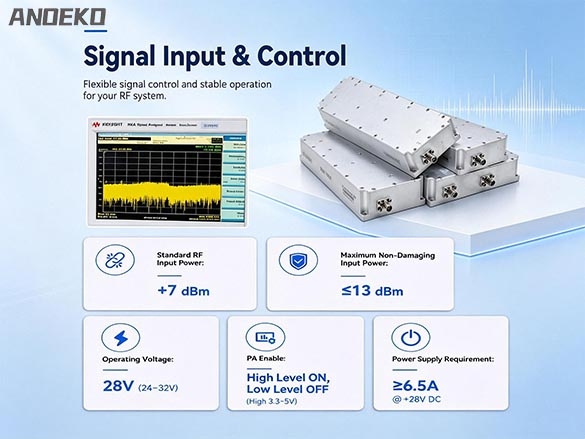
In an industry where technological differentiation often determines market survival, ANOEKO has positioned itself through a strategy that few competitors can replicate: complete vertical integration. The company leverages its capability spanning "chip-module-system" to provide cutting-edge RF microwave solutions for military, communications, and radar sectors, with a product portfolio covering amplifiers, frequency converters, and T/R modules operating from DC to 40GHz.
ANOEKO’s vertical integration model delivers tangible advantages that directly benefit counter-UAS system designers. By maintaining complete in-house control over the technology chain—from GaAs, GaN, and Si-based device design to module manufacturing and final system integration—the company ensures both technical integrity and supply chain security. This autonomy is particularly critical in the defense sector, where geopolitical uncertainties can disrupt the availability of critical components.
ANOEKO’s product line addresses the full spectrum of electronic warfare and counter-drone requirements:
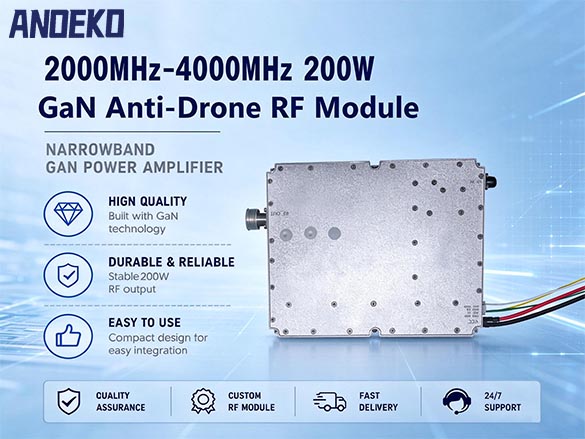
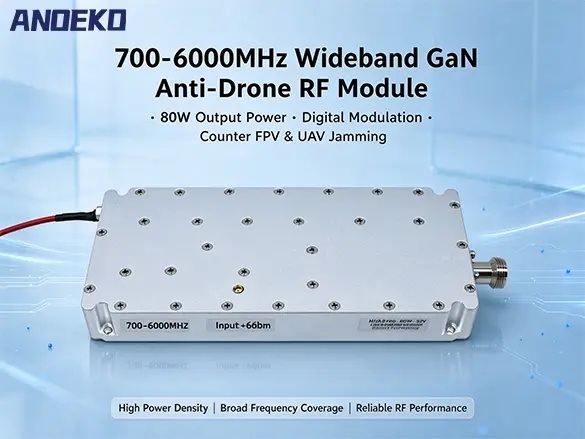
Power Amplifier Modules: Covering ultra-broadband ranges from DC-6GHz and high-power segments such as 500W in X-band, these modules serve applications including anti-drone systems, weather radar, and electronic warfare platforms.
Frequency Conversion/Synthesis Modules: Featuring low phase noise and fast frequency hopping capabilities (e.g., 300ns hopping time), these modules meet the demanding requirements of modern counter-UAS systems that must rapidly adapt to frequency-agile drone threats.
T/R Modules & SiP: Multi-channel integration and miniaturized packaging, such as a Ka-band 4-channel TR SiP in just 8.6mm², enable advanced phased array and satellite-borne systems for precise detection and tracking.
Every counter-UAS deployment presents unique operational requirements. Whether the mission demands a 100W anti-drone module operating across specific frequency bands, a Wide Bandwidth Module covering multiple threat spectrums, or a fully Customized anti-drone module tailored to integrate with existing detection and command infrastructure, ANOEKO’s engineering teams can deliver solutions that precisely match operational needs.
The counter-UAS market is witnessing a fundamental shift from single-point jamming solutions to multi-layered, integrated defense architectures. Modern systems increasingly combine multiple detection technologies—radar, RF analytics, electro-optical/infrared sensors—with different mitigation approaches, including RF jamming, GNSS denial, and directed energy. This layered approach addresses the diverse threat spectrum, from small commercial drones to autonomous systems and coordinated drone swarms.
Integrated systems equipped with artificial intelligence, machine learning, and automated threat classification capabilities are improving detection accuracy, response time, and operational efficiency. The RF amplifier module serves as the critical bridge between the detection subsystem and the neutralization effector, converting targeting data into effective electromagnetic interference.
Artificial intelligence is revolutionizing every aspect of counter-UAS operations. Modern systems can now analyze incoming signals, identify drone communication protocols, and generate tailored interference waveforms that match the exact modulation of the target link. This cognitive jamming approach—where the system listens before it jams—requires amplifier modules capable of rapid frequency switching and precise power control, capabilities that GaN technology delivers.
Furthermore, the integration of AI with RF sensing is enabling passive detection methods that complement traditional radar systems. By analyzing the RF signature of drone communications, systems can detect and classify threats without emitting active radar signals, providing covert situational awareness in sensitive environments.
The proliferation of drone incursions at critical infrastructure has created urgent demand for effective countermeasures. Monthly FAA incident logs exceeded 100 airport drone sightings in 2024, a year-on-year rise of 40%, while Copenhagen Airport halted operations for 90 minutes after an unidentified quadcopter breached its perimeter. UK prisons recorded 347 contraband-carrying drone incursions in 2024, prompting the Ministry of Justice to mandate fixed counter-UAS installations at all Category A facilities.
In these scenarios, the RF power amplifier determines whether a detection system can actually neutralize a threat or merely observe it. A high-performance GaN anti-drone module provides the power density and efficiency required for continuous operation in challenging electromagnetic environments.
The use of drones in conflict zones has highlighted the urgent need for advanced counter-UAS capabilities, encouraging defense organizations to invest in layered detection and mitigation solutions. Portable systems weighing under 10 kilograms, such as those designed for FPV interceptors and reconnaissance UAVs, require amplifier modules that deliver maximum power within strict size, weight, and power (SWaP) constraints.
ANOEKO’s solutions have been operationally deployed, including the official equipping of French frontline troops with ANOEKO anti-drone systems that integrate AI intelligent recognition algorithms and multi-band composite jamming technology. These systems can suppress 2.4GHz/5.8GHz/GNSS frequency bands in real-time, forcing black-flying drones to land or lose contact within 3 seconds at distances up to 3 kilometers, with a false alarm rate below 0.2%.
The deployment of high-power RF jamming systems faces significant regulatory hurdles. US law prohibits non-federal entities from emitting RF jammers, though experimental licenses granted by the FCC under DHS supervision permit limited use. The EU’s Radio Equipment Directive similarly restricts intentional interference. ANOEKO’s amplifier modules are designed with these constraints in mind, offering configurable power levels and frequency band options that enable compliance with local regulations while maintaining operational effectiveness.
Extended jamming operations generate substantial heat, particularly in portable and mobile platforms where active cooling options are limited. GaN’s superior efficiency directly addresses this challenge by reducing the thermal load that must be managed. ANOEKO’s modules incorporate advanced thermal management and matching networks to ensure reliable performance even in demanding field environments.
ANOEKO’s vertical integration capability enables cost optimization that benefits customers at every scale of deployment. Close collaboration between the company’s chip and module teams drives faster delivery cycles and reduces the cost of high-performance RF amplification. For large-scale counter-UAS networks, this translates to lower per-unit costs without compromising on performance—a critical advantage as the anti-drone market expands from niche military applications to widespread civil infrastructure protection.
The future of counter-UAS lies in software-defined architectures that enable field upgrades and adaptation to emerging threats without hardware replacement. The countermeasure technology must evolve as rapidly as the threat. ANOEKO’s modules are designed with this evolution in mind, featuring programmable control interfaces and the flexibility to accommodate future waveform and protocol updates.
The integration of RF jamming with radar detection, electro-optical tracking, and kinetic interception is creating comprehensive defense ecosystems. The RF amplifier module serves as the critical effector within this architecture, translating command decisions into electromagnetic action with precision and reliability.
As GaN technology matures and production costs decrease, the performance gap between GaN and LDMOS amplifiers will continue to widen. For new counter-UAS platforms targeting long-range, high-power, or continuous-duty applications, GaN has become the preferred choice. ANOEKO’s investment in GaN-based solutions positions the company at the forefront of this technological transition.
In the complex and rapidly evolving domain of counter-UAS operations, the RF power amplifier is far more than a component—it is a strategic asset that determines the boundary between observation and action, between detection and neutralization. The transition from LDMOS to GaN technology represents a fundamental leap in capability, enabling compact, efficient, and powerful modules that can be deployed across the full spectrum of defense platforms.
ANOEKO’s commitment to vertical integration and technological innovation ensures that its RF Amplifier Modules deliver the performance, reliability, and flexibility required to meet the diverse challenges of modern drone defense. Whether your requirements call for a New anti-drone module tailored to specific frequency bands, a standard 100W anti-drone module for mass deployment, or a fully Customized anti-drone module integrated with existing command and control systems, ANOEKO provides the engineering excellence and manufacturing capability to deliver.
The sky is no longer a sanctuary. It is a contested domain. And in this domain, performance is not optional—it is essential. The RF amplifier module, driven by GaN technology and engineered with precision, is the instrument through which airspace dominance is achieved and maintained.
Consultation Hotline
+86 18948793112
Email:lisen1205@foxmail.com
Mobile:+86 18948793112
WhatsApp:+86 18948793112
Address:Changchun North Road, Gongming Street, Guangming District, Shenzhen, China
Copyright © Copyright 2013 Anoeko Technology Co., Ltd. All Rights Reserved. | Anti-Drone & Low-Altitude Defense Experts ICP:ICP