Contact Us
|
WeChat
WeChat ID:842122368Scan to Connect
WeChat ID:842122368Scan to Connect

From OFDM Decoding to Analog FPV Tracking – How Next‑Generation Handheld Detection is Transforming Low‑Altitude Security
The low‑altitude domain has become the new frontier of security vulnerabilities. What began as a hobbyist curiosity has evolved into a persistent threat vector: commercial drones repurposed for industrial espionage, DIY racing drones conducting reconnaissance near sensitive facilities, and off‑the‑shelf UAVs delivering contraband into prisons or interfering with airport operations.
Traditional counter‑unmanned aircraft systems (C‑UAS) have historically relied on fixed installations—ground‑based radar, wide‑area spectrum monitors, and networked sensor arrays. These solutions are effective for permanent perimeters, but they fall short in scenarios that demand mobility, rapid deployment, and operational discretion. Security teams patrolling large events, border agents conducting mobile surveillance, and facility managers responding to transient threats need a different tool: a lightweight, handheld detector that can travel with them and deliver actionable intelligence in real time.
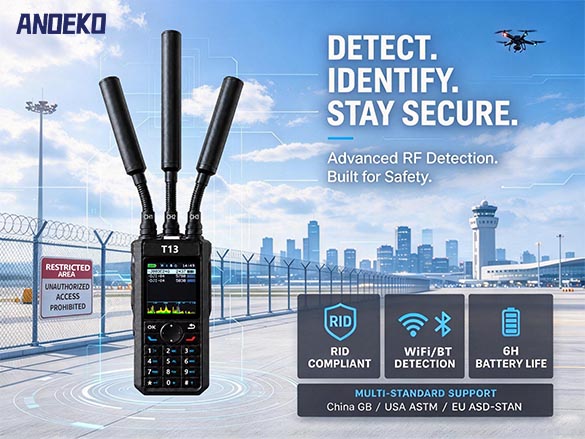
The ANOEKO‑T03 ultra‑wideband portable drone detector answers this call. Unlike conventional handheld scanners that merely indicate the presence of RF activity, the T03 employs a superheterodyne architecture to perform deep signal analysis across an unprecedented 70MHz‑8GHz frequency span. This is not a simple power‑meter; it is a sophisticated signal‑intelligence instrument engineered to decode the complex modulation schemes used by modern drones—from OFDM high‑definition video streams to analog FPV feeds—while maintaining complete radio silence.
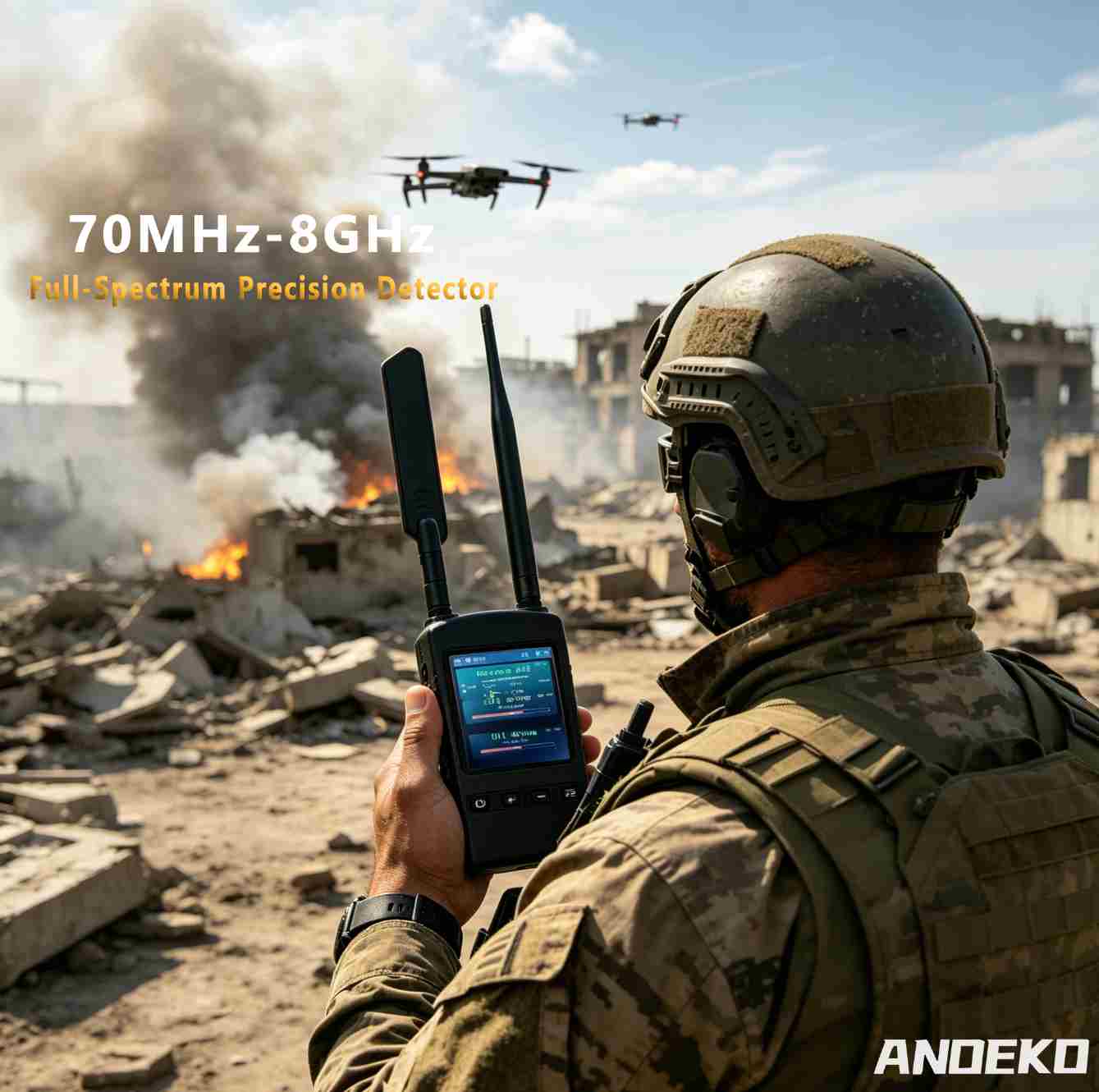
The core of the ANOEKO‑T03 is its superheterodyne receiver design—a time‑honored RF engineering principle elevated for the drone‑detection mission. Unlike direct‑conversion or zero‑IF architectures that can suffer from image rejection and dynamic range limitations, the superheterodyne approach converts incoming signals to a fixed intermediate frequency (IF) where filtering and amplification can be performed with exceptional selectivity and sensitivity.
This translates into tangible operational advantages:
Superior sensitivity – The T03 can detect weak drone signals that would be lost in the noise floor of simpler detectors, extending effective detection range in challenging urban environments.
Excellent selectivity – The architecture rejects out‑of‑band interference, ensuring that the device focuses on drone‑specific emissions rather than being overwhelmed by nearby Wi‑Fi, cellular, or broadcast signals.
Consistent performance – The fixed‑IF design provides stable gain and linearity across the entire 70MHz‑8GHz band, eliminating the performance swings that plague broadband direct‑sampling designs.
This is particularly critical when detecting OFDM (Orthogonal Frequency‑Division Multiplexing) signals—the modulation scheme used by DJI and Autel for their high‑definition video transmission links. OFDM signals are robust and spectrally efficient, but they are also subtle and easily masked. The T03’s superheterodyne front end, combined with advanced digital signal processing, extracts these signals from the noise floor with remarkable reliability.
Drone communications span a vast and growing range of frequencies:
2.4GHz band – Legacy control links and Wi‑Fi‑based telemetry
5.2GHz / 5.8GHz bands – High‑definition video downlinks for consumer and enterprise drones
900MHz band – Long‑range control for industrial and agricultural UAVs
1.2GHz / 1.3GHz bands – Analog video transmission favored by FPV racing pilots
70MHz‑400MHz lower bands – Emerging long‑range control frequencies used by custom‑built systems
The T03’s 70MHz‑8GHz coverage ensures that no drone—regardless of its communication protocol or frequency hopping strategy—can evade detection. This is not a device that covers “most” drone bands; it is a device that covers all drone bands currently in use, with headroom for future spectrum allocations.
The physical manifestation of this wideband capability is the T03’s dual‑antenna configuration—separate high‑frequency and low‑frequency antennas working in concert. This design serves two critical functions:
Simultaneous multi‑band scanning – While single‑antenna designs must time‑share between frequency bands, the T03’s dual‑channel architecture scans multiple bands concurrently, dramatically reducing the time required to complete a full spectrum sweep.
Direction finding with zero deviation – The dual‑antenna array, combined with phase‑comparison algorithms, provides accurate 360° direction‑of‑arrival information. Security operators can not only detect a drone but also point toward it—and toward its pilot—with confidence.
The result is fast detection, long detection distance, and a low false alarm rate. In practical terms, this means the T03 can identify a drone, determine its bearing, and alert the operator within seconds—all while maintaining a false‑positive rate that keeps security teams focused on genuine threats rather than chasing ghosts.
The drone ecosystem is bifurcated: at one end, sophisticated consumer platforms like DJI Mavic and Autel EVO transmit OFDM‑modulated high‑definition video; at the other, DIY racing drones and FPV craft rely on analog video links that are simpler but equally detectable.
The T03 is purpose‑built to handle both worlds:
For DJI and Autel drones, the device decodes the OFDM signals, extracting not just the presence of a drone but also its unique identifier, flight parameters, and real‑time location.
For DIY FPV drones, the T03 detects the analog video carriers—typically in the 5.8GHz band—providing early warning of racing drones that may be operating beyond visual line of sight.
This dual‑capability is essential because threat actors rarely constrain themselves to a single drone type. A sophisticated adversary may use a DJI drone for surveillance while deploying FPV craft for rapid, agile approaches. The T03 sees them all.
Remote ID (RID) is becoming a global standard for drone identification, but compliance is neither universal nor sufficient for security purposes. The T03 goes beyond RID by passively capturing the full flight data broadcast by RID‑enabled drones, including the pilot’s takeoff coordinates.
This is a game‑changer for law enforcement and security teams: when a drone is detected, the operator knows not only what the drone is doing but where the pilot is standing. The T03’s built‑in compass interface displays the pilot’s location relative to the operator, enabling rapid response that targets the source of the threat—not just the symptom.
In many security scenarios—surveillance of sensitive facilities, protection of VIP events, or investigation of organized drone‑smuggling networks—radio silence is paramount. The T03 supports a fully silent mode that disables audio and vibration alerts, allowing covert patrols that cannot be detected by drone operators.
This is not a minor feature. Drone pilots who suspect they are being tracked can alter their behavior, switch frequencies, or abort missions. The T03’s passive, silent operation ensures that the advantage remains with the defender.
Weighing just 320g and measuring 155×75×33mm, the T03 is designed for all‑day carry. The 8000mAh battery provides over 6 hours of continuous operation, and the universal Type‑C charging port enables rapid recharging in the field.
This is not a device that stays in the security office—it travels with the patrol, ready for deployment at a moment’s notice.
There is a fundamental principle that distinguishes the T03 from many other counter‑drone tools: it does not emit.
Active radar systems announce their presence. Jammers disrupt the electromagnetic environment. The T03 simply listens—passively, silently, invisibly.
This passive approach is not merely a technical choice; it is a strategic one. In the chess game of low‑altitude security, the side that reveals its capabilities first loses. The T03 enables defenders to gather intelligence, assess threats, and make decisions without ever alerting the adversary. It is the difference between playing defense and playing invisible defense—a philosophy that elevates security from reaction to anticipation.
The drone threat is not static. As commercial UAVs become more capable and adversary tactics more sophisticated, the tools used to counter them must evolve. The ANOEKO‑T03 represents a significant step forward in handheld drone detection—not through brute force, but through precision, breadth, and intelligence.
With its superheterodyne architecture, 70MHz‑8GHz coverage, dual‑antenna multi‑channel scanning, and silent operation, the T03 is purpose‑built for the realities of modern low‑altitude security. It detects the full spectrum of drone signals—from OFDM high‑definition video to analog FPV feeds—and provides operators with actionable intelligence that includes drone identity, pilot location, and real‑time bearing.
For security teams, event organizers, border patrols, and facility managers, the T03 offers a practical answer to a complex challenge: how to see the invisible threat, without becoming visible yourself.
Consultation Hotline
+86 18948793112
Email:lisen1205@foxmail.com
Mobile:+86 18948793112
WhatsApp:+86 18948793112
Address:Changchun North Road, Gongming Street, Guangming District, Shenzhen, China
Copyright © Copyright 2013 Anoeko Technology Co., Ltd. All Rights Reserved. | Anti-Drone & Low-Altitude Defense Experts ICP:ICP