Contact Us
|
WeChat
WeChat ID:842122368Scan to Connect
WeChat ID:842122368Scan to Connect

The past decade has witnessed an unprecedented proliferation of unmanned aerial vehicles (UAVs) across both civilian and military domains. From consumer photography and logistics delivery to border reconnaissance and precision strikes, drones have become deeply embedded in modern society. Yet this technological diffusion has a darker side: the surge of unauthorized "black flight" operations that threaten critical infrastructure, public events, and national security.
Recent incidents underscore the urgency of this challenge. In early 2025, a drone incursion at an Indian chemical park triggered a catastrophic explosion, resulting in significant casualties and economic losses. Along the Pakistan-India border, Pakistani边防 forces have repeatedly reported cross-border UAV reconnaissance missions that bypass conventional defense systems. These events expose a fundamental question: how can innovative technology build a reliable low-altitude defense barrier?
At the heart of every effective anti-drone system lies the RF power amplifier module – the component that determines whether a countermeasure succeeds or fails. This article explores how next-generation RF amplifier modules – powered by GaN and LDMOS technologies, wide bandwidth coverage, and AI-driven precision – are transforming the counter-UAS landscape.
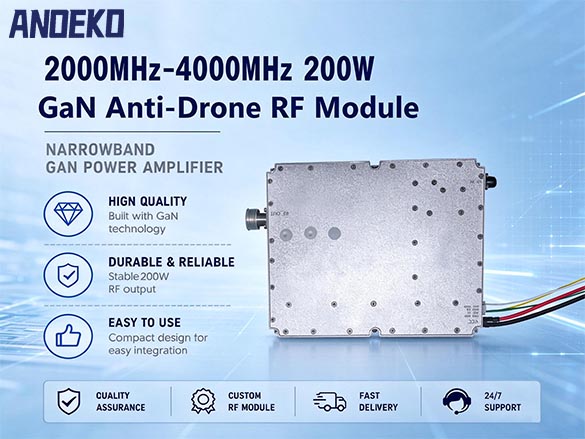
Anti-drone systems neutralize threats by disrupting, jamming, or hijacking the communication links between a drone and its operator. The RF power amplifier module serves as the heart of the signal transmission chain – its performance directly dictates the effectiveness of the entire countermeasure system.
Key capabilities enabled by advanced RF modules:
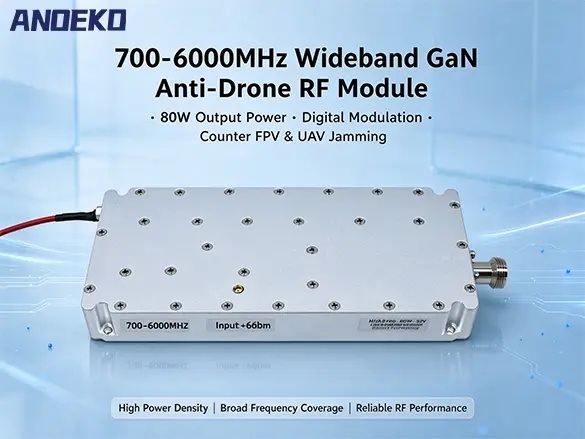
Power Enhancement: By amplifying RF signals, modern modules dramatically extend jamming range. For example, ANOEKO’s wide bandwidth modules can expand interference radius from 500 meters to over 2 kilometers – sufficient to protect airports, chemical parks, and military installations.
Frequency Coverage: High-performance modules support the 2.4GHz and 5.8GHz bands used by commercial drones, while also extending to military-grade frequencies for full-spectrum suppression. This makes them true wide bandwidth modules capable of countering diverse threats.
Dynamic Response: Integrated with AI algorithms, next-generation modules can identify drone models in real time and adapt jamming strategies on the fly – minimizing collateral disruption to civilian communications.
Early anti-drone systems suffered from two critical limitations:
Insufficient power: Unable to counter coordinated drone swarms
Narrow frequency bands: Easily defeated by frequency-hopping technologies
Today’s new anti-drone modules overcome these barriers through several groundbreaking innovations:
Gallium Nitride (GaN) Technology: Compared to traditional silicon-based modules, GaN anti-drone modules deliver up to 3x higher power density and 50% better heat dissipation, enabling sustained high-load operation in demanding environments. This makes GaN the material of choice for high anti-drone module applications requiring continuous, reliable performance.
LDMOS Alternatives: For applications where cost-effectiveness and proven reliability are paramount, LDMOS anti-drone modules offer a mature, field-tested solution with excellent linearity and ruggedness – particularly valuable in wide bandwidth, high-power scenarios.
Digital Pre-Distortion (DPD): This algorithmic technique compensates for signal distortion, ensuring that jamming signals precisely target the intended frequency bands – critical for customized anti-drone modules deployed in complex electromagnetic environments.
Modular Architecture: Modern designs support cascaded module configurations, allowing users to scale power output based on mission requirements – from portable manpack units to fixed-site installations.
In March 2025, Pakistani border forces deployed new UAV reconnaissance systems in the Kashmir region, conducting repeated incursions into Indian airspace. The Indian military responded with counter-drone systems equipped with advanced RF power amplifier modules.
According to official disclosures, the systems achieved:
10-second target identification through spectrum analysis
30-second jamming establishment with 200W output power cutting drone-ground links
Zero collateral interference with civilian communication networks
This engagement marked a pivotal shift from passive defense to active suppression – and drew global attention to the strategic value of high-performance RF amplifier modules in modern warfare.
Domestically, unauthorized drone flights pose grave risks to chemical parks, stadiums, and other high-density venues. In April 2025, an incident at a coastal chemical park demonstrated the effectiveness of RF-based countermeasures:
Directional jamming using phased-array antennas for precise targeting
Multi-band suppression simultaneously disrupting 2.4GHz (video transmission), 5.8GHz (data link), and GPS signals – forcing rogue drones to land
Similar deployments have become standard practice nationwide. During the Hangzhou Asian Games, public security forces deployed an integrated counter-drone network that intercepted over 20 unauthorized UAVs daily, ensuring event security. These systems relied on 100W anti-drone modules and wide bandwidth modules to maintain comprehensive airspace coverage.
Despite dramatic performance improvements, high-power RF modules face regulatory constraints. The EU’s CE certification, for instance, limits civilian EIRP to 36dBm, while military-grade modules can reach 50dBm. Bridging this gap – delivering high anti-drone module capability within compliance frameworks – remains a critical engineering challenge.
Most countries lack comprehensive frameworks for testing and deploying counter-UAS systems. India’s 2023 Drone Rules, for example, provide limited guidance on countermeasure equipment, slowing technology adoption.
End-users increasingly demand system-level solutions rather than standalone jammers. Leading providers now offer integrated platforms combining RF amplifier modules, radar detection, and electro-optical tracking – forming a complete “detect-identify-counter” loop.
Future modules will leverage machine learning to:
Self-optimize jamming strategies based on historical data
Coordinate across multiple devices to form “countermeasure swarms” against drone集群 attacks
In military contexts, RF technology is evolving beyond simple disruption. Systems like the U.S. military’s DRONE-DEFENDER now demonstrate signal hijacking capabilities – turning enemy drones into friendly assets.
As drone logistics, inspection, and urban air mobility expand, counter-UAS technology will transition from a security tool to critical infrastructure. The global low-altitude defense market is projected to exceed $50 billion by 2030, with RF power amplifier modules accounting for over 40% of that value.
From the battlefields of the India-Pakistan border to the chemical parks of coastal China, RF power amplifier modules are reshaping the low-altitude security landscape through raw technological power. Chinese companies – leveraging breakthroughs in GaN materials, LDMOS reliability, wide bandwidth design, and AI-driven optimization – are not only supporting national defense but also contributing a distinctive “China Solution” to global low-altitude governance.
As technology matures and regulatory frameworks evolve, anti-drone systems will transition from passive defense to proactive airspace management – ensuring the safety of every inch of low-altitude airspace. ANOEKO remains at the forefront of this transformation, delivering customized anti-drone modules, wide bandwidth solutions, and high-power RF amplifier modules that set the standard for next-generation counter-UAS performance.
Consultation Hotline
+86 18948793112
Email:lisen1205@foxmail.com
Mobile:+86 18948793112
WhatsApp:+86 18948793112
Address:Changchun North Road, Gongming Street, Guangming District, Shenzhen, China
Copyright © Copyright 2013 Anoeko Technology Co., Ltd. All Rights Reserved. | Anti-Drone & Low-Altitude Defense Experts ICP:ICP