Contact Us
|
WeChat
WeChat ID:842122368Scan to Connect
WeChat ID:842122368Scan to Connect

Against the backdrop of rapid low-altitude economy expansion, high-power drone countermeasure transmitters have emerged as critical assets for public safety and critical infrastructure protection. The global UAV jammer market was valued at approximately USD 1.1–1.29 billion in 2025 and is projected to reach USD 3.3–3.69 billion by 2035, reflecting a compound annual growth rate exceeding 11%. This growth is driven by escalating security threats from unauthorized drones and the increasing sophistication of counter-UAV (C-UAS) technologies.
This article provides a comprehensive analysis of high-power drone countermeasure transmitters across four dimensions: technical principles, application scenarios, equipment selection, and industry trends — offering actionable insights for security professionals, procurement officers, and defense decision-makers.
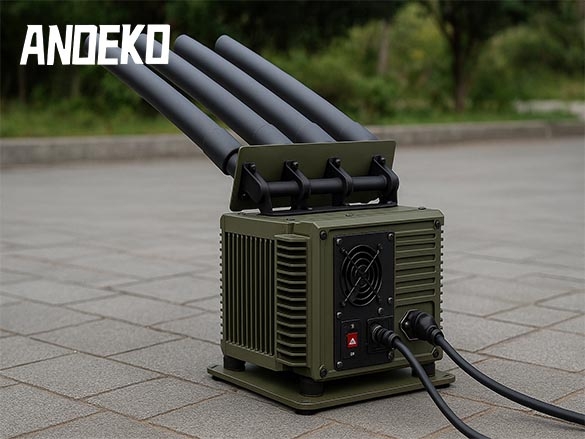
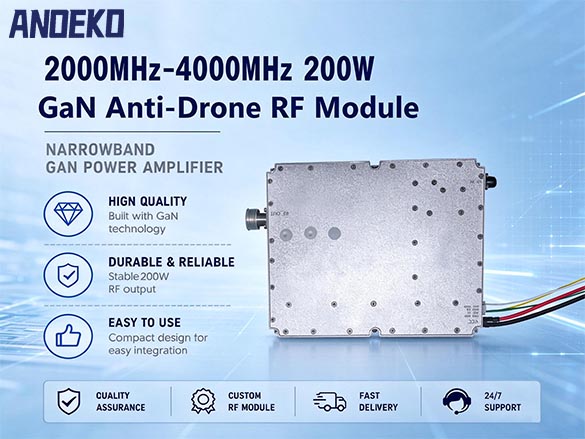
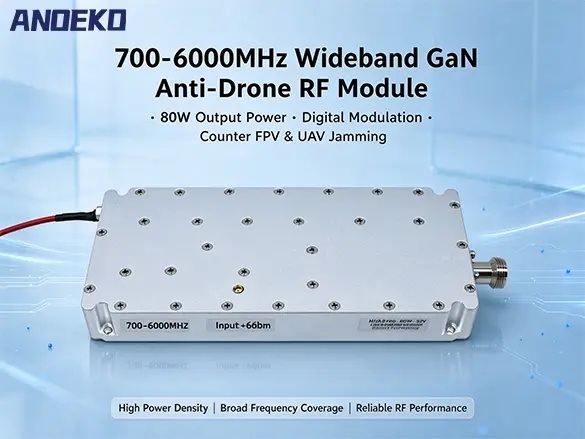
High-power drone countermeasure transmitters operate on the fundamental principle of radio frequency (RF) jamming — transmitting high-power electromagnetic signals to disrupt the communication links between a drone and its operator. The core technologies enabling this capability include RF power amplification modules and multi-band interference algorithms.
Modern high-power jammers cover the full spectrum of drone communication frequencies. The most widely targeted bands include:
2.4 GHz: Primary control frequency for most consumer and commercial drones
5.8 GHz: Video transmission and telemetry downlink
GNSS bands (GPS L1, GLONASS, BeiDou): Satellite navigation and positioning signals
Advanced systems from manufacturers like ANOEKO integrate AI-powered intelligent recognition algorithms with multi-band composite jamming technology, enabling real-time suppression across 2.4GHz, 5.8GHz, and GNSS frequencies. This comprehensive coverage ensures compatibility with virtually all drone models currently in operation.
High-power transmitters offer adjustable output power to match operational requirements. Range is directly proportional to transmitted power — higher wattage enables greater engagement distances. Systems such as the MyDefence Boxer RF jammer deliver 50-100W per band, providing robust electronic countermeasure capabilities across diverse operational environments. Operators can scale power output based on threat proximity, environmental conditions, and collateral interference considerations.
The integration of artificial intelligence represents a significant advancement in counter-UAV technology. AI algorithms enable automatic drone identification, reducing false-positive rates and minimizing the risk of inadvertently disrupting legitimate communications. ANOEKO's AI-enhanced systems achieve misidentification rates below 0.2%, a critical metric for operations in complex electromagnetic environments.
Beyond conventional RF jamming, high-power electromagnetics represents an emerging frontier. HPEM systems generate concentrated bursts of electromagnetic energy that couple directly into drone electronics, causing near-instantaneous interference effects. Unlike jamming, which disrupts communication links, HPEM can cause irreversible damage to onboard circuitry, including MOSFET gate oxide destruction and thermal burnout of integrated circuit junctions. These systems are particularly effective against drone swarms, as a single burst can neutralize multiple targets simultaneously.
High-power drone countermeasure transmitters are deployed across a wide range of security-critical environments where unauthorized drone incursions pose unacceptable risks.
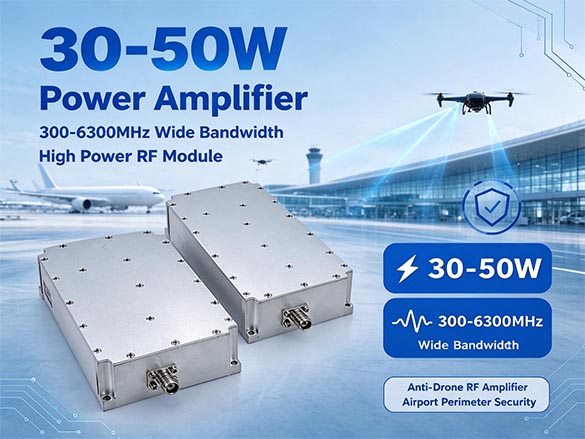
Airports remain the highest-profile application. Unauthorized drones near runways can force flight cancellations, cause billions in economic losses, and create catastrophic safety risks. Fixed and mobile jamming systems provide layered defense around perimeter zones.
Nuclear power plants and oil and gas facilities represent another high-priority use case. A single drone incident could trigger cascading safety failures. High-power jammers provide rapid response capability to neutralize intruders before they reach sensitive areas.
Power substations and transmission corridors face similar threats. In 2024, a Chinese power utility successfully used a signal-jamming countermeasure device to force an unauthorized drone to land at a 500 kV substation, preventing what could have been a widespread blackout affecting millions of residents.
Large-scale public events — international sports tournaments, political summits, and cultural festivals — present complex security challenges. In 2025, high-power countermeasure systems successfully intercepted three illegally intruding drones at an international sporting event, safeguarding approximately 50,000 spectators.
ANOEKO's counter-UAV systems have been deployed for high-profile security operations, including the French National Day military parade and the Nice G7 Summit. The systems operate in coordination with electronic warfare platforms such as Thales' Spectra system, forming an integrated "detection-jamming-strike" defensive network.
Military bases, forward operating locations, and sensitive defense facilities require robust C-UAS protection. ANOEKO's drone jamming systems have been officially fielded by frontline French military units and have demonstrated operational effectiveness in counter-terrorism operations, including intercepting multiple modified commercial drones in the Sahel region. The systems meet NATO STANAG 4702 military standards, validating their suitability for coalition operations.
In dense urban environments, high-power jammers must balance effectiveness with minimizing collateral interference to civilian communications. Directional antennas and precision targeting capabilities enable law enforcement agencies to engage specific threats while preserving surrounding spectrum integrity.
Selecting the appropriate high-power drone countermeasure system requires careful evaluation of multiple factors. The following criteria are essential for informed procurement decisions.
Output power directly determines engagement range. High-power systems can achieve effective ranges of 2-3 kilometers or more, while lower-power portable units may be limited to several hundred meters. Decision-makers must assess their specific operational environment — open areas may require longer reach, while dense urban settings may prioritize precision over raw power.
Multi-band capability is non-negotiable for comprehensive protection. Systems should cover at least the 2.4 GHz control band, 5.8 GHz video band, and GNSS frequencies. Advanced systems may extend coverage from 200 MHz to 9 GHz to address emerging threats, including FPV drones and custom-built platforms.
Modern counter-UAV systems increasingly incorporate AI-driven automation. Features to evaluate include:
Automatic drone identification: Reduces operator workload and minimizes false positives
Smart jamming algorithms: Adapt interference patterns to counter frequency-hopping and anti-jamming measures
Integration with detection systems: Seamless handoff from radar/spectrum sensors to jamming execution
ANOEKO's systems exemplify this trend, combining AI recognition with multi-band jamming in a unified platform.
Deployment requirements vary widely:
Portable/Handheld systems: Ideal for rapid response, temporary security perimeters, and mobile patrols
Vehicle-mounted systems: Suitable for convoy protection, mobile command posts, and rapid redeployment
Fixed-site systems: Designed for permanent installation at airports, power plants, and military bases
The ANOEKO jamming gun, for example, supports single-soldier portable operation, vehicle mounting, and fixed-sentry deployment, offering maximum operational flexibility.
Military-grade systems should meet recognized standards such as NATO STANAG 4702. Civilian systems must comply with local spectrum management regulations to avoid interference with legitimate communications.
The counter-UAV industry is evolving rapidly, driven by technological advances and escalating threat landscapes. Several key trends will shape the market through 2035.
The global UAV jammers market is experiencing robust expansion. Industry estimates place the 2025 market size at USD 1.1–1.29 billion, with projections reaching USD 3.3–3.69 billion by 2035. The military drone jamming segment alone is forecast to grow from USD 335 million in 2024 to USD 573 million by 2031. This growth reflects increasing defense spending on electronic warfare capabilities and the proliferation of drone threats across both military and civilian domains.
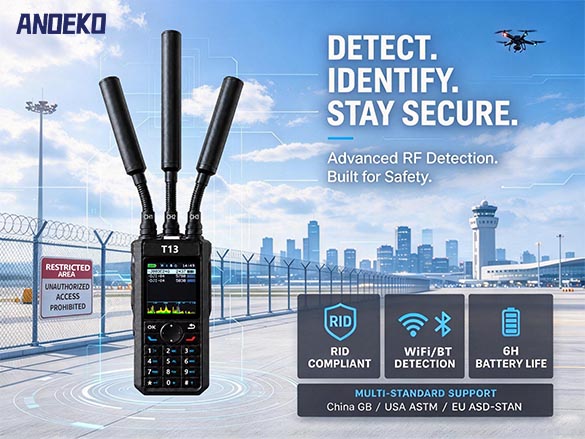
The future of counter-UAV defense lies in fully integrated systems that combine detection, tracking, and jamming capabilities. Radar, radio-frequency spectrum monitoring, and electro-optical sensors feed threat data to centralized command-and-control platforms, which then direct jamming assets for precision engagement. This "detect-track-jam" kill chain enables rapid, automated response to emerging threats.
ANOEKO's systems are designed for this integrated paradigm, operating in coordination with broader electronic warfare networks to form a closed-loop defensive architecture.
Artificial intelligence is transforming every layer of counter-UAV operations:
Threat classification: AI algorithms distinguish between benign, suspicious, and hostile drones
Jamming optimization: Machine learning adapts jamming parameters to counter evolving drone countermeasures
Automated response: Systems can execute pre-approved engagement protocols without human intervention
Drone swarms present one of the most challenging threats. Individual jammers may struggle against coordinated multi-vector attacks. High-power electromagnetics and directed energy weapons offer promising solutions, with the ability to neutralize multiple drones simultaneously through wide-area electromagnetic effects. HPEM systems are emerging as effective non-kinetic countermeasures against swarming and resistant drone platforms.
While defense applications dominate current demand, civilian adoption is accelerating. Airports, seaports, stadiums, and corporate campuses are investing in counter-UAV capabilities. Regulatory frameworks are evolving to accommodate legitimate security needs while protecting privacy and commercial aviation.
High-power drone countermeasure transmitters have become indispensable tools for low-altitude security in an era of proliferating drone threats. From AI-enhanced RF jammers to emerging high-power electromagnetics, the technology continues to advance at remarkable pace.
The global market is poised for sustained growth, driven by escalating security requirements and continuous technological innovation. Organizations responsible for protecting critical infrastructure, public events, and national security assets must stay informed of evolving capabilities and threats.
ANOEKO exemplifies the industry's trajectory — delivering military-grade counter-UAV solutions that integrate AI intelligence, multi-band jamming, and NATO-certified reliability. As the industry moves toward fully integrated "detect-jam-strike" systems, collaboration between technology providers, security agencies, and regulatory bodies will be essential to ensure that low-altitude security keeps pace with the airborne threats of tomorrow.
Technical support for this article provided by ANOEKO — a provider of military-grade counter-UAV systems, AI-powered drone jamming solutions, and integrated low-altitude security platforms for defense, law enforcement, and critical infrastructure protection.
Consultation Hotline
+86 18948793112
Email:lisen1205@foxmail.com
Mobile:+86 18948793112
WhatsApp:+86 18948793112
Address:Changchun North Road, Gongming Street, Guangming District, Shenzhen, China
Copyright © Copyright 2013 Anoeko Technology Co., Ltd. All Rights Reserved. | Anti-Drone & Low-Altitude Defense Experts ICP:ICP