Contact Us
|
WeChat
WeChat ID:842122368Scan to Connect
WeChat ID:842122368Scan to Connect

For decades, silicon has been the backbone of power electronics and RF amplification. It is mature, inexpensive, and well-understood. But as the demands of modern defense, communications, and counter-UAS applications continue to escalate, silicon's fundamental physical limitations have become increasingly apparent.
Enter gallium nitride (GaN) – a wide-bandgap semiconductor that has rapidly transformed the landscape of high-power RF amplification. Today, GaN anti-drone modules are setting new benchmarks for performance, efficiency, and reliability, outperforming traditional silicon-based designs in virtually every meaningful metric.
For system integrators, defense contractors, and security professionals evaluating RF Amplifier Modules for counter-UAS applications, understanding the advantages of GaN over silicon is no longer optional – it is essential. This article examines the key technical differentiators that make GaN the material of choice for next-generation high anti-drone module designs.
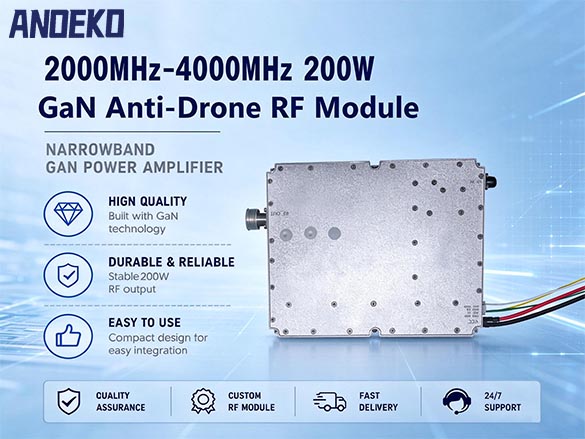
One of the most significant advantages of GaN over silicon is its superior breakdown electric field. The breakdown field is the maximum electric field strength a material can withstand before it breaks down and fails. GaN's breakdown field is substantially higher than that of silicon – roughly ten times greater, in fact.
This translates directly into practical benefits for New anti-drone module designs:
Higher voltage operation: GaN devices can handle much higher voltages than silicon devices of the same size, making them ideal for high-power applications such as 100W anti-drone module designs where silicon would require multiple devices in series.
Smaller device footprint: For the same voltage rating, GaN components can be significantly smaller than their silicon counterparts. This enables more compact system designs – a critical advantage in portable and vehicle-mounted counter-UAS platforms.
Reduced component count: The ability to operate at higher voltages means fewer devices are needed in series, simplifying circuit design and improving overall system reliability.
In practical terms, this means that a Customized anti-drone module built with GaN can achieve higher power output in a smaller form factor than an equivalent silicon-based module – a crucial advantage for field-deployable systems where size and weight are at a premium.
Electron mobility refers to how quickly electrons can move through a material under an electric field. GaN exhibits exceptionally high electron mobility – significantly higher than silicon.
This characteristic has profound implications for RF and power switching applications:
Faster switching speeds: The high electron mobility in GaN enables devices to switch on and off much more rapidly than silicon-based equivalents. This translates directly into reduced switching losses and improved efficiency.
Lower switching losses: Every time a transistor switches, energy is lost as heat. Faster switching means less time spent in the transition region, dramatically reducing power dissipation.
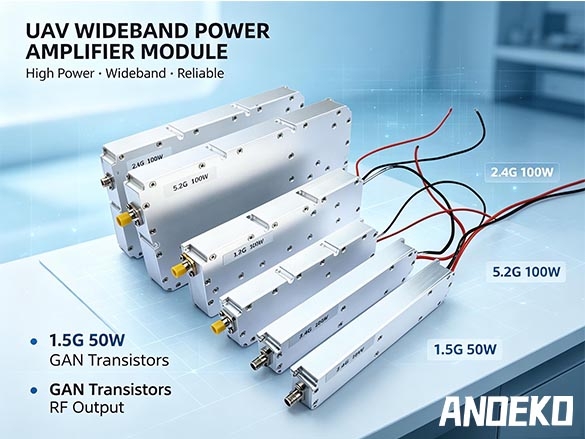
Higher frequency operation: GaN devices can operate effectively at much higher frequencies than silicon, making them ideal for Wide Bandwidth Module designs that require broadband coverage from 300MHz through 6GHz.
In the context of counter-UAS systems, this means that GaN-based RF Amplifier Modules can respond more quickly to emerging threats, cover a wider range of frequencies, and do so with greater efficiency – all of which are critical for effective drone detection and jamming.
On-resistance (Rds(on)) is the resistance of a device when it is in the conducting state. Lower on-resistance means less energy is dissipated as heat when current flows through the device.
GaN devices have significantly lower on-resistance than silicon devices of comparable voltage rating. This translates directly into:
Higher power conversion efficiency: Less energy wasted as heat means more of the input power is delivered to the load – a critical consideration for battery-powered portable systems where every watt counts.
Reduced thermal management requirements: Lower heat generation means smaller heatsinks, simpler cooling designs, and improved reliability in demanding environments.
Higher power density: The combination of lower on-resistance and smaller device size enables GaN modules to deliver more power per unit volume – a key metric for High anti-drone module designs where output power is paramount.
For a 100W anti-drone module, this efficiency advantage is particularly significant. A silicon-based amplifier might require extensive cooling to manage thermal losses, while a GaN-based alternative can deliver the same output power with substantially less heat generation – enabling more compact, lighter, and more reliable systems.
The combination of high electron mobility and low parasitic capacitance gives GaN devices exceptional performance at high frequencies. While silicon devices struggle to maintain efficiency and gain above a few gigahertz, GaN remains effective well into the millimeter-wave spectrum.
This high-frequency capability is essential for Wide Bandwidth Module designs that must cover the full range of drone communication frequencies – from the 2.4GHz and 5.8GHz bands used by consumer drones, through the 900MHz and 1.2GHz bands favored by FPV racing and custom-built systems, and beyond.
In radar applications, GaN-based amplifiers enable higher resolution and longer detection ranges – a direct benefit for C-UAS systems that need to detect and track small, fast-moving targets at extended distances.
GaN's wide bandgap gives it excellent thermal stability. GaN devices can operate at much higher junction temperatures than silicon devices without degrading performance or reliability.
This thermal advantage translates into several practical benefits:
Wider operating temperature range: GaN modules can function reliably in extreme environments where silicon devices would fail – including the -40°C to +85°C range common in outdoor and military deployments.
Simplified cooling requirements: Reduced heat generation and higher temperature tolerance mean less reliance on complex cooling systems.
Improved long-term reliability: Lower operating temperatures and reduced thermal stress contribute to longer device lifetimes and more consistent performance over time.
For field-deployed anti-drone systems, this thermal robustness is invaluable. A Customized anti-drone module built with GaN can be deployed in desert heat, arctic cold, or high-altitude environments without the performance degradation that would plague silicon-based alternatives.
One of the most compelling advantages of GaN technology for counter-UAS applications is its ability to support wide bandwidth module designs that cover the entire spectrum of drone communication frequencies.
Modern drones use a diverse array of frequencies and protocols:
2.4GHz – Control links and Wi-Fi-based telemetry
5.2GHz / 5.8GHz – High-definition video downlinks
900MHz – Long-range control for industrial and agricultural UAVs
1.2GHz / 1.3GHz – Analog video for FPV racing drones
70MHz-400MHz – Emerging long-range control frequencies
A GaN-based RF Amplifier Module can deliver consistent gain and efficiency across this entire range, enabling a single amplifier to address multiple threat types without the need for band-specific modules.
The advantages of GaN over silicon translate directly into real-world performance improvements for anti-drone systems:
| Aspect | Silicon-Based Module | GaN-Based Module (ANOEKO) |
|---|---|---|
| Power Output | Limited by thermal and voltage constraints | Higher power in same form factor |
| Efficiency | Lower, more heat | Higher, less heat |
| Frequency Range | Narrow, band-limited | Wide bandwidth coverage |
| Thermal Performance | Requires active cooling | Passive cooling often sufficient |
| Size | Larger for same power | Smaller, lighter |
| Reliability | Degrades at high temperature | Stable across wide temperature range |
ANOEKO has fully embraced GaN technology across its product line, recognizing that the future of counter-UAS systems demands the superior performance that only GaN can deliver.
Whether you need a 100W anti-drone module for fixed-site protection, a high anti-drone module for vehicle-mounted applications, or a customized anti-drone module tailored to your specific frequency and power requirements, ANOEKO's GaN-based designs offer the performance, reliability, and efficiency that modern defense and security applications demand.
As a new anti-drone module designed for the challenges of tomorrow's battlefield, ANOEKO's GaN solutions represent a significant step forward in low-altitude security technology – delivering the power, bandwidth, and reliability needed to counter evolving drone threats effectively.
The technical advantages of GaN over silicon are substantial and well-documented. Higher breakdown voltage enables smaller, more powerful designs. Higher electron mobility delivers faster switching and lower losses. Lower on-resistance means higher efficiency and less heat. Superior high-frequency performance enables wide bandwidth coverage. And exceptional thermal stability ensures reliable operation in extreme conditions.
For system integrators and security professionals evaluating RF Amplifier Modules for counter-UAS applications, the choice is increasingly clear: GaN-based GaN anti-drone modules offer superior performance, greater reliability, and better value than traditional silicon-based alternatives.
ANOEKO's commitment to GaN technology ensures that its wide bandwidth modules and customized anti-drone modules deliver the performance that modern counter-UAS systems demand – making ANOEKO the partner of choice for next-generation low-altitude security solutions.
For more information on ANOEKO's GaN-based anti-drone modules and RF amplifier solutions, contact our technical team for a consultation tailored to your specific requirements.
Consultation Hotline
+86 18948793112
Email:lisen1205@foxmail.com
Mobile:+86 18948793112
WhatsApp:+86 18948793112
Address:Changchun North Road, Gongming Street, Guangming District, Shenzhen, China
Copyright © Copyright 2013 Anoeko Technology Co., Ltd. All Rights Reserved. | Anti-Drone & Low-Altitude Defense Experts ICP:ICP