Contact Us
|
WeChat
WeChat ID:842122368Scan to Connect
WeChat ID:842122368Scan to Connect

The global counter-unmanned aircraft systems (C-UAS) market is experiencing unprecedented growth. Industry forecasts now estimate the market could expand from roughly $6.6 billion in 2025 to more than **$20 billion by 2030**, reflecting one of the fastest expansion rates in defense technology. The anti-drone market alone is projected to reach $3.73 billion in 2026, continuing at a compound annual growth rate of 27.62%. This explosive growth is driven by a fundamental structural shift: the offense has become cheap, distributed, and adaptive — so defense has had to become layered, sensor-fused, and cost-effective.
The proliferation of commercial drones across logistics, surveying, agriculture, and entertainment has brought immense economic benefits — China's low-altitude economy is projected to exceed 1 trillion yuan in 2026. Yet this same accessibility has enabled a parallel rise in "black flight" intrusions, privacy violations, airport disruptions, and even terrorist threats. Traditional air defense systems struggle against Low, Slow, and Small (LSS) targets — drones with radar cross-sections as small as 0.01–0.1 square meters that fly at low altitudes and slow speeds, often indistinguishable from birds or ground clutter.
Against this backdrop, the 7-inch rocket FPV (First-Person View) interceptor drone has emerged as a game-changing physical interception solution. Representing a paradigm shift from passive electronic jamming to active precision hard-kill engagement, these specialized aircraft are rewriting the economics of counter-drone warfare.
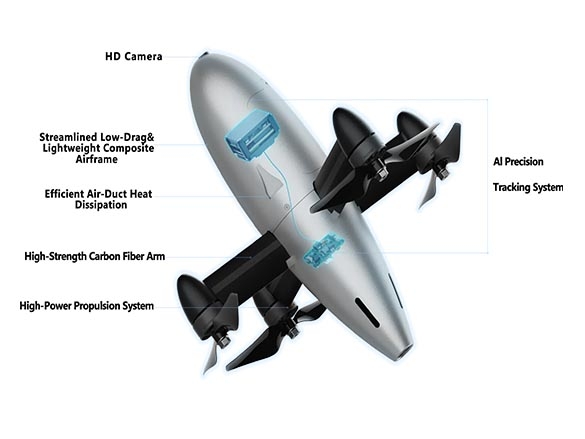
The 7-inch rocket FPV interceptor is not a modified consumer drone. It is a purpose-built kinetic effector engineered around two core design pillars: extreme speed and payload capacity.
Propulsion and Power Architecture:
These interceptors employ high-KV brushless motors paired with high-discharge-rate lithium batteries and lightweight carbon fiber frames, achieving exceptional thrust-to-weight ratios. Top speeds can exceed 400 km/h, enabling rapid closure from standstill to intercept velocity within seconds — ensuring engagement before a target penetrates sensitive airspace. Recent combat-proven variants like the Kolibri 7-inch FPV drone have been codified and approved for use by the Defense Forces of Ukraine, with NATO Stock Numbers assigned.
Payload Systems: Hard-Kill and Soft-Kill Options:
For counter-drone missions, 7-inch interceptors integrate miniaturized warheads or net-launching apparatus:
Directional fragmentation — precisely damaging target propellers and motors
Kinetic collision — utilizing high-speed impact energy to disable target flight surfaces
Net entanglement — deploying capture nets to wrap enemy rotors, enabling "soft-kill" forced landing
This modular approach reduces collateral damage while maintaining lethal effectiveness, making these systems particularly suitable for urban environments where safety margins are critical.
Flight Control and AI-Powered Autonomous Tracking:
The flight control system is optimized with specialized algorithms, incorporating vision-based recognition and RF-signal-guided automatic tracking modules. These systems maintain stable attitude control and trajectory prediction even in high-electromagnetic-interference environments. As noted in recent C-UAS briefings, over 30 new types of counter-UAS interceptor drones were launched in the first three months of 2026 alone, with increasing performance capabilities.
Effective counter-drone defense requires the coordinated operation of two complementary technical paths: electronic warfare (soft-kill) and physical interception (hard-kill) .
Electronic Warfare — The First Line of Defense:
Electronic countermeasures serve as the initial shield, leveraging RF spectrum analyzers and omnidirectional jamming antennas to detect and disrupt common communication bands (2.4GHz, 5.8GHz) and navigation signals. This enables early warning and, through high-power noise transmission or navigation spoofing, can force drones to deviate from their intended courses.
However, electronic warfare has inherent limitations — particularly against fiber-optic tethered drones or those with autonomous flight programs and advanced anti-jamming capabilities. As one industry analysis notes, "fiber-optic FPV drones have virtually wiped out the effectiveness of traditional electronic warfare systems."
Physical Interception — The Ultimate Guarantee:
When electronic countermeasures fail, physical interception becomes the last line of defense. The 7-inch rocket interceptor serves as the core execution unit in this layer. As demonstrated by systems like ParaZero's DefendAir net launcher, physical interception achieves 100% success rates against fast incoming FPV drone threats in live demonstrations.
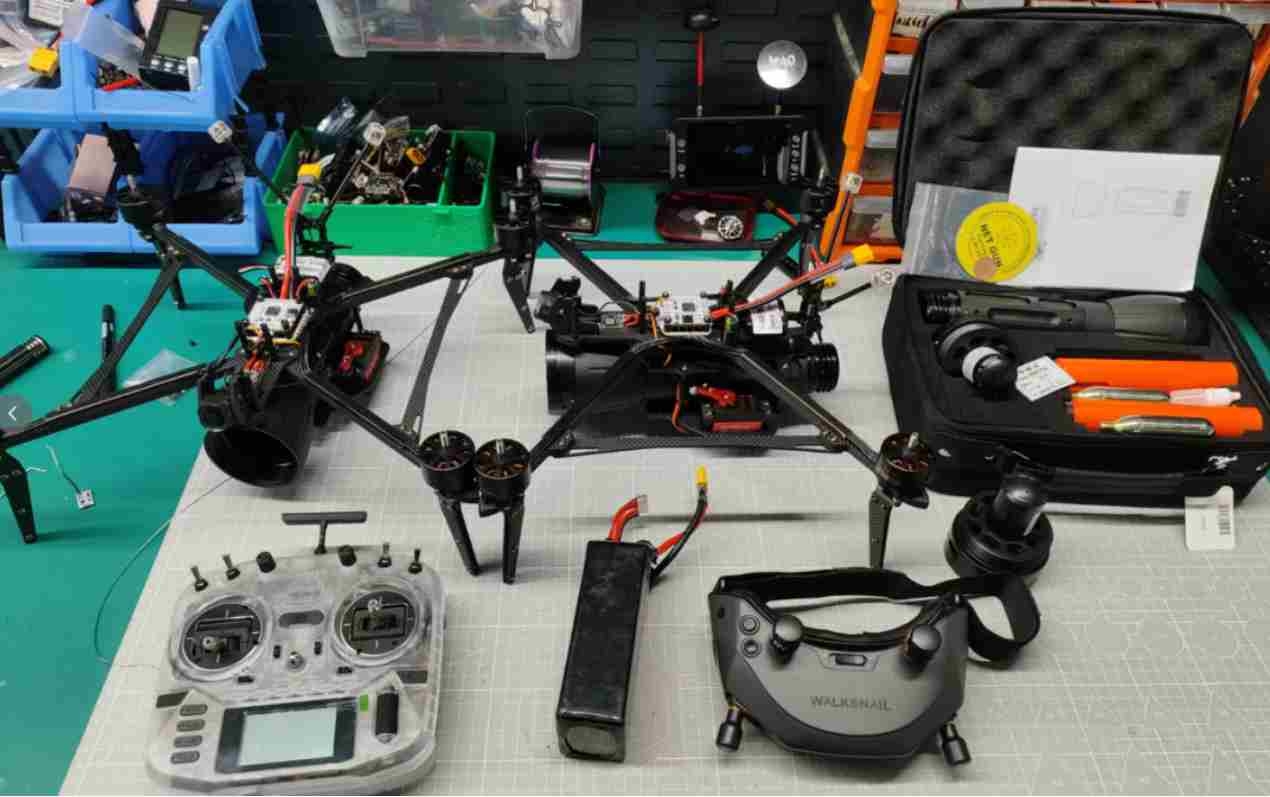
Modern counter-UAS systems operate through a rigorous closed-loop process:
| Phase | Core Task | Key Technologies |
|---|---|---|
| Detection & Identification | Multi-dimensional sensing network using radar, electro-optical sensors, and RF monitoring — distinguishing birds from drones and determining friend-or-foe status | Low-altitude surveillance radar, spectrum detection, optical recognition |
| Tracking & Localization | Multi-sensor data fusion calculating target coordinates, velocity, and heading — transmitting to command center in real time | Sensor fusion, TDOA positioning |
| Decision & Engagement | Automated threat-level assessment — low-risk targets receive electronic suppression; high-risk, jam-resistant targets trigger 7-inch interceptor launch with real-time trajectory optimization | AI threat assessment, intelligent dispatch |
| Battle Damage Assessment | Impact evaluation and mission reporting | Image recognition, data analytics |
The entire process can be completed in minutes or even seconds — a critical capability when engaging high-speed FPV attack drones.
Traditional laser and microwave counter-drone systems cost anywhere from $1 million to $5 million per unit, requiring specialized technical teams and months of training. By contrast, new-generation AI-powered rocket interceptors achieve per-unit costs in the thousand-dollar range with minimal operator training requirements.
This economics solves the long-standing "million-dollar missile vs. thousand-dollar drone" cost-exchange ratio dilemma that has plagued conventional air defense. As the C-UAS sector moves beyond "single threat, single tool" approaches, scalable hard-kill capabilities are becoming standard procurement items.
7-inch rocket interceptors offer rapid response times and flexible deployment options — fixed installation around critical infrastructure, vehicle-mounted mobility, or man-portable configurations. This versatility enables the creation of layered, three-dimensional low-altitude protection networks.
Drone-on-drone collision engagement represents the state-of-the-art in kinetic counter-UAS. Systems like the Bumblebee V2 are specifically designed to physically intercept and neutralize hostile small unmanned aircraft systems through direct engagement. Interceptor drones can contend with FPV threats that simply cannot be electronically jammed.
Domestic Critical Infrastructure Protection:
Remote base stations, energy mining sites, unattended industrial parks, border outposts, and isolated vital facilities
These locations have low population density and open airspace — minimizing secondary damage risks from downed drones
Primary threats: high-speed black-flight FPV drones conducting surveillance, intrusion, or disruption
International Military and Security Operations:
Overseas military outposts, field camps, overseas engineering sites, border defense positions
Core requirements: low cost, batch producibility, hard-kill capability, effective high-speed FPV drone interception
The convergence of artificial intelligence and swarm control technologies is driving counter-UAS systems toward intelligent, coordinated architectures.
Autonomous Decision-Making Enhancement:
Future 7-inch interceptors will possess stronger autonomous decision capabilities, coordinating in drone swarms to counter large UAV formations. AI is becoming a cumulative force multiplier across anti-drone systems — improving object classification, reducing false alarms, correlating radar, RF, EO/IR, and acoustic data, while supporting faster operator decision-making.
Edge Computing Integration:
On-device AI processing will enable complex image recognition and trajectory prediction at the edge, further compressing reaction times. Systems like the Svarog pro air defense drone, outfitted with AI-assisted final guidance, are already undergoing combat testing.
Non-Lethal Technology Expansion:
Advances in net-based capture will expand applications into law enforcement evidence collection, biological sampling, and other civilian domains — broadening the utility of interceptor platforms beyond pure military applications.
As the counter-UAS sector transitions from experimental prototypes to real infrastructure, the 7-inch rocket FPV interceptor drone stands at the forefront of a new defense paradigm. By combining low-cost producibility, extreme maneuverability, and hard-kill reliability, these systems provide the physical interception layer essential to any layered C-UAS architecture.
Anliton, a specialist in low-altitude defense systems, exemplifies this integrated approach — combining radar detection, RF spectrum monitoring, electro-optical identification, and AI-powered decision-making into comprehensive counter-drone solutions. The company's TDOA-based urban grid management system and "four-dimensional detection" architecture (radar + RF + EO/IR + acoustic) demonstrate the multi-technology fusion essential for effective low-altitude security.
The continuous refinement of low-altitude security defense systems will provide the solid technological foundation for a safe and orderly low-altitude economy — ensuring that drone industries can scale within regulatory frameworks while safeguarding public safety. In the words of the industry's emerging consensus: no security, no low-altitude economy.
Consultation Hotline
+86 18948793112
Email:lisen1205@foxmail.com
Mobile:+86 18948793112
WhatsApp:+86 18948793112
Address:Changchun North Road, Gongming Street, Guangming District, Shenzhen, China
Copyright © Copyright 2013 Anoeko Technology Co., Ltd. All Rights Reserved. | Anti-Drone & Low-Altitude Defense Experts ICP:ICP