Contact Us
|
WeChat
WeChat ID:842122368Scan to Connect
WeChat ID:842122368Scan to Connect

Evolving Drone Threats & Comprehensive Guide to Modern Counter Drone Solutions Powered by ANOEKO C-UAS Technology
As consumer and military UAV technology evolves at an unprecedented speed, counter drone detection and mitigation have become a core strategic priority for global air defense and urban security teams. Large-scale drone swarm deployments in regional conflicts, coupled with surging illegal civilian drone “black flights,” have drastically elevated low-altitude aerial risks, making mature C-UAS (Counter Unmanned Aircraft System) infrastructure a mandatory investment for governments, airports, industrial facilities and event organizers worldwide.
Industry forecasts indicate the global drone market will surpass $100 billion in 2025, while unauthorized drone intrusion incidents targeting high-value sites rise at an annual rate of nearly 70%. By 2026, unmanned aerial vehicles and counter drone detection systems will maintain a continuous “spear-and-shield” technological arms race. To address this fast-growing security demand, this article breaks down mainstream drone detection sensors, soft/hard kill countermeasure methods, real-world deployment scenarios and future industry trends, with a focus on full-spectrum ANOEKO passive wireless drone detection and anti-drone product portfolios.
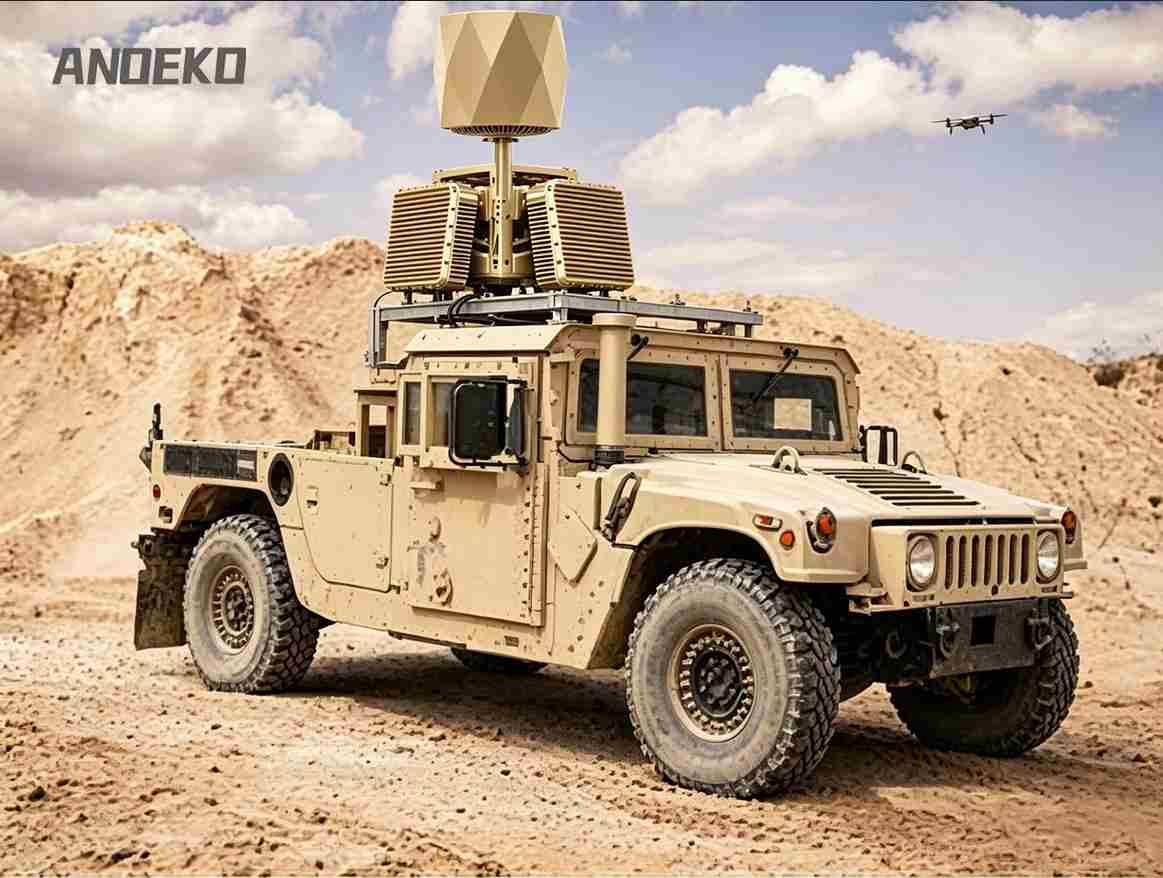
1. Core Detection Technologies: The Eyes & Ears of Any Counter Drone Detection System
Reliable target identification serves as the first line of defense for all C-UAS platforms. Current mainstream drone detection hardware includes RF spectrum analyzers, 2D/3D radar, electro-optical/infrared cameras and acoustic sensors. Faced with the industry-wide shift toward miniaturized, swarm-capable and low-observable drones, single-mode detection equipment can no longer deliver comprehensive coverage. Multi-source fused sensing architectures have become the gold standard for professional passive drone signal detector deployments.
1.1 RF Spectrum Monitoring & Radio Frequency Analyzers
RF spectrum sensors capture wireless communication signals between drones and ground controllers to extract real-time positioning data, delivering cost-effective multi-target tracking capabilities. This all-band drone detector works efficiently for most consumer UAVs including DJI and Autel models, yet struggles to track drones operating on pure inertial navigation without radio transmissions.
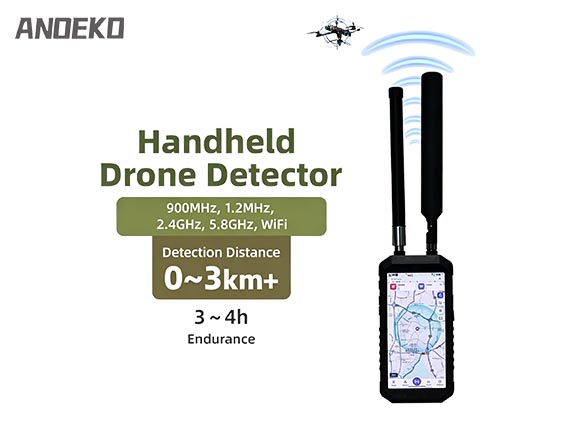
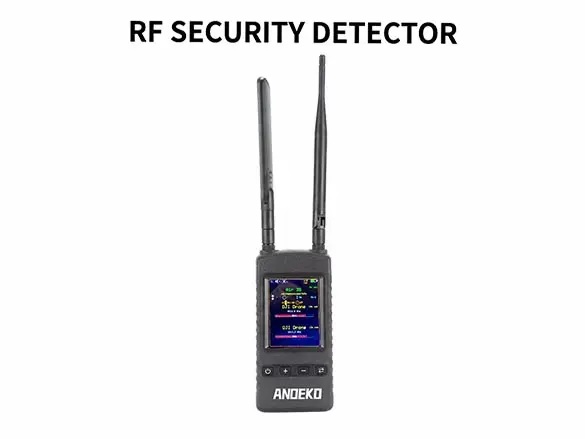
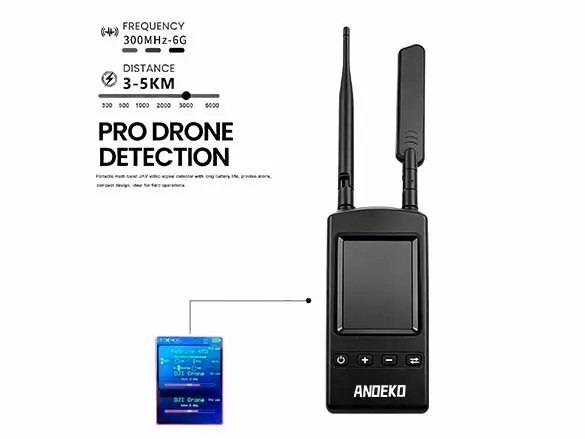
ANOEKO integrates multi-band RF receiving modules across its product lineup, including the AOK-T3 RID Handheld Drone Detector, a portable FPV drone detector that covers 300MHz–6000MHz full spectrum to instantly lock drone RF signals and pilot coordinates for rapid threat response.
1.2 Radar Detection: The Primary Sensor for Low-Small-Slow UAV Targets
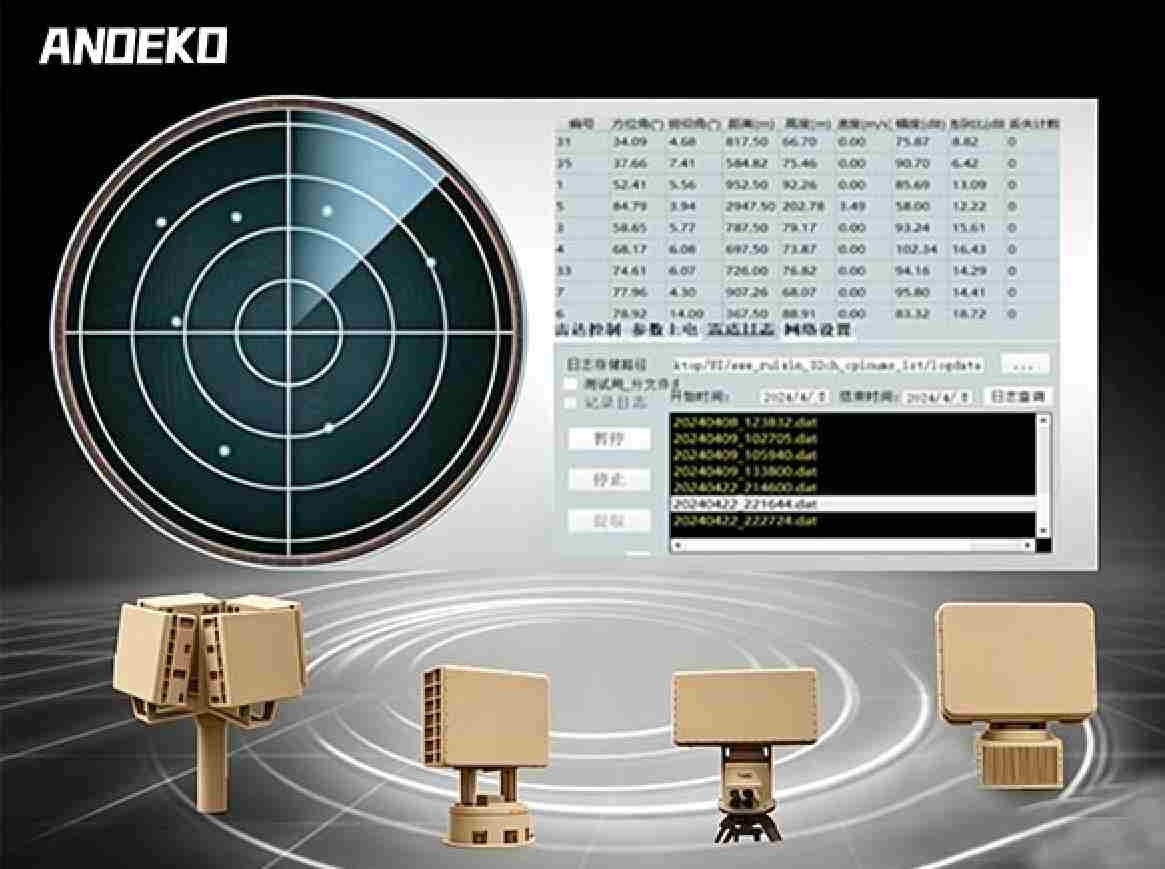
Radar systems remain irreplaceable for tracking low, slow, small drones with tiny radar cross-section (RCS) signatures. Basic 2D radar provides horizontal positioning only, while 3D phased array radar adds vertical altitude tracking to eliminate blind zones.
ANOEKO’s AOK-L02 phased array counter drone radar adopts electronic beam scanning on both horizontal and vertical axes, supporting parallel multi-task processing and simultaneous tracking of hundreds of swarm drones with strong anti-saturation attack performance. It delivers a 5km maximum detection radius and can identify palm-sized micro-UAVs with 0.2-meter positioning accuracy.
To resolve clutter interference in complex urban environments, ANOEKO built its proprietary SkyNet perception platform, a multi-sensor fusion Passive Wireless Drone Detection System combining four core detection layers:
1. Multi-band RF analyzers for drone and pilot localization (5km detection range)
2. ANOEKO phased array radar for full-time low-altitude swarm tracking
3. IR-visible dual-mode optical cameras with over 95% identification rate in zero-light conditions
4. Acoustic sensor arrays to detect silent autonomous drones without RF emissions
1.3 Electro-Optical, Infrared & Acoustic Detection Sensors
EO/IR cameras deliver high-definition visual evidence for close-range drone identification, yet performance drops drastically under heavy fog, rain or poor lighting. ANOEKO’s multi-spectral imaging module combines thermal infrared hardware with deep learning AI vision algorithms, retaining above 95% recognition accuracy even in hazy weather.
Acoustic sensors calculate drone bearing via engine noise capture, ideal for detecting RF-silent autonomous drones, though background urban noise severely weakens detection precision. ANOEKO integrates acoustic sensing into its full-site C-UAS defense network to fill blind spots left by RF and radar equipment.
2. Two Major Counter Drone Mitigation Routes: Soft Kill vs Hard Kill
After detection and classification, modern counter drone detection systems deploy two distinct intervention frameworks: non-destructive soft kill suppression and destructive hard kill neutralization. ANOEKO develops integrated defense hardware covering both categories to match diverse security scenarios.
2.1 Soft Kill Countermeasures (Low Collateral Damage for Civilian Sites)
Soft kill solutions dominate airport drone detection, city security and critical infrastructure protection thanks to low operational risks and minimal secondary damage.
1. RF Communication Jamming
The most widely adopted anti-drone technology, RF jammers transmit high-power signals on 2.4GHz, 5.8GHz and GNSS bands to sever drone remote control and video downlink channels, triggering automatic return-to-home or forced landing safety protocols.
ANOEKO Thunderstorm electronic suppression system uses GaN power amplifiers to reach 200W total jamming power, far exceeding the 60W industry average. Its proprietary frequency hopping tracking jamming technology neutralizes anti-jamming commercial drones, with directional high-gain antennas supporting 1–5km precision suppression across 12 full frequency bands.

2. GNSS Navigation Spoofing
A sophisticated stealth soft kill tactic that broadcasts fake GPS, Beidou and GLONASS signals to hijack drone positioning receivers and redirect UAVs to designated safe landing zones. ANOEKO’s tri-mode navigation spoofing module delivers over 500-meter diversion offset and has been widely deployed at petrochemical and nuclear power facilities.
3. Network Protocol Hijacking
This high-tech method cracks encrypted drone communication links to seize flight control authority remotely. ANOEKO Shadow protocol hijacking platform successfully decrypts DJI AES-256 encrypted transmission channels for authorized law enforcement traceability operations.
2.2 Hard Kill Countermeasures (High Destructive Power for Military & High-Threat Zones)
Hard kill systems deliver immediate physical neutralization and serve battlefield and military base defense missions, despite higher costs and potential collateral risks.
- High-Energy Laser Weapons: ANOEKO Blade 30kW vehicle-mounted laser interceptor destroys 500g-class drones in only 2.3 seconds via thermal ablation of core flight components. Performance is limited by heavy rain, fog and dust.
- High-Power Microwave (HPM) Weapons: ANOEKO Zeus microwave gun emits narrow 5° directional electromagnetic pulses to fry swarm drone circuit boards, boosting cluster suppression efficiency by 90% within a 3km effective radius.
- Counter-Drone Interceptor UAVs: ANOEKO swarm countermeasure drones carry EMP warheads to neutralize mass UAV swarms, though kinetic interception creates higher deployment costs and site safety hazards.
2.3 ANOEKO Closed-Loop C-UAS Defense Architecture
Leading industry development trends favor soft-hard kill collaborative linkage. ANOEKO’s three-stage closed-loop defense system completes full “detection – identification – neutralization” workflows with a response time under 0.5 seconds. Built-in AI threat grading automatically matches intervention tactics: visual warning flashes for non-cooperative low-risk drones, navigation spoofing for unauthorized civilian UAVs, and laser hard kill for hostile attack drones.
3. Global Deployment Scenarios for Counter Drone Detection Equipment
The application scope of C-UAS hardware expands rapidly across military, civil aviation, energy and urban low-altitude management sectors, with ANOEKO solutions covering all vertical market demands:
1. Military Base & Combat Zone Defense
Distributed ANOEKO sensor networks achieve 97.6% interception success rate against multi-unit drone swarm assaults, supporting ground troop anti-UAV battlefield protection.
2. Airport Drone Detection & Airspace Protection
Customized ANOEKO early warning systems eliminate illegal drone incursions into runway clear zones to prevent flight safety disasters. For large sports tournaments, concerts and summits, ANOEKO portable drone signal detector hardware locates pilots and triggers forced landings to build dual warning/interception buffer zones.
3. Critical National Infrastructure Security
Nuclear power plants, oil refineries and government compounds adopt ANOEKO 10km-radius 3D aerial monitoring networks; navigation spoofing modules are officially recommended in petrochemical industry security upgrade guidelines.
4. Smart City & Low-Altitude Economy Regulation
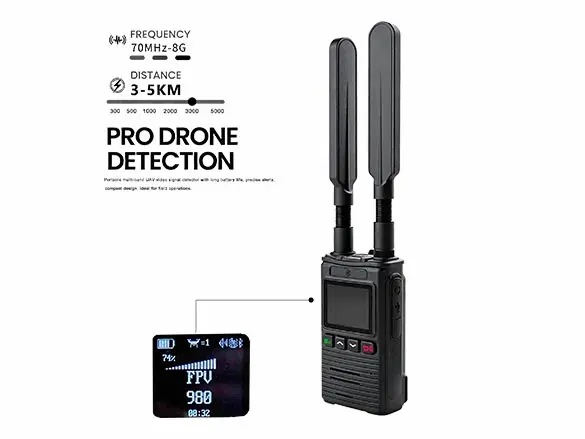
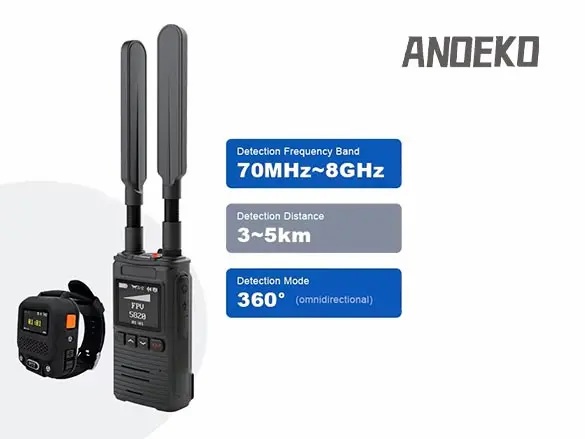
Scenic spots, logistics parks and urban air mobility zones deploy lightweight ANOEKO Portable FPV Drone Detector units for daily standardized low-altitude airspace supervision, addressing rampant unregulated black flight issues.
4. Five Core Future Trends of Global C-UAS Industry
4.1 Deep AI Integration for Intelligent Threat Prediction
Artificial intelligence and large multimodal models redefine modern counter drone detection systems, shifting defense logic from passive target detection to proactive threat prediction. ANOEKO’s AI decision core uses deep learning algorithms to cut threat identification latency to 0.15 seconds, autonomously generating optimal interception strategies based on drone flight trajectory and risk classification. The industry has officially entered the intelligent C-UAS era driven by data and collaborative system coordination.
4.2 Integrated Multi-Function All-in-One Defense Platforms
Future counter drone detection systems will combine radar, RF, optical, jamming and laser hardware into unified integrated platforms, enabling flexible tactic switching against diverse drone threats. ANOEKO maintains full-chain “perception – decision – interception – effect evaluation” C-UAS solutions to lead integrated defense technology innovation.
4.3 Miniaturized, Portable Rapid-Deployment Hardware
Lightweight, easy-to-transport equipment becomes a mainstream R&D focus for mobile security patrol teams. ANOEKO AOK-T3 RID Handheld Drone Detector weighs only 320g with palm-sized dimensions, supporting real-time RID drone distance, altitude, azimuth and pilot location display, ideal for airport perimeter and complex urban low-altitude patrols. The ANOEKO F1 multi-band drone jammer delivers seamless wideband interference targeting only drone control and video transmission frequencies to avoid disrupting nearby civilian wireless devices.
4.4 Low-Cost Mass Scalable Deployment
Technological iteration reduces R&D and manufacturing costs for counter drone detection hardware while boosting detection range, precision and mitigation efficiency. Low-price, wide-coverage C-UAS systems lay the foundation for full regional low-altitude airspace monitoring.
4.5 Countermeasures Against Emerging Drone Threat Vectors
Fiber-optic controlled FPV drones pose severe challenges to traditional RF jamming systems, as fiber signal transmission avoids electromagnetic interference. Defense suppliers must build composite sensing and neutralization systems combining optical detection, physical thermal cutting and multi-spectrum jamming to counter these new threats. Fast jet fixed-wing UAVs and loitering munition swarms also raise higher requirements for C-UAS response speed to avoid target overload and allocation failures during mass simultaneous attacks.
5. Global & Regional C-UAS Market Outlook
The worldwide counter drone detection market enters a high-growth cycle, with industry projections valuing the sector at $800 billion by 2026; RF power amplifier modules account for over 40% of total market share. Chinese manufacturers including ANOEKO capture over 35% of global C-UAS product shipments. North America retains the largest market share, while the Asia-Pacific region records the fastest year-on-year growth rate.
Domestically, China’s counter drone industry scale reached RMB 1.678 billion in 2025 and is projected to hit RMB 2.045 billion in 2026. Driven by booming low-altitude economy policies, demand for passive drone signal detector, radar and jamming hardware surges, accelerating the full industrial chain’s expansion.
Conclusion
Against complex global security landscapes, counter drone detection technology stands as a critical pillar of modern safety defense. From passive RF spectrum monitoring and phased array radar tracking to AI-powered intelligent decision-making, C-UAS systems advance toward intelligence, integration, portability and affordability.
To tackle the evolving risks of miniaturized, stealthy and swarm-based UAVs, security operators must build complete “detect – identify – track – neutralize” closed-loop defense frameworks. As a leading supplier of all-band drone detector and full-spectrum C-UAS solutions, ANOEKO delivers scalable hardware ranging from handheld Portable FPV Drone Detector to fixed radar stations and vehicle-mounted laser interception systems, offering customized anti-drone protection for military, airport, energy and urban security clients worldwide. In the fast-expanding low-altitude economy, reliable counter drone detection infrastructure has transitioned from optional auxiliary equipment to non-negotiable core safety assets for every high-security site.
Consultation Hotline
+86 18948793112
Email:lisen1205@foxmail.com
Mobile:+86 18948793112
WhatsApp:+86 18948793112
Address:Changchun North Road, Gongming Street, Guangming District, Shenzhen, China
Copyright © Copyright 2013 Anoeko Technology Co., Ltd. All Rights Reserved. | Anti-Drone & Low-Altitude Defense Experts ICP:ICP