Contact Us
|
WeChat
WeChat ID:842122368Scan to Connect
WeChat ID:842122368Scan to Connect

Portable Handheld Drone Detector: The Battlefield Guardian
How a Portable Drone Detector Enhances Modern Battlefield Security
In an era where drones dominate the skies, small unmanned aerial vehicles (UAVs) have become a silent yet formidable threat on the battlefield. From reconnaissance to targeted strikes, drones—especially First-Person View (FPV) drones—pose serious risks to military personnel and critical infrastructure. The solution? A portable drone detector that fits in a soldier’s gear and delivers real-time threat intelligence.
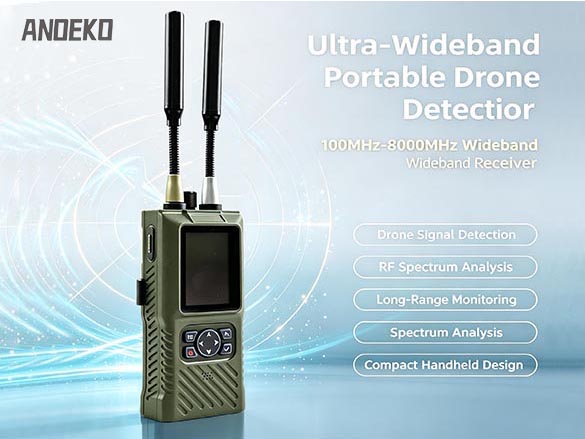
The handheld drone detector is a lightweight, compact device designed to detect, identify, and locate unauthorized drones. These portable UAV detection systems are rapidly becoming essential tools for infantry units, border patrols, and security forces worldwide. But how do they work, and why are they so critical today?
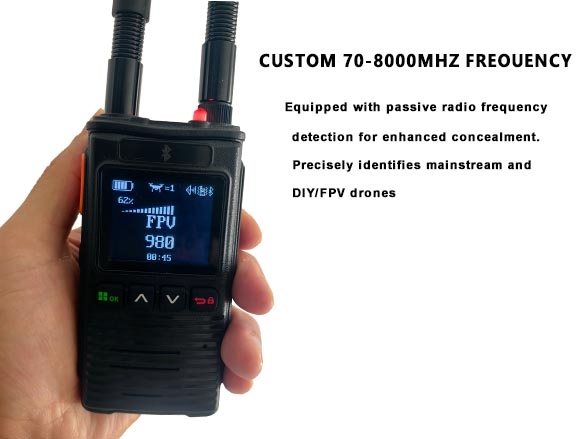
What is a Portable Handheld Drone Detector?
Imagine a soldier on patrol, scanning the horizon. Suddenly, a small drone appears, hovering silently. Without detection, it could surveil troop movements or deliver explosives. A handheld drone detector changes the game. It’s a personal, wearable device that alerts the user to the presence of drones—often before they are visible to the naked eye.
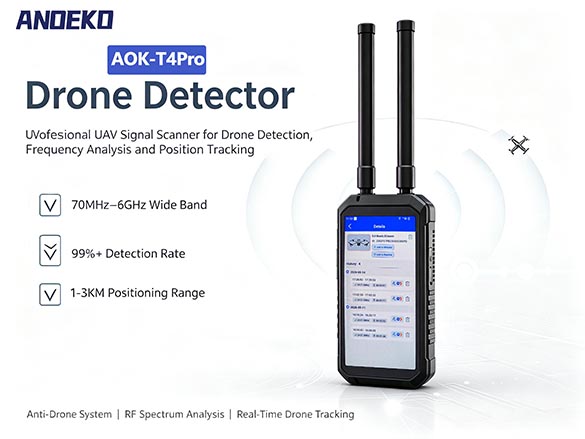
According to a Ukraine battlefield report, portable detectors like the Obriy 1.3 can warn soldiers of hostile FPV drones at ranges up to 2.5 km (1.55 miles), providing critical reaction time [8†L23-L26]. Devices such as the AOK-T2 Handheld UAV Detector are specifically designed for individual combat operations, offering passive 360° real-time monitoring, identification, and alerting for both DIY FPV drones and conventional UAVs [9†L5-L8].
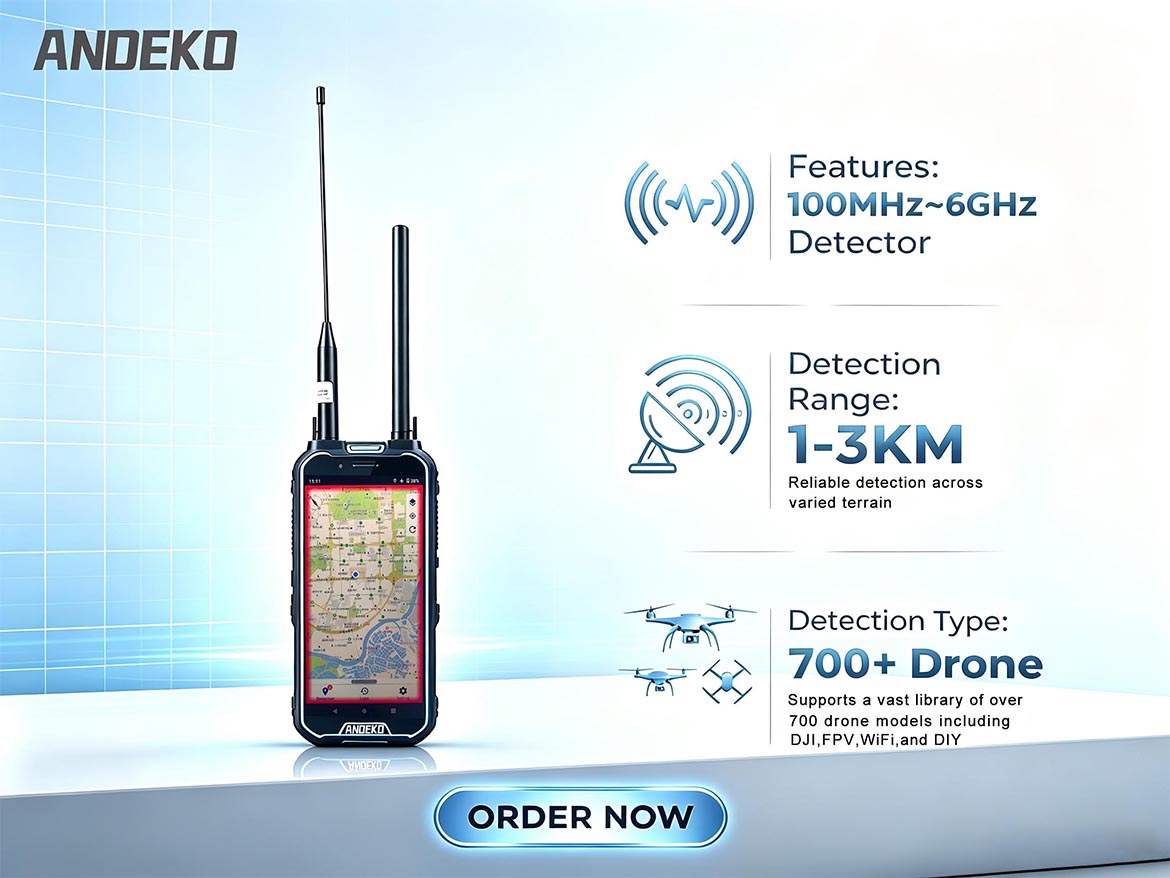
At ANOEKO, we have embraced this evolution. Our GA-series portable anti-drone detectors integrate advanced spectrum sensing with AI-driven analytics to deliver reliable early warning across complex electromagnetic environments—whether securing a forward operating base or safeguarding a VIP convoy. ANOEKO’s tactical UAV management tool, already deployed with the U.S. Marine Corps, integrates AI recognition and multi-band signal analysis to detect and counter hostile drones within seconds [10†L5-L8].
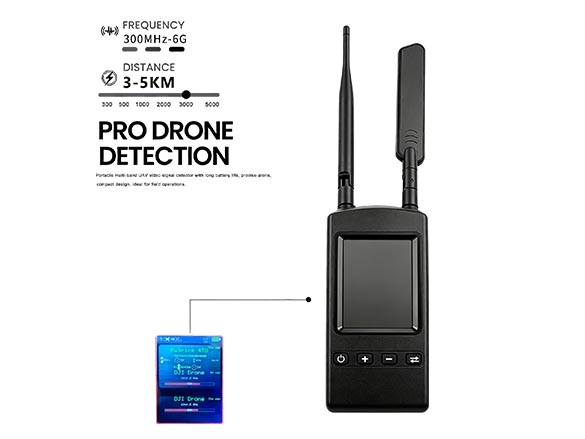
How Does a Portable Drone Detector Work?
These devices rely on multiple sensing technologies, with radio frequency (RF) detection being the most common. Here’s a breakdown of the core mechanisms:
Radio Frequency (RF) Signal Detection
The primary method. Portable RF detectors passively scan the spectrum for communication links between a drone and its controller. According to industry data, modern systems capture RF emissions across bands such as 1.2 GHz, 2.4 GHz, 5.2 GHz, and 5.8 GHz—frequencies commonly used by commercial DJI drones, FPV racers, and custom-built UAVs [14†L23-L24]. Devices like the Wolfpack detector can achieve detection ranges up to 10 km in optimal conditions [14†L11-L12]. This RF drone detection approach is highly effective for **DJI drone detection and other mainstream models.
Acoustic and Optical Analysis
Some advanced units incorporate high-sensitivity microphones to detect drone motor noise or employ thermal/optical cameras for visual confirmation. This multi-sensor fusion improves accuracy and reduces false alarms.
Edge AI and Cognitive Radio
The latest generation of portable detectors integrates edge machine learning to identify non-cooperative and previously unseen drones. Systems like Metis’ Skyperion Lightweight use non-library-based Open ESM waveform analysis to identify both cooperative and non-cooperative emitters across a wide spectrum, without reliance on static signal libraries [13†L22-L26]. This AI-driven approach is transforming the UAV detection system market.
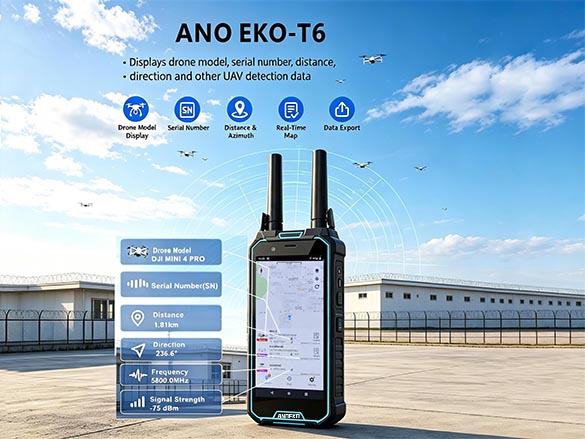
Once a drone is detected, the system triggers visual, audible, or vibration alerts. Many devices also display the drone’s bearing, estimated range, and even flight trajectory on a built-in screen or connected smartphone app, enabling the operator to take appropriate countermeasures.
Real-World Applications: Where Are These Devices Used?
The need for best handheld drone detectors spans multiple sectors, but nowhere is it more urgent than on the modern battlefield.
Military & Defense
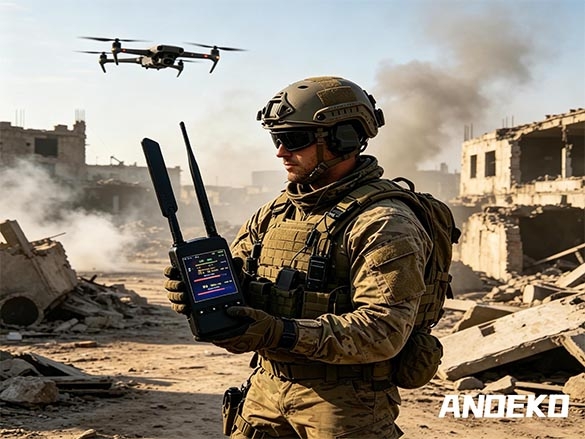
In active combat zones, portable detectors are saving lives. The Ukrainian Obriy 1.3, now being evaluated by U.S. forces at the National Training Center in California, detects FPV, DJI, and Autel drones and runs for eight hours on battery [8†L31-L34]. ANOEKO’s man-portable system, weighing just 2.7 kg, has been combat-tested in Syria, intercepting drone swarms and providing soldiers with critical early warning against threats like the “Witness-136” loitering munition [10†L6-L8].
Border Security & Critical Infrastructure
Portable detectors are used to protect borders, power plants, and government facilities. Systems such as the HDJS 3.0 offer all-in-one detection, jamming, and spoofing in a handheld form, making them ideal for rapid deployment in contested environments [3†L17-L18].
Major Public Events
During the Paris 2024 Olympics, counter-UAS teams deployed portable RF detectors to secure stadiums and public areas from drone intrusions. Similarly, ANOEKO’s solutions have been used to protect high-profile gatherings where airspace security is paramount.
What’s the Future of Portable Drone Detection?
The future lies in smarter, faster, and more integrated systems. Expect to see:
● AI-powered classification: Distinguishing between friendly, neutral, and hostile drones using deep learning models trained on vast RF signature databases.
● Networked detection: Multiple handheld drone detectors sharing data via IoT or tactical networks to create real-time airspace maps and triangulate drone positions.
● Lower size, weight, and power (SWAP): Devices becoming even more compact, with extended battery life and seamless integration with other soldier-borne sensors (helmets, radios, night vision).
However, challenges remain. High-speed drones, low-flying micro-drones, and heavily encrypted control links can still evade detection. Continuous R&D in drone signal detector technology is essential to close these gaps. Companies like ANOEKO are at the forefront, developing next-generation modules that combine RF sensing with radar and electro-optical tracking for comprehensive coverage.
How to Choose a Handheld Drone Detector?
If you are in procurement or security planning, here are the key factors to consider:
I.Detection Range: Look for a reliable portable drone detector with a detection range of at least 2–3 km (1.2–1.8 miles) in real-world conditions.
II. Frequency Coverage: Ensure the UAV detection system covers key bands (1.2 GHz, 2.4 GHz, 5.8 GHz) and can detect FPV signals (typically 5.2–5.8 GHz) as well as 433 MHz and 868 MHz for DIY drones [14†L23-L24].
III. False Alarm Rate: The best handheld drone detector should have advanced filtering to avoid false alerts in RF-congested environments (e.g., near Wi-Fi hotspots or cell towers).
IV. Ease of Use: A clear interface, intuitive controls, and rapid startup (under 10 seconds) are critical for battlefield conditions.
V. Battery Life: For extended missions, look for a drone detection module that can operate for 8+ hours on a single charge [8†L33-L34].
VI. Integration: Choose drone detection systems that can integrate with existing C2 platforms or jamming devices for a layered security posture.
Price is also a factor; but for military and critical infrastructure applications, performance and reliability far outweigh up-front cost. ANOEKO’s product family—including the GA625 portable FPV detector and other advanced modules—offers scalable solutions that balance affordability with battlefield-proven capability.
Final Thoughts
From trenches to tech hubs, portable drone detectors are no longer optional—they are essential. As drone threats evolve, so must our defenses. Whether you are a defense contractor, a security manager, or a tech enthusiast, understanding how a portable drone detector works is the first step toward securing your airspace.
> Learn more about ANOEKO’s advanced portable detection solutions at [www.anoeko.com](https://www.anoeko.com).
Consultation Hotline
+86 18948793112
Email:lisen1205@foxmail.com
Mobile:+86 18948793112
WhatsApp:+86 18948793112
Address:Changchun North Road, Gongming Street, Guangming District, Shenzhen, China
Copyright © Copyright 2013 Anoeko Technology Co., Ltd. All Rights Reserved. | Anti-Drone & Low-Altitude Defense Experts ICP:ICP