Contact Us
|
WeChat
WeChat ID:842122368Scan to Connect
WeChat ID:842122368Scan to Connect

As unmanned aerial vehicles (UAVs) become more widely used in commercial, industrial, and recreational environments, demand is growing for reliable counter-unmanned aircraft system (counter-UAS) technologies. These systems may combine RF sensing, signal analysis, radar, tracking, and other technologies to support airspace awareness and authorized security operations.
Behind many RF-based systems is a critical component: the RF power amplifier module.
Choosing between gallium nitride (GaN), laterally diffused metal-oxide-semiconductor (LDMOS), and other semiconductor technologies can affect output power, operating frequency, thermal management, system size, and integration requirements. However, no semiconductor technology is automatically the best choice for every application. Performance depends on device design, operating conditions, circuit topology, and the requirements of the complete system.
For engineers and system integrators evaluating a new anti-drone module, understanding these differences is an important first step.
ANOEKO develops RF modules and related technologies for professional RF integration. This guide explains the practical differences between GaN and LDMOS RF amplifier modules and outlines the factors to consider when selecting a wideband RF amplifier module or a customized solution.
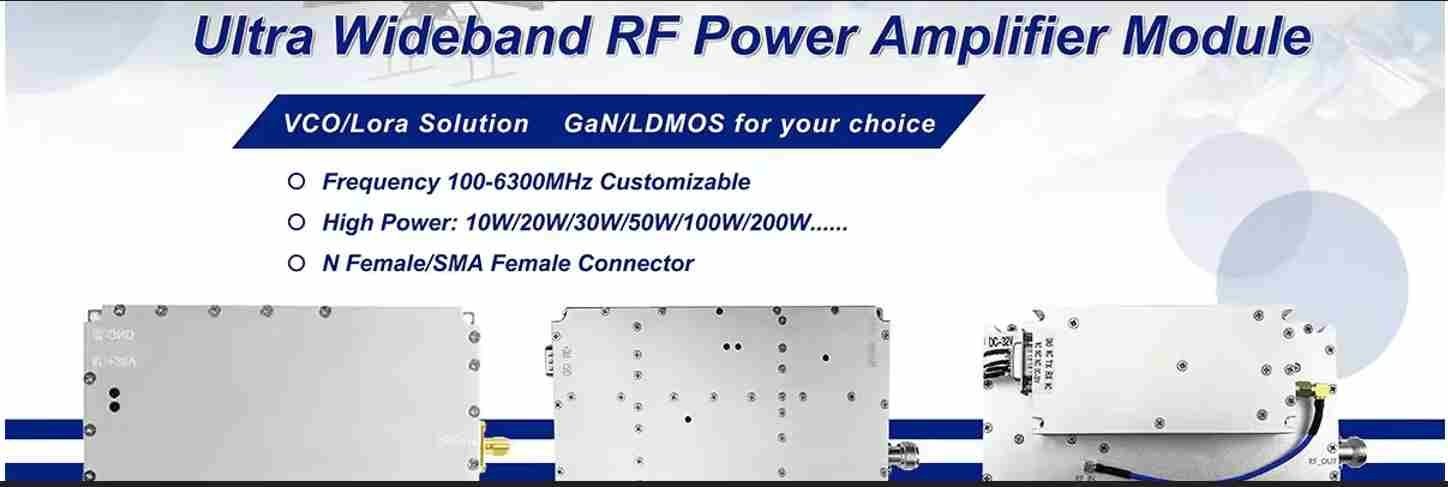
An RF power amplifier module increases the power of an RF signal to a level required by a downstream RF subsystem. Depending on the application, the module may be integrated into a communications platform, test system, RF signal chain, or authorized counter-UAS installation.
The term GaN anti-drone module is often used in commercial searches to describe a GaN-based RF power amplifier intended for integration into counter-UAS equipment. In technical terms, it is important to distinguish an amplifier from a complete counter-UAS system.
An RF power amplifier does not independently detect, identify, locate, or track a drone. Those functions require appropriate sensing hardware, signal-processing capabilities, software, antennas, and system integration.
A typical RF integration project may require engineers to evaluate:
Operating frequency and usable bandwidth
Rated RF output power and gain
Gain flatness across the specified band
Efficiency and DC power requirements
Thermal resistance and cooling arrangements
Input and output impedance matching
VSWR protection and temperature monitoring
Mechanical dimensions, connectors, and control interfaces
These factors provide a more useful basis for comparison than semiconductor material alone.
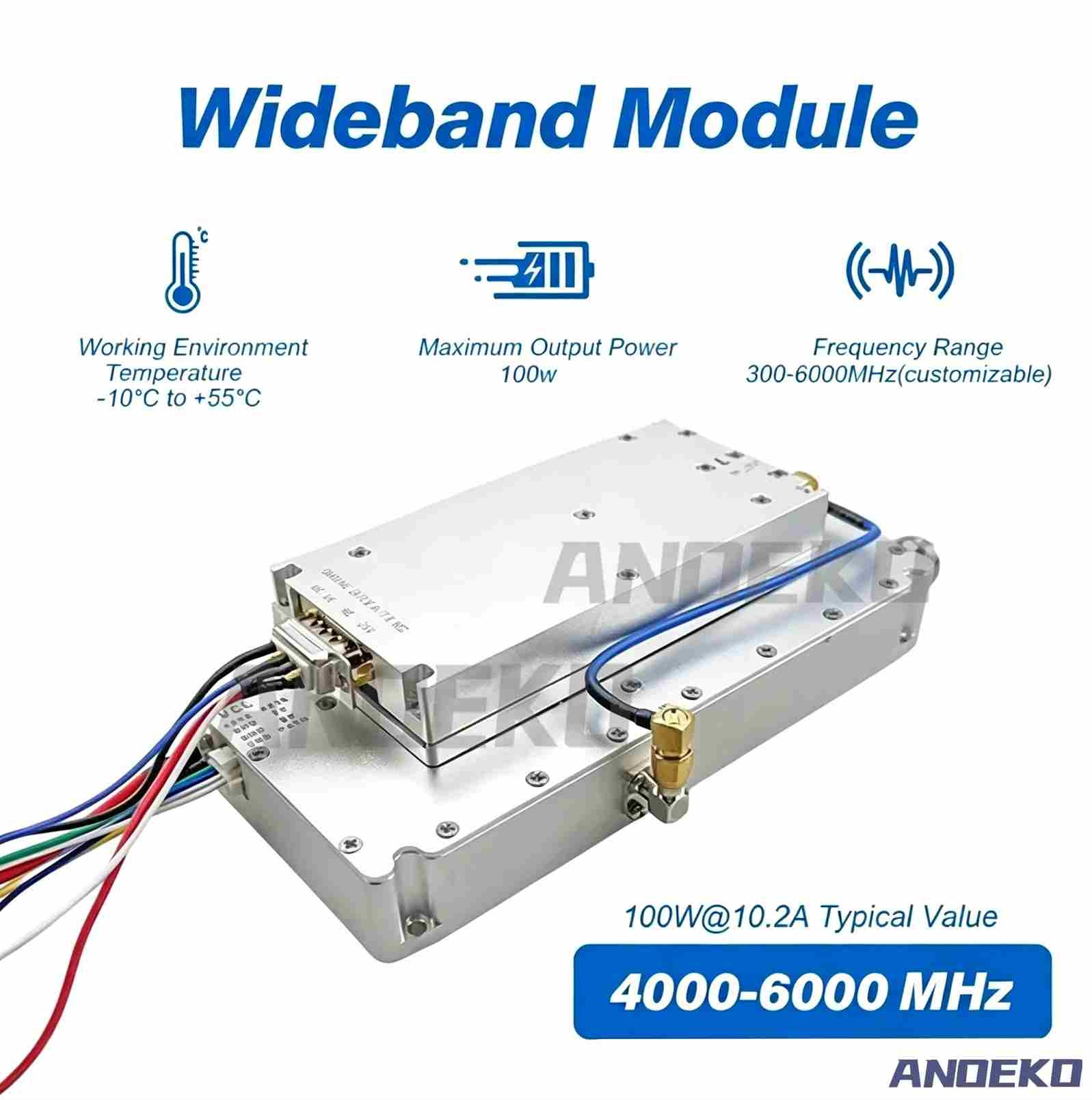
GaN and LDMOS are established semiconductor technologies used in RF power amplification. Their characteristics differ, but the performance of a finished RF amplifier depends on more than the material from which its transistors are made.
Gallium nitride is a wide-bandgap semiconductor. Its material properties support high electric-field operation and high power density, making GaN an important option for demanding RF power applications.
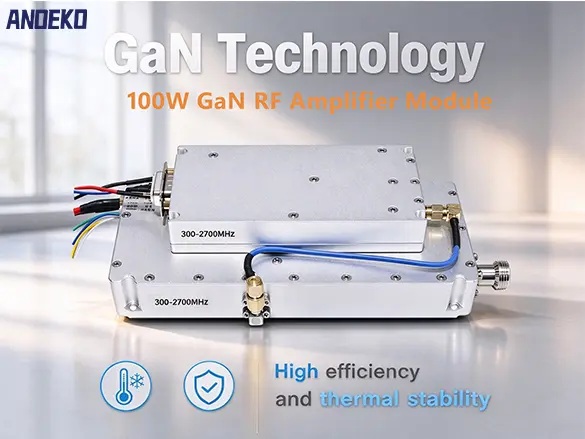
A well-designed GaN RF Amplifier Module can offer several potential advantages:
High power density
GaN technology can support substantial RF output power in a relatively compact active device. This can help designers manage equipment size when combined with appropriate circuit, thermal, and mechanical engineering.
High-frequency capability
GaN devices are used in RF applications ranging from lower microwave frequencies to higher-frequency bands. The actual usable frequency range depends on the transistor, matching network, circuit design, and amplifier architecture.
Thermal design flexibility
GaN devices can support high junction temperatures under specified conditions. However, this does not eliminate the need for proper heat spreading, thermal interfaces, heatsinks, or airflow. The finished module's permitted operating temperature must always be checked against its datasheet.
Potential for high efficiency
GaN can provide favorable efficiency in suitable designs, but efficiency varies with frequency, output power, gain compression, bias conditions, and circuit topology. It should be evaluated using measured data at the operating point relevant to the application.
LDMOS technology has a long history in RF power amplification, particularly in established cellular infrastructure and other power-amplifier applications.
An LDMOS anti-drone module may be suitable when its operating frequency, power level, efficiency, size, and cost align with the system requirements.
Potential advantages include:
Mature design and manufacturing processes
Extensive use in established RF power-amplifier architectures
Competitive performance in suitable frequency bands
Availability of proven reference designs and integration approaches
LDMOS is not inherently unsuitable for modern RF systems. Its practical limitations depend on the device generation and amplifier design. Likewise, a GaN solution is not automatically more efficient or less expensive in every operating condition.
The best comparison uses verified specifications and measured performance for the two actual modules under consideration.
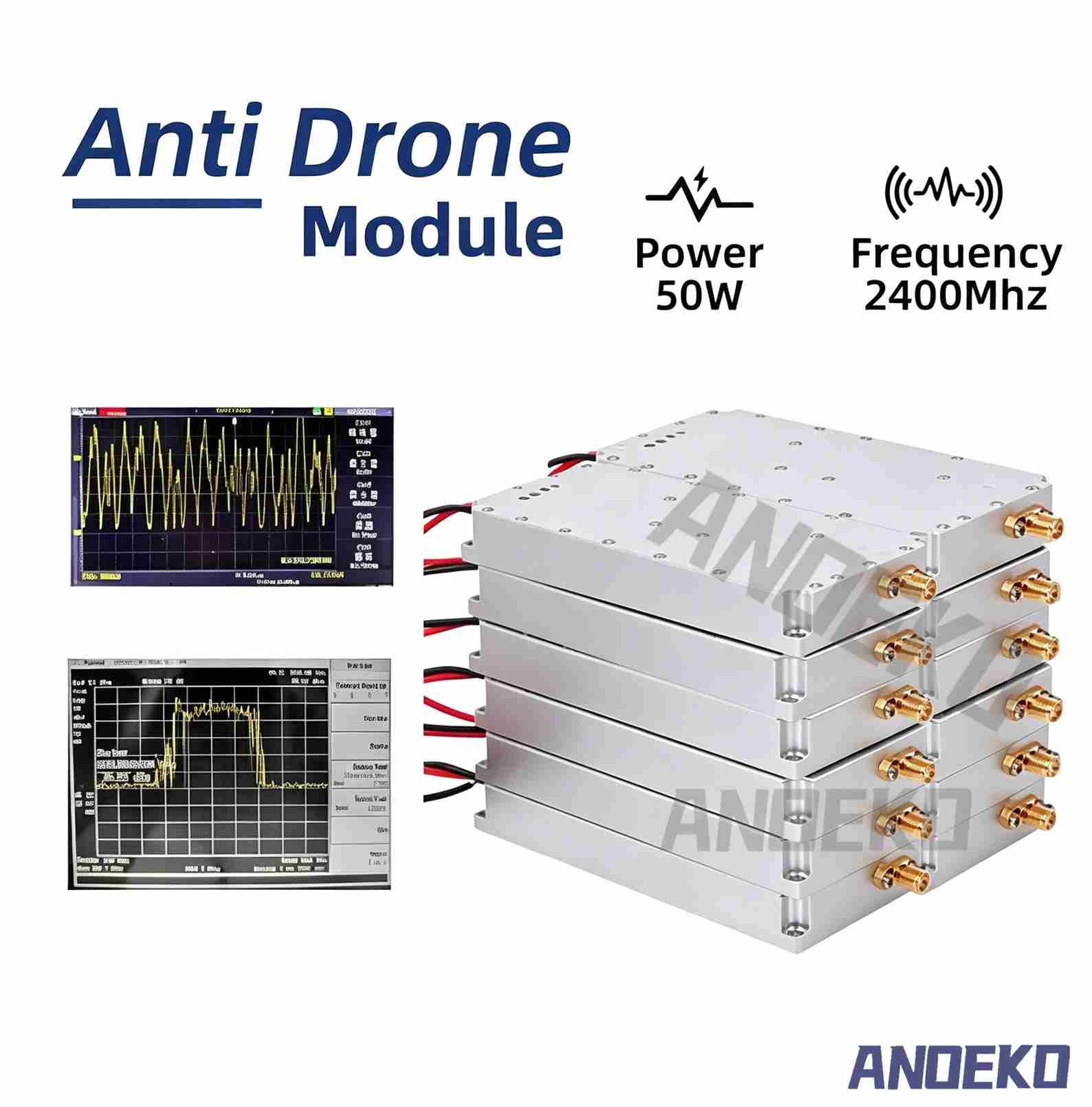
Frequency range is one of the first specifications engineers should examine when choosing a Wide Bandwidth Module.
A product advertised as covering a broad range does not necessarily deliver its rated output power, gain, or efficiency uniformly across that entire range. Some modules operate over a continuous band, while others support specific frequency configurations or narrower instantaneous bandwidths.
Before selecting a wideband RF amplifier, confirm the following:
Specified frequency range
Check the minimum and maximum operating frequencies in the manufacturer's datasheet. Confirm whether the stated range represents continuous operation or a set of selectable configurations.
Output power across the band
Determine whether rated output power is maintained across the complete specified frequency range. If output power varies by frequency, obtain the relevant power-versus-frequency data.
Gain and gain flatness
Maximum gain alone does not describe how consistently the module amplifies signals across its operating band. Gain flatness, input drive requirements, and output-power specifications should be considered together.
RF connectors and impedance
Verify the connector types, nominal impedance, and RF interface requirements. Connector selection can affect mechanical integration and the compatibility of the surrounding signal chain.
Control and protection features
Depending on the design, temperature monitoring, VSWR protection, enable control, and serial interfaces may simplify integration and system monitoring.
For a wideband RF project, the most useful question is not simply how wide the advertised frequency range is. It is whether the module meets the required performance criteria throughout the portion of the spectrum that the system actually uses.
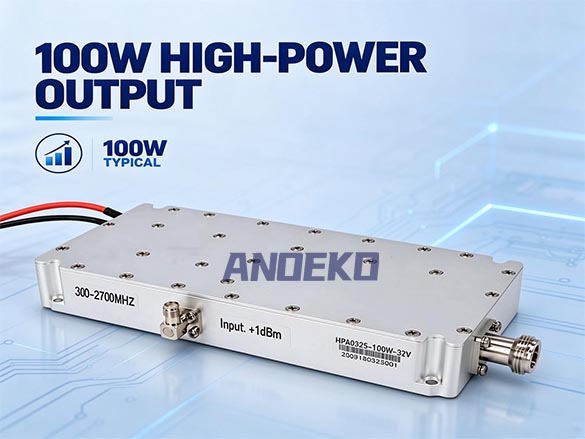
Searches for a 100W anti-drone module often reflect a requirement for a high-power RF amplifier. However, a 100W rating alone is not enough to determine whether a module is appropriate for a particular system.
Engineers should first clarify what the power rating represents. Depending on the manufacturer's specification, it may refer to saturated output power, rated RF output power, or another defined test condition.
The following parameters help establish whether a 100W RF amplifier module meets the intended integration requirements.
Confirm the rated output power, frequency range, duty cycle, input drive level, and conditions under which the specification was measured.
A module's output power may vary with frequency, temperature, supply voltage, and operating mode. A single headline figure should not replace a complete specification.
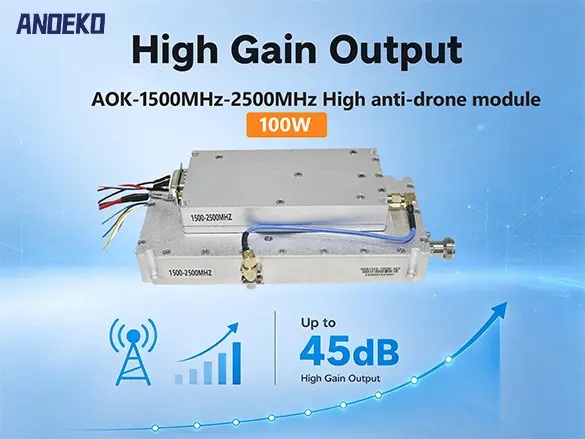
Gain determines the relationship between input and output signal power under specified conditions. It should be evaluated alongside the required input drive level and the module's linearity or compression characteristics.
High gain does not automatically mean high efficiency, and it does not guarantee that the module will meet the complete system's signal-quality requirements.
Efficiency affects the DC power required to produce a given RF output. For example, if a module delivers 100 W of RF output at 40% efficiency under a particular test condition, the corresponding DC input power attributable to that operating point is approximately 250 W, before accounting for other system losses.
This illustrates why power-supply capacity and thermal design should be considered early in the integration process.
A high-power RF amplifier generates heat that must be transferred away from the active components. Engineers should review the specified mounting arrangement, heatsink requirements, thermal interface, and operating-temperature limits.
A compact module may reduce installation volume, but compact dimensions do not remove the need for an adequate thermal path.
Depending on the application, useful features may include temperature monitoring, VSWR protection, current monitoring, and remote enable or control interfaces. Their availability should be confirmed for the specific model rather than assumed from the product category.
For these reasons, selecting a 100W anti-drone module should begin with the complete electrical and mechanical requirements, not the output-power rating alone.
Standard RF amplifier modules can simplify product development when their specifications match the system design. A customized anti-drone module may be worth evaluating when standard products do not meet the required combination of frequency coverage, output power, dimensions, interfaces, or environmental conditions.
Common customization considerations include:
Frequency configuration: selecting an operating band appropriate for the intended RF system
Output power: defining the required rated power and operating conditions
Mechanical design: accommodating available installation space and mounting requirements
RF interfaces: specifying suitable input and output connectors
Control interfaces: determining whether remote enable, serial communication, or monitoring is required
Thermal design: matching the module's heat-dissipation requirements to the enclosure and cooling arrangement
Environmental requirements: defining operating temperature, vibration, and other applicable conditions
Customization should begin with a documented technical specification. This helps establish measurable acceptance criteria and reduces uncertainty during design, testing, and production.
ANOEKO can discuss RF module requirements with customers seeking a suitable configuration. Availability, customization scope, and achievable performance should be confirmed for each project.
When evaluating GaN and LDMOS options, use a consistent comparison process.
| Evaluation factor | What to verify |
|---|---|
| Frequency coverage | Continuous range or selectable bands |
| RF output power | Rated power and test conditions |
| Gain | Typical and maximum gain, where specified |
| Gain flatness | Variation across the operating band |
| Efficiency | Measurement conditions and operating point |
| DC supply | Voltage range and current requirements |
| Thermal management | Mounting, cooling, and temperature limits |
| RF interfaces | Connector type and nominal impedance |
| Protection features | Available monitoring and protection functions |
| Documentation | Datasheet, test results, and integration guidance |
A comparison table should use specifications from the actual products being evaluated. Avoid relying on generic claims such as a fixed efficiency advantage for every GaN design or a universal frequency limit for every LDMOS design.
Where possible, request measured results under comparable conditions. This provides a more defensible basis for selecting a module and helps identify potential integration issues before system-level testing.
ANOEKO focuses on RF technologies and module solutions for professional customers and system integrators.
When evaluating an ANOEKO RF Amplifier Module, customers should identify the target frequency range, rated output power, gain requirements, available DC supply, cooling arrangement, mechanical constraints, and required interfaces.
For projects that require a Wide Bandwidth Module or a customized RF configuration, sharing these details at the beginning of the discussion can help establish whether an existing module is suitable or whether a tailored design should be considered.
Product specifications should always be reviewed at the individual model level. Frequency coverage, output power, efficiency, connector options, protection functions, and customization availability may differ among products.
For project-specific information, contact ANOEKO through the official website:
No. GaN can offer advantages in power density and high-frequency applications, while LDMOS remains useful in suitable RF designs. The right choice depends on frequency, output power, efficiency, cost, thermal constraints, and the requirements of the complete system.
Review the operating frequency range, rated output power, gain, efficiency, DC power requirements, thermal conditions, connectors, and protection features. Confirm that the specifications apply across the required operating range.
A wideband RF amplifier module is designed to amplify RF signals over a specified frequency range. The term does not guarantee uniform output power, gain, or efficiency across the entire range, so the detailed datasheet remains essential.
Consider customization when standard modules do not satisfy the project's frequency, power, mechanical, interface, thermal, or environmental requirements. A clear technical specification helps determine the feasibility and scope of a custom solution.
An RF power amplifier is an amplification component, not a complete detection or tracking system. Detection and tracking require suitable sensing hardware, signal processing, and system-level integration.
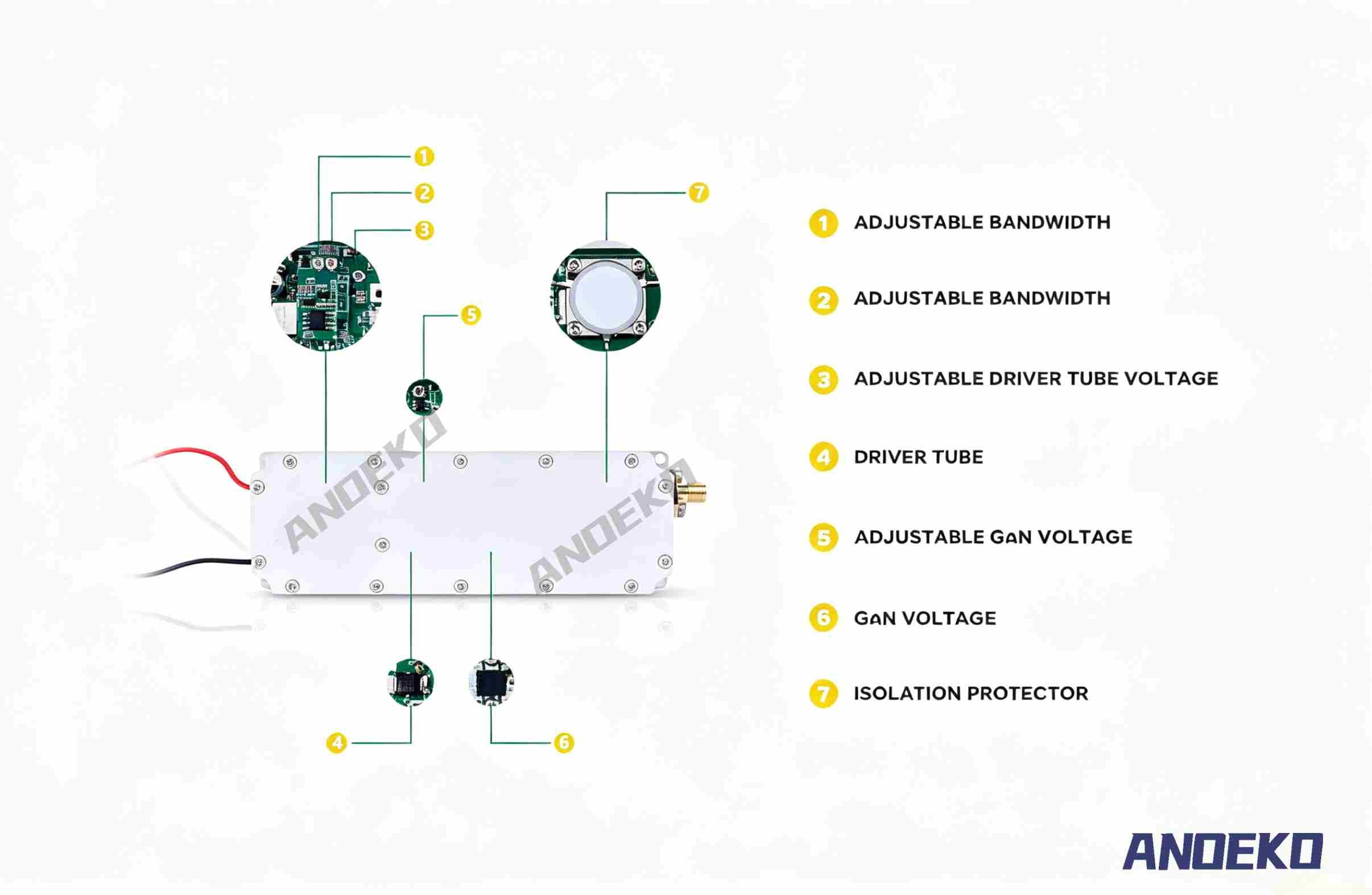
GaN and LDMOS each have a place in modern RF engineering. GaN may be attractive when power density, high-frequency operation, and compact integration are important. LDMOS can remain competitive where its characteristics align with the intended application.
For engineers comparing a GaN anti-drone module, a 100W RF amplifier module, or a customized wideband solution, the most reliable decision comes from verified specifications, comparable test data, and a clear understanding of the complete system requirements.
ANOEKO encourages customers to evaluate RF modules against their actual frequency, power, thermal, and integration needs. A well-matched module is not simply the one with the highest headline specification; it is the one whose documented performance meets the project's requirements consistently and reliably.
Consultation Hotline
+86 18948793112
Email:lisen1205@foxmail.com
Mobile:+86 18948793112
WhatsApp:+86 18948793112
Address:Changchun North Road, Gongming Street, Guangming District, Shenzhen, China
Copyright © Copyright © 2024 Anoeko Technology Co., Ltd. All Rights Reserved. | Anti-Drone & Low-Altitude Defense Experts ICP:粤ICP备13053733号-1