Contact Us
|
WeChat
WeChat ID:842122368Scan to Connect
WeChat ID:842122368Scan to Connect

The modern battlefield extends far beyond physical borders. It reaches into the electromagnetic spectrum where invisible signals dictate the outcome of asymmetric threats. As drones proliferate across both civilian and military domains, the need for sophisticated counter-unmanned aerial system (C-UAS) technology has never been more urgent. At the heart of every effective anti-drone solution lies a critical decision: selecting the right signal generation technology to disrupt hostile communications.
Contemporary drone jamming modules deploy three primary signal source technologies, each representing a distinct strategic approach. DDS (Direct Digital Synthesis) embodies precision strike, targeting specific frequencies with surgical accuracy. SDR (Software Defined Radio) represents intelligent countermeasure, adapting dynamically to evolving threats. Noise sources deliver comprehensive suppression, overwhelming targets with broadband interference across the spectrum. Understanding this triad is essential for any system integrator seeking to build effective, future-proof counter-drone capabilities.
Direct Digital Synthesis (DDS) operates on the principle of generating precise waveforms through digital processing. The system employs a phase accumulator that increments at a controlled rate, generating digital samples that are converted to analog signals through a digital-to-analog converter (DAC). This architecture enables precise frequency control with exceptional resolution, allowing the jammer to target specific communication bands used by drones.
DDS systems typically combine with clock generators and low-pass filters to produce clean, controlled sweep signals. The frequency of the output signal is determined by the clock frequency and the digital tuning word, enabling rapid frequency hopping and precise targeting capabilities.
The precision inherent in DDS technology translates to several operational advantages:
Surgical Targeting: DDS modules can focus energy on narrow frequency bands, maximizing interference effectiveness while minimizing collateral disruption to adjacent spectrum users
Rapid Frequency Switching: The digital nature of DDS enables near-instantaneous frequency changes, essential for countering drones that employ frequency-hopping spread spectrum (FHSS) techniques
Deterministic Output: The repeatable nature of digital synthesis ensures consistent jamming behavior across multiple units, simplifying system calibration and deployment
While DDS offers precision, it carries inherent limitations. The continuous wave output from DDS generators may not provide sufficient signal density to disrupt sophisticated drones employing advanced modulation techniques. The signal characteristics can be insufficient for maintaining effective jamming conditions against drones that implement robust error correction or adaptive frequency selection.
Software Defined Radio (SDR) represents a paradigm shift in RF technology. Instead of relying on hardware-configured signal generation, SDR enables the entire jamming waveform to be defined and modified through software. This architecture provides unprecedented flexibility, allowing operators to reprogram jamming modules overnight to address new threats or adapt to changing frequency allocations.
An SDR-based anti-drone system typically integrates detection capabilities, RF classification using machine learning algorithms, and adaptive jamming. The system can analyze incoming signals, identify the drone's communication protocol, and generate tailored interference waveforms that match the exact modulation of the target link.
The intelligence of SDR platforms enables sophisticated jamming strategies beyond simple broadband interference:
Cognitive Jamming: The system listens before it jams, identifies active frequencies, and generates interference patterns that match the target's modulation scheme
Predictive Interference: Advanced algorithms can learn a drone's frequency-hopping patterns and predict the next frequency, effectively cutting off the control link before the drone can switch
Multi-Protocol Adaptation: SDR modules can switch between jamming strategies, responding to different drone types with optimized interference patterns
An SDR anti-drone module offers significant efficiency improvements over traditional approaches. Instead of continuously broadcasting at maximum power, smart modules can adapt output levels based on target distance estimates. A modern module might use 20W for a close-range quadcopter and ramp up to 80W only for high-altitude threats. This adaptive approach conserves energy, reduces thermal stress, and enables continuous operation in challenging environments.
Furthermore, the modular nature of SDR platforms supports field-upgradeable firmware, ensuring that counter-drone capabilities remain current without requiring complete hardware replacement. This approach significantly extends the operational lifetime of deployed systems.
Noise sources represent the most fundamental approach to RF suppression. By generating broadband random signals that cover a wide spectrum, noise jammers overwhelm drone communication links with powerful interference. The principle is straightforward: if the signal-to-noise ratio at the drone's receiver drops below a critical threshold, the communication link becomes unusable.
A noise source jammer typically employs a high-speed noise-modulated signal source, integrated with power amplifiers to deliver effective interference. The signal generation may utilize various techniques, including the mixing of white noise with swept signals to create continuous, broadband interference patterns.
Broad Spectrum Coverage: Noise sources can blanket large frequency ranges, ensuring that even unknown drone frequency bands are covered
Simplicity and Reliability: The straightforward nature of noise generation reduces system complexity, improving reliability and reducing failure points
Cost-Effectiveness: Noise-based modules generally offer excellent performance-to-cost ratios, making them ideal for large-scale deployment scenarios
Despite their advantages, noise sources lack the precision of DDS or the intelligence of SDR. The broadband energy distribution may result in less efficient jamming compared to targeted approaches, requiring higher power levels to achieve similar effectiveness. Additionally, noise jamming may interfere with friendly communications, limiting deployment scenarios in complex electromagnetic environments.
The choice between DDS, SDR, and noise sources depends on the specific operational requirements and threat environment. The following comparison highlights the key differences:
| Feature | DDS Technology | SDR Technology | Noise Source |
|---|---|---|---|
| Targeting Precision | High – narrow frequency bands | High – adaptive to specific signals | Low – broad spectrum coverage |
| Frequency Agility | Rapid frequency switching | Software-defined, fully flexible | Fixed or adjustable sweep |
| Adaptive Capability | Limited – requires hardware changes | High – software reprogrammable | Minimal – hardware-defined |
| Power Efficiency | Moderate | High – adaptive power output | Variable – depends on bandwidth |
| Cost | Moderate | Higher initial investment | Generally lower |
| Operational Flexibility | Medium | Maximum – field-upgradeable | Low – fixed configuration |
For project developers, the selection of a signal source is often a strategic decision. While DDS provides precision for specific threat scenarios, SDR offers the long-term flexibility needed to address evolving drone technologies. Noise sources deliver the most straightforward and cost-effective solution for broad coverage requirements.
The modern counter-drone architecture increasingly adopts hybrid approaches, combining multiple signal generation technologies to create layered defense systems. A sophisticated drone jammer module may integrate a noise-modulated source with optional DDS or SDR customization, allowing operators to select the appropriate jamming strategy for different threat scenarios.
This integrated approach reflects the complexity of the modern threat landscape. Drones equipped with frequency-hopping capabilities may evade simple noise jammers but remain vulnerable to cognitive SDR-based interference. Conversely, drones using encrypted communications may be effectively neutralized by broadband noise suppression even when protocol-specific jamming fails.
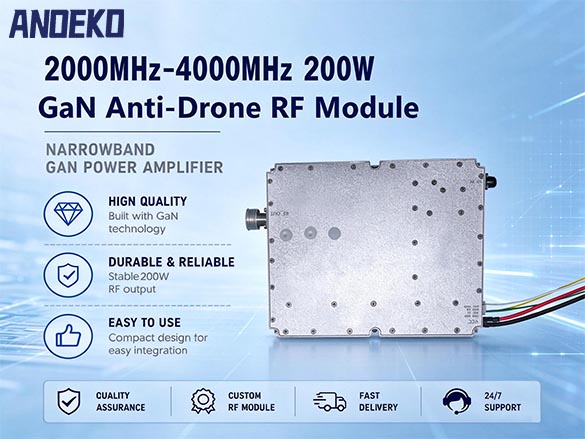
Regardless of the signal source technology, the effectiveness of any drone jammer module depends heavily on the power amplification stage. GaN (Gallium Nitride) technology has revolutionized this aspect, enabling high-output power in compact form factors. A 100W GaN-based drone jammer module offers the power density needed for reliable counter-drone operations while maintaining manageable thermal profiles and operational efficiency.
The future of counter-UAS technology lies in integrating intelligence into the RF domain. As demonstrated by L3Harris's Wraith Shield capability, even handheld radios can be transformed into counter-drone jammers through software upgrades that enable coordinated jamming across multiple units. This approach demonstrates the power of software-defined architecture in expanding counter-UAS capabilities without requiring hardware replacements.
The tactical deployment of drone jamming modules depends on a thorough understanding of signal generation technologies. DDS, SDR, and noise sources each represent a strategic approach to RF dominance, with distinct strengths and limitations. The integration of these technologies into a cohesive counter-drone architecture enables operators to address the diverse challenges posed by modern unmanned aerial systems.
For manufacturers and system integrators, the selection of signal source technology is not merely a technical decision but a strategic one. It determines the operational envelope of the system, its adaptability to evolving threats, and ultimately its effectiveness in protecting critical infrastructure and personnel. As the counter-UAS market continues to mature, the emphasis on intelligent, adaptive, and software-driven solutions will only increase.
In the dynamic landscape of electromagnetic warfare, the key to success lies not in selecting the "best" technology, but in understanding the strategic trade-offs and building integrated systems that leverage the strengths of each approach. Whether prioritizing precision strike, intelligent countermeasure, or comprehensive suppression, the modern counter-drone system must be engineered with a clear understanding of the triad of RF dominance.
Consultation Hotline
+86 18948793112
Email:lisen1205@foxmail.com
Mobile:+86 18948793112
WhatsApp:+86 18948793112
Address:Changchun North Road, Gongming Street, Guangming District, Shenzhen, China
Copyright © Copyright 2013 Anoeko Technology Co., Ltd. All Rights Reserved. | Anti-Drone & Low-Altitude Defense Experts ICP:ICP