Contact Us
|
WeChat
WeChat ID:842122368Scan to Connect
WeChat ID:842122368Scan to Connect

The rapid development of unmanned aerial systems has changed the way governments, infrastructure operators and security organizations approach low-altitude protection. Airports, energy facilities, transportation networks, industrial sites and public venues increasingly need integrated systems capable of detecting, identifying, tracking and responding to unauthorized drone activity.
The market reflects this growing demand. According to MarketsandMarkets, the global Counter-UAS market was estimated at approximately USD 6.64 billion in 2025 and is projected to reach USD 20.31 billion by 2030, representing a compound annual growth rate of 25.1%.
Behind this expansion is a broader engineering challenge: developing counter-UAS platforms that are more compact, adaptable, reliable and suitable for integration into increasingly complex security environments.
One component deserves particular attention in this development process: the RF Power Amplifier Module.
An RF amplifier does not independently determine the performance of an entire counter-UAS system. However, its output capability, frequency response, efficiency, linearity, thermal characteristics and protection functions establish important limits within the RF signal chain.
This leads to a more useful engineering question:
What actually defines the performance envelope of a modern C-UAS RF amplifier module, and why is maximum output power only part of the answer?
For system integrators and professional RF equipment manufacturers, understanding this question is essential when evaluating a new anti-drone module, comparing GaN and LDMOS technologies, or developing a customized RF amplifier architecture.
A modern Counter-UAS architecture may combine several technologies:
Radar-based target detection
Passive RF signal monitoring
Electro-optical and infrared observation
Signal classification and identification
Command-and-control software
Authorized mitigation technologies
Each subsystem performs a different function.
Detection identifies potential aerial activity. Tracking provides information about target movement. Identification helps distinguish relevant threats from other objects. The response subsystem operates according to the system architecture and applicable authorization.
Within an RF-based response architecture, the RF power amplifier provides the required amplification capability for the designed signal chain.
This is why the quality of an RF Amplifier Module matters.
However, it is inaccurate to assume that a higher amplifier output rating automatically produces a longer system range or better overall performance. Actual system results depend on the complete RF architecture, including antenna characteristics, cable losses, propagation conditions, receiver and target characteristics, operating environment and system-level integration.
The amplifier establishes an important part of the available RF performance, but it cannot compensate for every limitation elsewhere in the system.
For OEM manufacturers, this distinction is particularly important. Selecting an amplifier should begin with the requirements of the complete platform rather than a single wattage figure.
The choice between GaN and LDMOS is one of the most important considerations in RF power amplifier development.
Both technologies have established applications in professional RF equipment. Their suitability depends on operating frequency, output requirements, efficiency, thermal design, cost and the intended product architecture.
Gallium Nitride (GaN) is a wide-bandgap semiconductor technology widely used in modern high-performance RF power amplifiers.
Its material characteristics support high operating voltages and strong power density, making GaN attractive for applications where compact packaging and substantial RF output capability are important.
A GaN anti-drone module may be considered when a platform requires:
High RF power density
Compact mechanical dimensions
Broadband or higher-frequency operation
Flexible RF architecture
Integration into size- and weight-constrained equipment
GaN is particularly relevant to modern broadband RF amplifier development. However, the material alone does not guarantee a specific output level, efficiency or operating temperature.
The final performance depends on transistor selection, circuit topology, impedance matching, operating conditions, power supply design and thermal management.
For this reason, buyers should evaluate the complete datasheet rather than selecting a product solely because it uses GaN technology.
Laterally Diffused Metal-Oxide-Semiconductor (LDMOS) technology has a long history in RF power amplification.
Its established manufacturing processes, mature device ecosystem and competitive economics continue to make it relevant to many RF applications.
An LDMOS anti-drone module may be appropriate when the required frequency range, output capability, cost structure and mechanical requirements align with the technology.
For some projects, a well-designed LDMOS amplifier can provide a practical balance between performance and production cost.
The comparison should therefore not be reduced to the statement that GaN is always better than LDMOS.
A more meaningful evaluation considers:
| Engineering factor | GaN | LDMOS |
|---|---|---|
| Power density | Often advantageous | Depends on device and frequency |
| Higher-frequency applications | Strong design potential | More application-dependent |
| Manufacturing maturity | Expanding ecosystem | Established ecosystem |
| Cost structure | Can be higher | Often competitive |
| Thermal requirements | Still requires careful design | Still requires careful design |
| Best choice | Depends on system requirements | Depends on system requirements |
The most suitable RF technology is the one that meets the required performance and lifecycle targets without introducing unnecessary cost or integration complexity.
The 100W anti-drone module is a frequently searched product category, but a nominal output rating provides only one part of the technical picture.
When evaluating a 100W RF power amplifier, engineering teams should first establish what the stated rating actually means.
For example, the following specifications should be clearly distinguished:
Continuous-wave output power
Peak output power
Saturated output power
Average output power under a defined signal condition
Output performance across the specified frequency range
These ratings are not interchangeable.
A module rated for 100W peak output should not automatically be described as a 100W continuous-wave amplifier.
Likewise, a product that reaches a specified output level at one frequency should not be assumed to maintain the same performance across its entire operating bandwidth.
A useful example of transparent specification reporting can be found in Empower RF Systems' Model 1211 documentation. The manufacturer specifies a 500–2500MHz operating range and a minimum output rating of 100W, with typical output of 125W under the stated conditions.
This illustrates why a technical comparison should examine guaranteed and typical performance separately.
For professional buyers, the key questions are:
Is the rated output continuous or peak?
What frequency range does the rating cover?
What gain and gain flatness are specified?
What supply voltage and current are required?
Under what temperature conditions was the performance verified?
What protection and monitoring functions are included?
A reliable 100W RF amplifier module should be evaluated through its complete electrical and mechanical specification, not its headline rating alone.
A Wide Bandwidth Module offers the ability to amplify signals across a broader frequency range.
This can be valuable in professional RF equipment, multi-band platforms, research systems and OEM applications where frequency flexibility is an important design requirement.
However, broadband performance involves more than the difference between the minimum and maximum frequency.
Several parameters deserve attention.
Gain flatness describes how consistently an amplifier maintains its gain across the specified operating range.
A wideband amplifier may cover a large frequency span while exhibiting variations in gain across that range.
Therefore, buyers should examine the full-band gain response rather than relying only on the nominal gain value.
An amplifier's efficiency may vary with frequency, output level, signal conditions and operating temperature.
A single efficiency figure should not automatically be interpreted as the performance of the entire broadband range.
Impedance matching affects power transfer and overall RF performance.
Input and output VSWR specifications, together with any protection mechanisms, should be reviewed as part of the system design.
Professional RF applications may require careful consideration of stability, harmonics, spurious emissions and other spectral characteristics.
These parameters influence how well the amplifier integrates into the wider RF platform.
For this reason, a high-quality Wide Bandwidth Module should be evaluated as a complete RF component rather than simply as an amplifier with a large frequency range.
RF power amplification involves converting DC electrical energy into RF output while managing the energy that is not converted into useful RF power.
That unconverted energy contributes to heat.
As output requirements increase, the power supply, heat-dissipation structure and mechanical enclosure become increasingly important.
This is why thermal design should be considered from the beginning of an RF amplifier project rather than treated as a final packaging decision.
Important design considerations include:
The power supply must support the module's electrical requirements under the specified operating conditions.
Voltage range, current demand, transient behavior and electrical protection should all be considered.
The mechanical interface between the amplifier and its heat-dissipation structure affects the path through which heat is transferred away from critical components.
Mounting surfaces, contact quality and enclosure design can influence the thermal performance of the complete assembly.
A module's ability to operate continuously depends on its design, cooling environment and specified operating limits.
Short-duration output capability should not be confused with guaranteed continuous operation.
Temperature sensing and protection functions can help equipment designers monitor operating conditions and manage abnormal states.
For fixed installations, vehicle-mounted platforms and portable RF equipment, the available cooling space and operating environment can differ substantially.
The best amplifier architecture is therefore not necessarily the one with the highest nominal efficiency. It is the one that maintains the required performance within the thermal limits of the intended platform.
High RF output is only meaningful when the amplifier maintains acceptable signal quality and operates within the requirements of the complete system.
Spectral characteristics such as harmonics, spurious emissions, gain behavior and stability are important parts of amplifier evaluation.
For professional RF equipment, engineers may also need to consider:
Output stability under defined operating conditions
Frequency-dependent gain behavior
VSWR monitoring and protection
Temperature and power monitoring
Control-interface compatibility
Factory test and verification records
These functions are particularly relevant when an RF amplifier is integrated into a larger equipment platform.
A module with suitable monitoring interfaces can make it easier for the host system to obtain operating-status information and coordinate equipment-level management.
However, system-level frequency authorization and interference management cannot be replaced by amplifier control functions alone.
The amplifier, signal source, filtering, antenna system and host controller must all be evaluated as part of the complete design.
The increasing demand for counter-UAS technology does not mean that every platform requires the same RF amplifier configuration.
Different installations have different requirements.
Portable platforms place greater emphasis on mechanical dimensions, weight, power consumption and thermal constraints.
For these products, power density and integration flexibility can be important design considerations.
Vehicle-mounted systems may have different power and cooling resources.
Their RF amplifier requirements can therefore emphasize environmental durability, stable operation, monitoring and compatibility with the vehicle's electrical architecture.
Fixed installations may provide more space for power supplies and thermal management.
Long-term reliability, environmental protection, maintainability and equipment monitoring can become major priorities.
These differences explain why a single standard amplifier cannot be assumed to fit every application.
The future of RF amplifier development is likely to involve a combination of standard product platforms and customized engineering configurations.
A customized anti-drone module is not simply a standard amplifier with a different label.
For OEM and ODM customers, customization may involve several parts of the engineering process:
Frequency configuration
RF output requirements
DC supply specifications
Mechanical dimensions
Mounting structure
RF connector selection
Power and control interfaces
Monitoring functions
Thermal interface requirements
Environmental operating conditions
The purpose is to make the amplifier compatible with the customer's wider equipment architecture.
This is particularly important for system integrators developing specialized RF equipment or upgrading an existing platform.
A good customization process should begin with a clear technical specification and a discussion of the intended integration environment.
It should also include a defined verification process so that the delivered module can be evaluated against the agreed requirements.
For buyers looking for a New anti-drone module, the most useful question is not simply whether a manufacturer can provide a different frequency range.
It is whether the manufacturer can understand the complete application requirement and provide a technically consistent RF configuration.
Recent airport disruptions have demonstrated the operational and economic consequences of unauthorized drone activity.
In September 2025, Copenhagen Airport was closed for approximately four hours after several unidentified drones were observed near the airport. Reuters reported that the incident caused flight diversions, delays and cancellations affecting thousands of passengers.
The incident highlights the importance of detection, identification, airspace coordination and appropriate response procedures around critical infrastructure.
It does not, by itself, demonstrate that higher RF amplifier output would have prevented the disruption.
That distinction matters.
Modern counter-UAS requirements are not simply about increasing RF output. They involve developing reliable detection and response architectures that can operate within complex aviation, communications and public-safety environments.
The same engineering principle applies to energy facilities, transportation networks, industrial sites and other sensitive locations.
An RF amplifier must be suitable for its intended role within the complete system.
RF equipment does not operate independently of the regulatory environment.
Frequency authorization, electromagnetic compatibility, unwanted emissions, equipment certification and operator permissions can all affect whether a particular system may be manufactured, marketed or operated in a given market.
For example, the U.S. Federal Communications Commission states that unauthorized signal-jamming equipment can violate federal communications law because of the risk of interference with licensed communications and public-safety services.
Other markets have their own regulatory frameworks and approval requirements.
For manufacturers and system integrators, this means that compliance should be considered during product development rather than after the hardware has been completed.
Relevant engineering considerations may include:
Spectral performance
Harmonic and spurious-emission characteristics
Electromagnetic compatibility
Equipment authorization requirements
System-level integration testing
Applicable operating permissions
A technically capable RF amplifier is not automatically an authorized system.
The distinction between engineering capability and lawful deployment is fundamental to professional RF product development.
For professional buyers, a structured evaluation is more useful than comparing product names or headline power ratings.
The following checklist can help engineering and procurement teams organize their assessment.
| Evaluation Area | Key Information to Review |
|---|---|
| Frequency range | Operating range and required frequency configuration |
| Output power | Continuous, peak or saturated rating |
| Gain | Nominal gain and gain flatness |
| Efficiency | Test frequency, output level and measurement conditions |
| RF performance | VSWR, stability and spectral specifications |
| Thermal design | Cooling requirements and operating temperature |
| Power supply | DC voltage and current requirements |
| Interfaces | RF, power and control connectors |
| Monitoring | Temperature, voltage, current and fault-status functions |
| Mechanical design | Dimensions, mounting and enclosure compatibility |
| Customization | Available electrical and mechanical options |
| Quality control | Inspection procedures and test documentation |
| Technical support | Engineering communication and integration support |
A manufacturer should be able to explain how its published specifications relate to the intended application.
For customized projects, the agreed technical specification and verification criteria should be documented before production.
ANOEKO develops RF power amplifier modules and related RF equipment for professional applications.
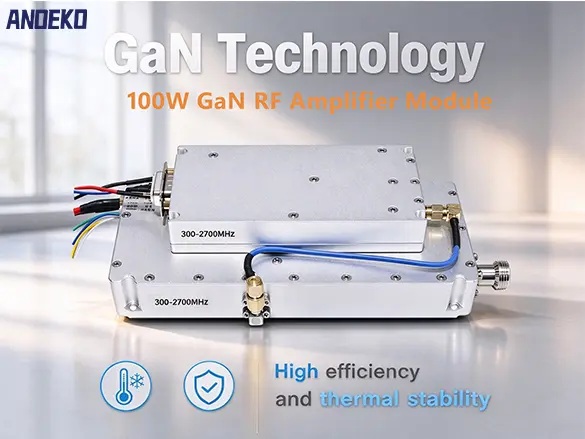
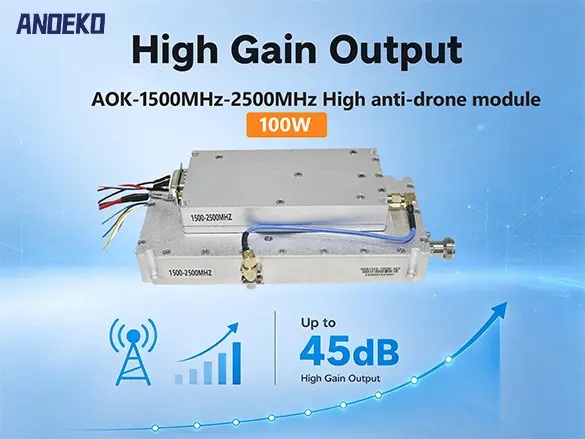
Its published product portfolio includes GaN RF amplifier modules with different frequency ranges and output configurations, including broadband and dedicated-band designs.
For system integrators, the selection of an RF amplifier should be based on the intended platform rather than a generic product label.
Depending on the project, engineering discussions may cover:
RF frequency requirements
Output-power specifications
Electrical compatibility
Mechanical dimensions
Thermal integration
Control and monitoring interfaces
Product customization
Inspection and verification requirements
ANOEKO's RF amplifier product range provides a starting point for OEM and ODM customers evaluating different RF architectures.
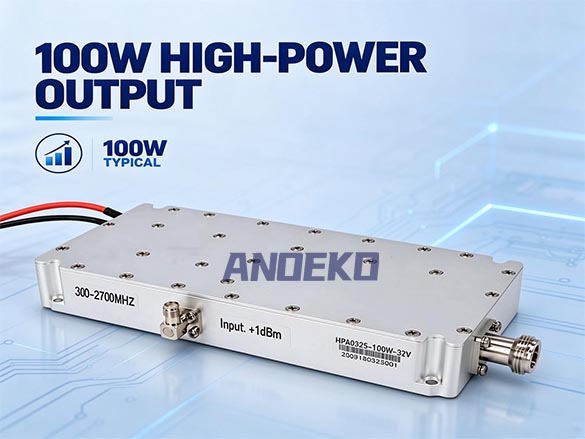
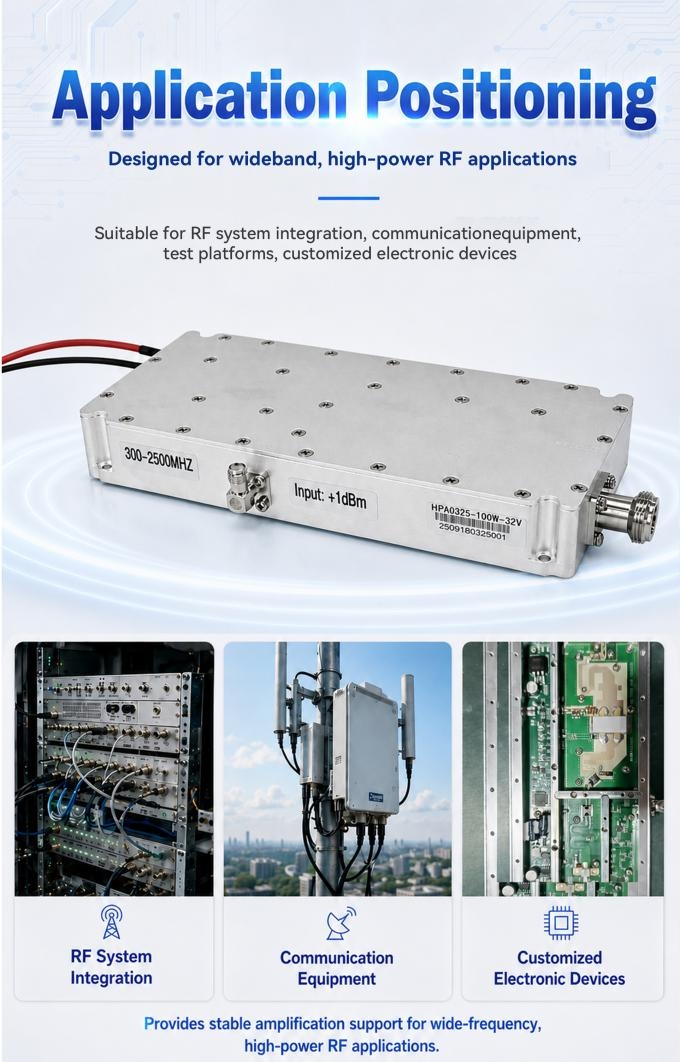
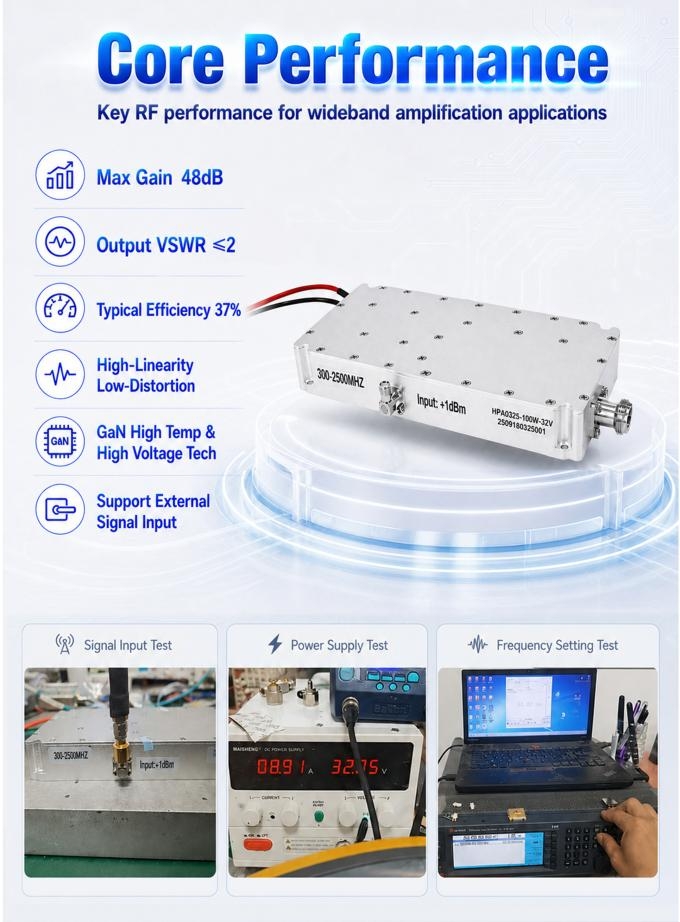
For example, buyers can review the company's Anti-Drone RF Power Amplifier Modules category and the 300–2700MHz 100W GaN Wideband RF Power Amplifier Module for product-specific information.
The final selection should always be based on the verified product datasheet and the technical requirements of the intended system.

The development of modern counter-UAS equipment is creating new demands for RF power amplifier technology.
GaN is expanding the possibilities for compact, high-power RF designs. LDMOS remains relevant where its performance and cost characteristics fit the application. Broadband architectures offer greater frequency flexibility, while customized configurations help manufacturers address specific mechanical, electrical and integration requirements.
Yet none of these technologies provides a complete answer on its own.
The performance envelope of an RF amplifier is shaped by the relationship between output capability, bandwidth, gain stability, efficiency, thermal design, spectral quality, monitoring and system integration.
For C-UAS developers, the most important decision is therefore not simply choosing the module with the largest power rating.
It is selecting an RF Amplifier Module whose verified performance matches the requirements of the complete platform.
That is where the next stage of RF engineering competition will be defined: not by wattage alone, but by the ability to deliver consistent, measurable and application-appropriate performance.
ANOEKO focuses on RF power amplifier development and customized integration solutions for professional RF equipment manufacturers and system integrators.
All RF equipment must be designed, marketed and operated in accordance with applicable local laws, spectrum regulations, equipment authorization requirements and safety standards. Product specifications and operating conditions should be confirmed with the manufacturer before procurement.
Consultation Hotline
+86 18948793112
Email:lisen1205@foxmail.com
Mobile:+86 18948793112
WhatsApp:+86 18948793112
Address:Changchun North Road, Gongming Street, Guangming District, Shenzhen, China
Copyright © Copyright © 2024 Anoeko Technology Co., Ltd. All Rights Reserved. | Anti-Drone & Low-Altitude Defense Experts ICP:粤ICP备13053733号-1